

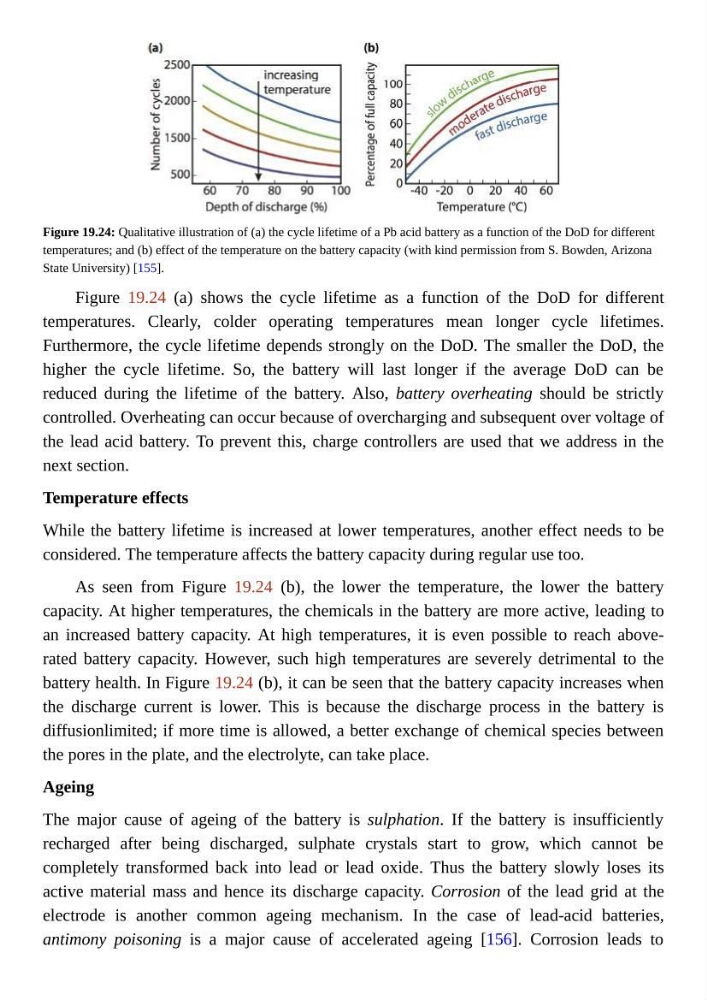
Figure 19.24: Qualitative illustration of (a) the cycle lifetime of a Pb acid battery as a function of the DoD for different
temperatures; and (b) effect of the temperature on the battery capacity (with kind permission from S. Bowden, Arizona
State University) [155].
Figure 19.24 (a) shows the cycle lifetime as a function of the DoD for different
temperatures. Clearly, colder operating temperatures mean longer cycle lifetimes.
Furthermore, the cycle lifetime depends strongly on the DoD. The smaller the DoD, the
higher the cycle lifetime. So, the battery will last longer if the average DoD can be
reduced during the lifetime of the battery. Also, battery overheating should be strictly
controlled. Overheating can occur because of overcharging and subsequent over voltage of
the lead acid battery. To prevent this, charge controllers are used that we address in the
next section.
Temperature effects
While the battery lifetime is increased at lower temperatures, another effect needs to be
considered. The temperature affects the battery capacity during regular use too.
As seen from Figure 19.24 (b), the lower the temperature, the lower the battery
capacity. At higher temperatures, the chemicals in the battery are more active, leading to
an increased battery capacity. At high temperatures, it is even possible to reach aboverated battery capacity. However, such high temperatures are severely detrimental to the
battery health. In Figure 19.24 (b), it can be seen that the battery capacity increases when
the discharge current is lower. This is because the discharge process in the battery is
diffusionlimited; if more time is allowed, a better exchange of chemical species between
the pores in the plate, and the electrolyte, can take place.
Ageing
The major cause of ageing of the battery is sulphation. If the battery is insufficiently
recharged after being discharged, sulphate crystals start to grow, which cannot be
completely transformed back into lead or lead oxide. Thus the battery slowly loses its
active material mass and hence its discharge capacity. Corrosion of the lead grid at the
electrode is another common ageing mechanism. In the case of lead-acid batteries,
antimony poisoning is a major cause of accelerated ageing [156]. Corrosion leads to
temperatures; and (b) effect of the temperature on the battery capacity (with kind permission from S. Bowden, Arizona
State University) [155].
Figure 19.24 (a) shows the cycle lifetime as a function of the DoD for different
temperatures. Clearly, colder operating temperatures mean longer cycle lifetimes.
Furthermore, the cycle lifetime depends strongly on the DoD. The smaller the DoD, the
higher the cycle lifetime. So, the battery will last longer if the average DoD can be
reduced during the lifetime of the battery. Also, battery overheating should be strictly
controlled. Overheating can occur because of overcharging and subsequent over voltage of
the lead acid battery. To prevent this, charge controllers are used that we address in the
next section.
Temperature effects
While the battery lifetime is increased at lower temperatures, another effect needs to be
considered. The temperature affects the battery capacity during regular use too.
As seen from Figure 19.24 (b), the lower the temperature, the lower the battery
capacity. At higher temperatures, the chemicals in the battery are more active, leading to
an increased battery capacity. At high temperatures, it is even possible to reach aboverated battery capacity. However, such high temperatures are severely detrimental to the
battery health. In Figure 19.24 (b), it can be seen that the battery capacity increases when
the discharge current is lower. This is because the discharge process in the battery is
diffusionlimited; if more time is allowed, a better exchange of chemical species between
the pores in the plate, and the electrolyte, can take place.
Ageing
The major cause of ageing of the battery is sulphation. If the battery is insufficiently
recharged after being discharged, sulphate crystals start to grow, which cannot be
completely transformed back into lead or lead oxide. Thus the battery slowly loses its
active material mass and hence its discharge capacity. Corrosion of the lead grid at the
electrode is another common ageing mechanism. In the case of lead-acid batteries,
antimony poisoning is a major cause of accelerated ageing [156]. Corrosion leads to