

19.2.3
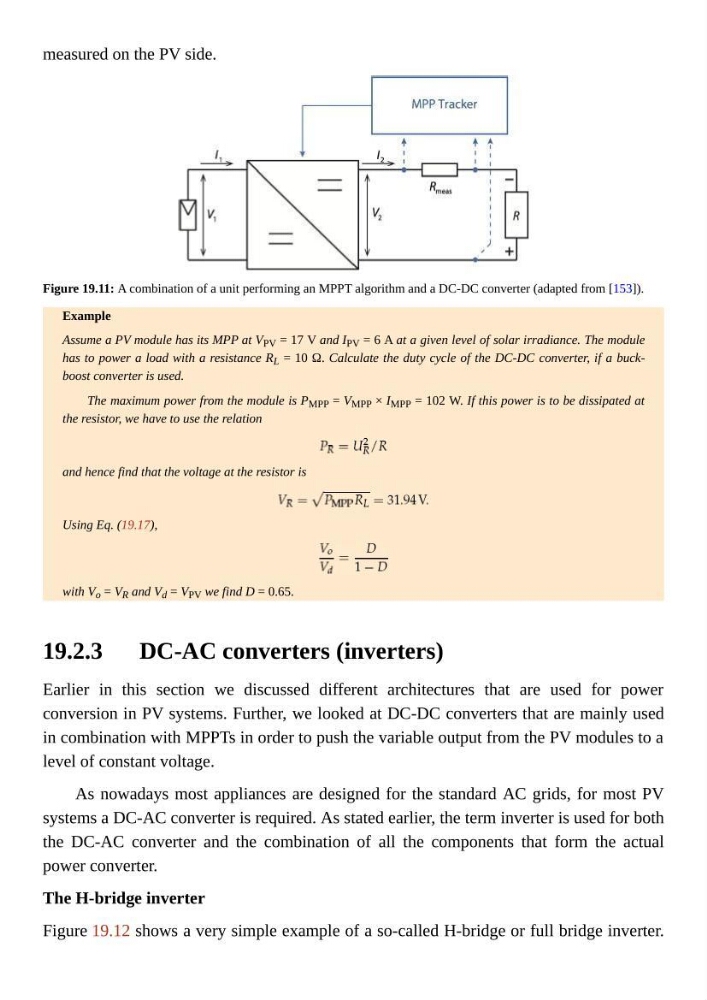
measured on the PV side.
Figure 19.11: A combination of a unit performing an MPPT algorithm and a DC-DC converter (adapted from [153]).
Example
Assume a PV module has its MPP at V PV = 17 V and I PV = 6 A at a given level of solar irradiance. The module
has to power a load with a resistance R L = 10 Ω. Calculate the duty cycle of the DC-DC converter, if a buckboost converter is used.
The maximum power from the module is P MPP = V MPP × I MPP = 102 W. If this power is to be dissipated at
the resistor, we have to use the relation
and hence find that the voltage at the resistor is
Using Eq. (19.17),
with V o = V R and V d = V PV we find D = 0.65.
DC-AC converters (inverters)
Earlier in this section we discussed different architectures that are used for power
conversion in PV systems. Further, we looked at DC-DC converters that are mainly used
in combination with MPPTs in order to push the variable output from the PV modules to a
level of constant voltage.
As nowadays most appliances are designed for the standard AC grids, for most PV
systems a DC-AC converter is required. As stated earlier, the term inverter is used for both
the DC-AC converter and the combination of all the components that form the actual
power converter.
The H-bridge inverter
Figure 19.12 shows a very simple example of a so-called H-bridge or full bridge inverter.
measured on the PV side.
Figure 19.11: A combination of a unit performing an MPPT algorithm and a DC-DC converter (adapted from [153]).
Example
Assume a PV module has its MPP at V PV = 17 V and I PV = 6 A at a given level of solar irradiance. The module
has to power a load with a resistance R L = 10 Ω. Calculate the duty cycle of the DC-DC converter, if a buckboost converter is used.
The maximum power from the module is P MPP = V MPP × I MPP = 102 W. If this power is to be dissipated at
the resistor, we have to use the relation
and hence find that the voltage at the resistor is
Using Eq. (19.17),
with V o = V R and V d = V PV we find D = 0.65.
DC-AC converters (inverters)
Earlier in this section we discussed different architectures that are used for power
conversion in PV systems. Further, we looked at DC-DC converters that are mainly used
in combination with MPPTs in order to push the variable output from the PV modules to a
level of constant voltage.
As nowadays most appliances are designed for the standard AC grids, for most PV
systems a DC-AC converter is required. As stated earlier, the term inverter is used for both
the DC-AC converter and the combination of all the components that form the actual
power converter.
The H-bridge inverter
Figure 19.12 shows a very simple example of a so-called H-bridge or full bridge inverter.