

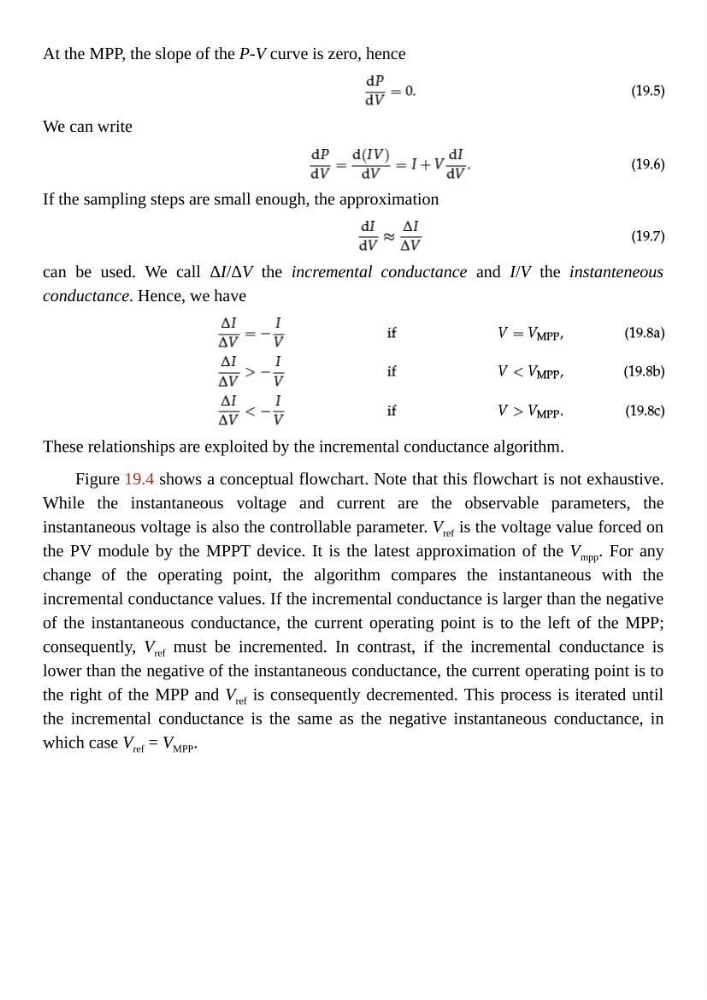
At the MPP, the slope of the P-V curve is zero, hence
We can write
If the sampling steps are small enough, the approximation
can be used. We call ΔI/ΔV the incremental conductance and I/V the instanteneous
conductance. Hence, we have
These relationships are exploited by the incremental conductance algorithm.
Figure 19.4 shows a conceptual flowchart. Note that this flowchart is not exhaustive.
While the instantaneous voltage and current are the observable parameters, the
instantaneous voltage is also the controllable parameter. V ref is the voltage value forced on
the PV module by the MPPT device. It is the latest approximation of the V mpp . For any
change of the operating point, the algorithm compares the instantaneous with the
incremental conductance values. If the incremental conductance is larger than the negative
of the instantaneous conductance, the current operating point is to the left of the MPP;
consequently, V ref must be incremented. In contrast, if the incremental conductance is
lower than the negative of the instantaneous conductance, the current operating point is to
the right of the MPP and V ref is consequently decremented. This process is iterated until
the incremental conductance is the same as the negative instantaneous conductance, in
which case V ref = V MPP .
We can write
If the sampling steps are small enough, the approximation
can be used. We call ΔI/ΔV the incremental conductance and I/V the instanteneous
conductance. Hence, we have
These relationships are exploited by the incremental conductance algorithm.
Figure 19.4 shows a conceptual flowchart. Note that this flowchart is not exhaustive.
While the instantaneous voltage and current are the observable parameters, the
instantaneous voltage is also the controllable parameter. V ref is the voltage value forced on
the PV module by the MPPT device. It is the latest approximation of the V mpp . For any
change of the operating point, the algorithm compares the instantaneous with the
incremental conductance values. If the incremental conductance is larger than the negative
of the instantaneous conductance, the current operating point is to the left of the MPP;
consequently, V ref must be incremented. In contrast, if the incremental conductance is
lower than the negative of the instantaneous conductance, the current operating point is to
the right of the MPP and V ref is consequently decremented. This process is iterated until
the incremental conductance is the same as the negative instantaneous conductance, in
which case V ref = V MPP .