

18.3.1
polynomial of T L (AM2). T rd has typical values between 0.05 for very clear skies and 0.22
for a very turbid atmosphere. F d is a diffuse angular function, given as a second-order
polynomial of sin a S . For more details we refer to the paper [141].
Computation of the irradiance on the module
In Section 18.2 we found that the direct irradiance on a module G M is given by
i.e. it is given as the direct normal irradiance (DNI) times the cosine of the angle of
incidence γ (AOI).
For PV modules installed on Earth two other factors also contribute to G M , as
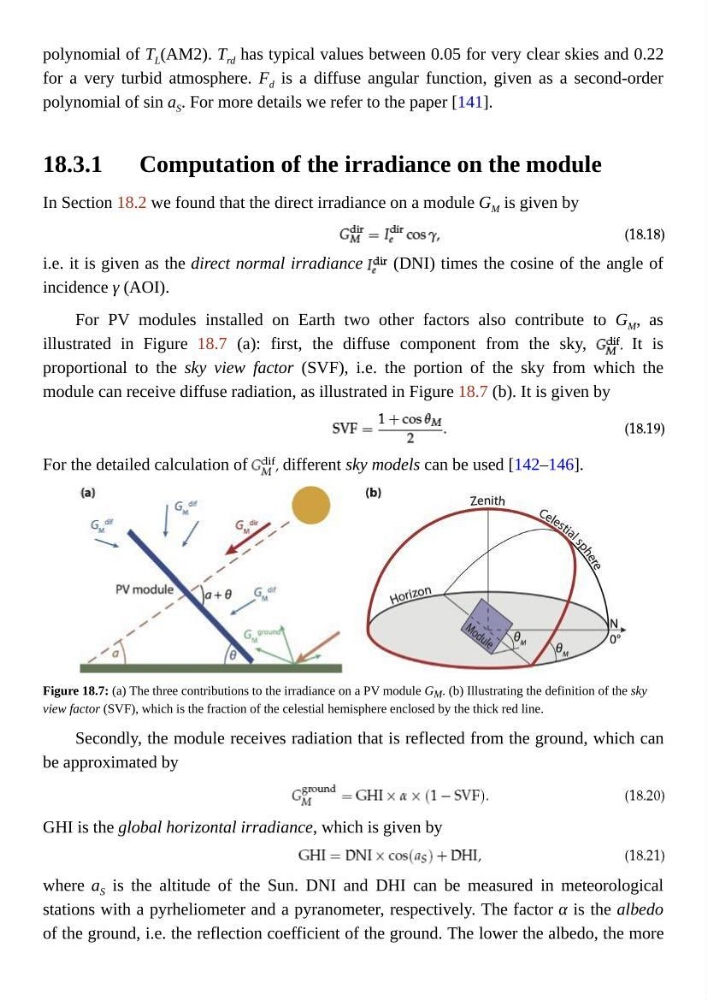
illustrated in Figure 18.7 (a): first, the diffuse component from the sky,
It is
proportional to the sky view factor (SVF), i.e. the portion of the sky from which the
module can receive diffuse radiation, as illustrated in Figure 18.7 (b). It is given by
For the detailed calculation of
different sky models can be used [142–146].
Figure 18.7: (a) The three contributions to the irradiance on a PV module G M . (b) Illustrating the definition of the sky
view factor (SVF), which is the fraction of the celestial hemisphere enclosed by the thick red line.
Secondly, the module receives radiation that is reflected from the ground, which can
be approximated by
GHI is the global horizontal irradiance, which is given by
where a S is the altitude of the Sun. DNI and DHI can be measured in meteorological
stations with a pyrheliometer and a pyranometer, respectively. The factor α is the albedo
of the ground, i.e. the reflection coefficient of the ground. The lower the albedo, the more
polynomial of T L (AM2). T rd has typical values between 0.05 for very clear skies and 0.22
for a very turbid atmosphere. F d is a diffuse angular function, given as a second-order
polynomial of sin a S . For more details we refer to the paper [141].
Computation of the irradiance on the module
In Section 18.2 we found that the direct irradiance on a module G M is given by
i.e. it is given as the direct normal irradiance (DNI) times the cosine of the angle of
incidence γ (AOI).
For PV modules installed on Earth two other factors also contribute to G M , as
illustrated in Figure 18.7 (a): first, the diffuse component from the sky,
It is
proportional to the sky view factor (SVF), i.e. the portion of the sky from which the
module can receive diffuse radiation, as illustrated in Figure 18.7 (b). It is given by
For the detailed calculation of
different sky models can be used [142–146].
Figure 18.7: (a) The three contributions to the irradiance on a PV module G M . (b) Illustrating the definition of the sky
view factor (SVF), which is the fraction of the celestial hemisphere enclosed by the thick red line.
Secondly, the module receives radiation that is reflected from the ground, which can
be approximated by
GHI is the global horizontal irradiance, which is given by
where a S is the altitude of the Sun. DNI and DHI can be measured in meteorological
stations with a pyrheliometer and a pyranometer, respectively. The factor α is the albedo
of the ground, i.e. the reflection coefficient of the ground. The lower the albedo, the more