

T L (AM2) is the Linke turbidity factor with which the haziness of the atmosphere is taken
into account. In this equation its value at an Air Mass 2 is used. m is the relative optical air
mass, and finally δ R (m) is the integral Rayleigh optical thickness. The different
components can be evaluated as follows.
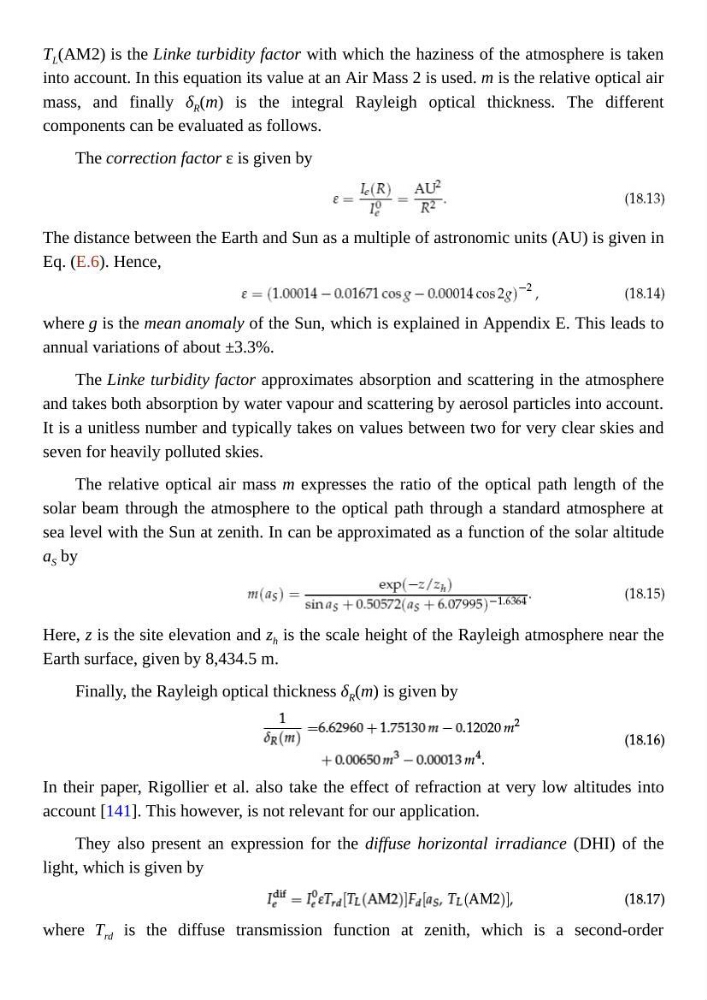
The correction factor ε is given by
The distance between the Earth and Sun as a multiple of astronomic units (AU) is given in
Eq. (E.6). Hence,
where g is the mean anomaly of the Sun, which is explained in Appendix E. This leads to
annual variations of about ±3.3%.
The Linke turbidity factor approximates absorption and scattering in the atmosphere
and takes both absorption by water vapour and scattering by aerosol particles into account.
It is a unitless number and typically takes on values between two for very clear skies and
seven for heavily polluted skies.
The relative optical air mass m expresses the ratio of the optical path length of the
solar beam through the atmosphere to the optical path through a standard atmosphere at
sea level with the Sun at zenith. In can be approximated as a function of the solar altitude
a S by
Here, z is the site elevation and z h is the scale height of the Rayleigh atmosphere near the
Earth surface, given by 8,434.5 m.
Finally, the Rayleigh optical thickness δ R (m) is given by
In their paper, Rigollier et al. also take the effect of refraction at very low altitudes into
account [141]. This however, is not relevant for our application.
They also present an expression for the diffuse horizontal irradiance (DHI) of the
light, which is given by
where T rd is the diffuse transmission function at zenith, which is a second-order
into account. In this equation its value at an Air Mass 2 is used. m is the relative optical air
mass, and finally δ R (m) is the integral Rayleigh optical thickness. The different
components can be evaluated as follows.
The correction factor ε is given by
The distance between the Earth and Sun as a multiple of astronomic units (AU) is given in
Eq. (E.6). Hence,
where g is the mean anomaly of the Sun, which is explained in Appendix E. This leads to
annual variations of about ±3.3%.
The Linke turbidity factor approximates absorption and scattering in the atmosphere
and takes both absorption by water vapour and scattering by aerosol particles into account.
It is a unitless number and typically takes on values between two for very clear skies and
seven for heavily polluted skies.
The relative optical air mass m expresses the ratio of the optical path length of the
solar beam through the atmosphere to the optical path through a standard atmosphere at
sea level with the Sun at zenith. In can be approximated as a function of the solar altitude
a S by
Here, z is the site elevation and z h is the scale height of the Rayleigh atmosphere near the
Earth surface, given by 8,434.5 m.
Finally, the Rayleigh optical thickness δ R (m) is given by
In their paper, Rigollier et al. also take the effect of refraction at very low altitudes into
account [141]. This however, is not relevant for our application.
They also present an expression for the diffuse horizontal irradiance (DHI) of the
light, which is given by
where T rd is the diffuse transmission function at zenith, which is a second-order