

(a)
(b)
(c)
(d)
16.3
16.4
(a)
(b)
(c)
Multi-junction.
Upconversion.
Downconversion.
Intermediate band.
Imagine you want to fabricate a triple-junction solar cell that consists of three quantum dotbased solar cells (see
Figure). Each cell consists of quantum dots of a certain diameter: 4 nm, 6 nm and 10 nm. In which order (from
top to bottom) would you put these cells in order to absorb the largest part of the solar spectrum?
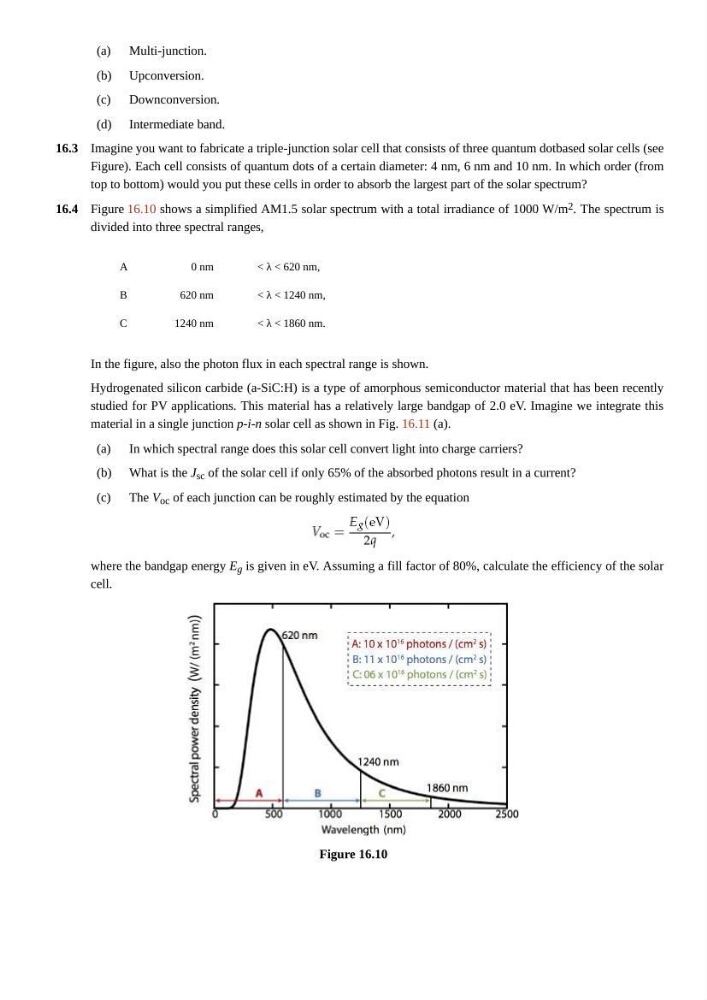
Figure 16.10 shows a simplified AM1.5 solar spectrum with a total irradiance of 1000 W/m 2 . The spectrum is
divided into three spectral ranges,
A
0 nm
< λ < 620 nm,
B
620 nm
< λ < 1240 nm,
C
1240 nm
< λ < 1860 nm.
In the figure, also the photon flux in each spectral range is shown.
Hydrogenated silicon carbide (a-SiC:H) is a type of amorphous semiconductor material that has been recently
studied for PV applications. This material has a relatively large bandgap of 2.0 eV. Imagine we integrate this
material in a single junction p-i-n solar cell as shown in Fig. 16.11 (a).
In which spectral range does this solar cell convert light into charge carriers?
What is the J sc of the solar cell if only 65% of the absorbed photons result in a current?
The V oc of each junction can be roughly estimated by the equation
where the bandgap energy E g is given in eV. Assuming a fill factor of 80%, calculate the efficiency of the solar
cell.
Figure 16.10
(b)
(c)
(d)
16.3
16.4
(a)
(b)
(c)
Multi-junction.
Upconversion.
Downconversion.
Intermediate band.
Imagine you want to fabricate a triple-junction solar cell that consists of three quantum dotbased solar cells (see
Figure). Each cell consists of quantum dots of a certain diameter: 4 nm, 6 nm and 10 nm. In which order (from
top to bottom) would you put these cells in order to absorb the largest part of the solar spectrum?
Figure 16.10 shows a simplified AM1.5 solar spectrum with a total irradiance of 1000 W/m 2 . The spectrum is
divided into three spectral ranges,
A
0 nm
< λ < 620 nm,
B
620 nm
< λ < 1240 nm,
C
1240 nm
< λ < 1860 nm.
In the figure, also the photon flux in each spectral range is shown.
Hydrogenated silicon carbide (a-SiC:H) is a type of amorphous semiconductor material that has been recently
studied for PV applications. This material has a relatively large bandgap of 2.0 eV. Imagine we integrate this
material in a single junction p-i-n solar cell as shown in Fig. 16.11 (a).
In which spectral range does this solar cell convert light into charge carriers?
What is the J sc of the solar cell if only 65% of the absorbed photons result in a current?
The V oc of each junction can be roughly estimated by the equation
where the bandgap energy E g is given in eV. Assuming a fill factor of 80%, calculate the efficiency of the solar
cell.
Figure 16.10