

(d)
(e)
(f)
(g)
16.5
(a)
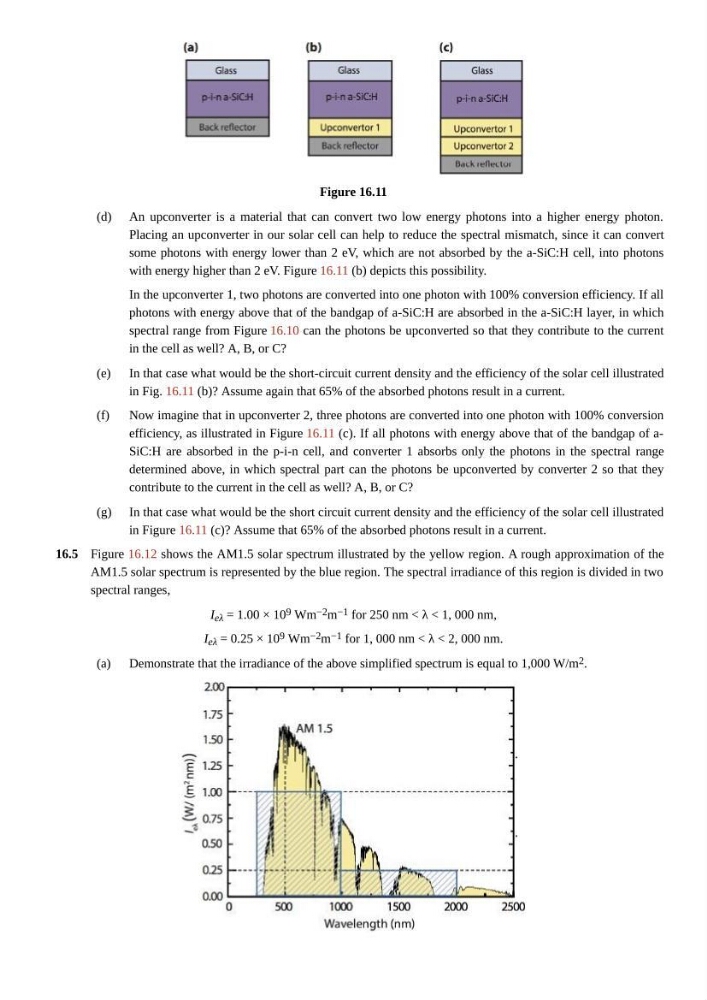
Figure 16.11
An upconverter is a material that can convert two low energy photons into a higher energy photon.
Placing an upconverter in our solar cell can help to reduce the spectral mismatch, since it can convert
some photons with energy lower than 2 eV, which are not absorbed by the a-SiC:H cell, into photons
with energy higher than 2 eV. Figure 16.11 (b) depicts this possibility.
In the upconverter 1, two photons are converted into one photon with 100% conversion efficiency. If all
photons with energy above that of the bandgap of a-SiC:H are absorbed in the a-SiC:H layer, in which
spectral range from Figure 16.10 can the photons be upconverted so that they contribute to the current
in the cell as well? A, B, or C?
In that case what would be the short-circuit current density and the efficiency of the solar cell illustrated
in Fig. 16.11 (b)? Assume again that 65% of the absorbed photons result in a current.
Now imagine that in upconverter 2, three photons are converted into one photon with 100% conversion
efficiency, as illustrated in Figure 16.11 (c). If all photons with energy above that of the bandgap of aSiC:H are absorbed in the p-i-n cell, and converter 1 absorbs only the photons in the spectral range
determined above, in which spectral part can the photons be upconverted by converter 2 so that they
contribute to the current in the cell as well? A, B, or C?
In that case what would be the short circuit current density and the efficiency of the solar cell illustrated
in Figure 16.11 (c)? Assume that 65% of the absorbed photons result in a current.
Figure 16.12 shows the AM1.5 solar spectrum illustrated by the yellow region. A rough approximation of the
AM1.5 solar spectrum is represented by the blue region. The spectral irradiance of this region is divided in two
spectral ranges,
I eλ = 1.00 × 10 9 Wm −2 m −1 for 250 nm < λ < 1, 000 nm,
I eλ = 0.25 × 10 9 Wm −2 m −1 for 1, 000 nm < λ < 2, 000 nm.
Demonstrate that the irradiance of the above simplified spectrum is equal to 1,000 W/m 2 .
(e)
(f)
(g)
16.5
(a)
Figure 16.11
An upconverter is a material that can convert two low energy photons into a higher energy photon.
Placing an upconverter in our solar cell can help to reduce the spectral mismatch, since it can convert
some photons with energy lower than 2 eV, which are not absorbed by the a-SiC:H cell, into photons
with energy higher than 2 eV. Figure 16.11 (b) depicts this possibility.
In the upconverter 1, two photons are converted into one photon with 100% conversion efficiency. If all
photons with energy above that of the bandgap of a-SiC:H are absorbed in the a-SiC:H layer, in which
spectral range from Figure 16.10 can the photons be upconverted so that they contribute to the current
in the cell as well? A, B, or C?
In that case what would be the short-circuit current density and the efficiency of the solar cell illustrated
in Fig. 16.11 (b)? Assume again that 65% of the absorbed photons result in a current.
Now imagine that in upconverter 2, three photons are converted into one photon with 100% conversion
efficiency, as illustrated in Figure 16.11 (c). If all photons with energy above that of the bandgap of aSiC:H are absorbed in the p-i-n cell, and converter 1 absorbs only the photons in the spectral range
determined above, in which spectral part can the photons be upconverted by converter 2 so that they
contribute to the current in the cell as well? A, B, or C?
In that case what would be the short circuit current density and the efficiency of the solar cell illustrated
in Figure 16.11 (c)? Assume that 65% of the absorbed photons result in a current.
Figure 16.12 shows the AM1.5 solar spectrum illustrated by the yellow region. A rough approximation of the
AM1.5 solar spectrum is represented by the blue region. The spectral irradiance of this region is divided in two
spectral ranges,
I eλ = 1.00 × 10 9 Wm −2 m −1 for 250 nm < λ < 1, 000 nm,
I eλ = 0.25 × 10 9 Wm −2 m −1 for 1, 000 nm < λ < 2, 000 nm.
Demonstrate that the irradiance of the above simplified spectrum is equal to 1,000 W/m 2 .