

16.6
16.1
(a)
(b)
(c)
(d)
i
ii
iii
(e)
(f)
16.2
Exercises
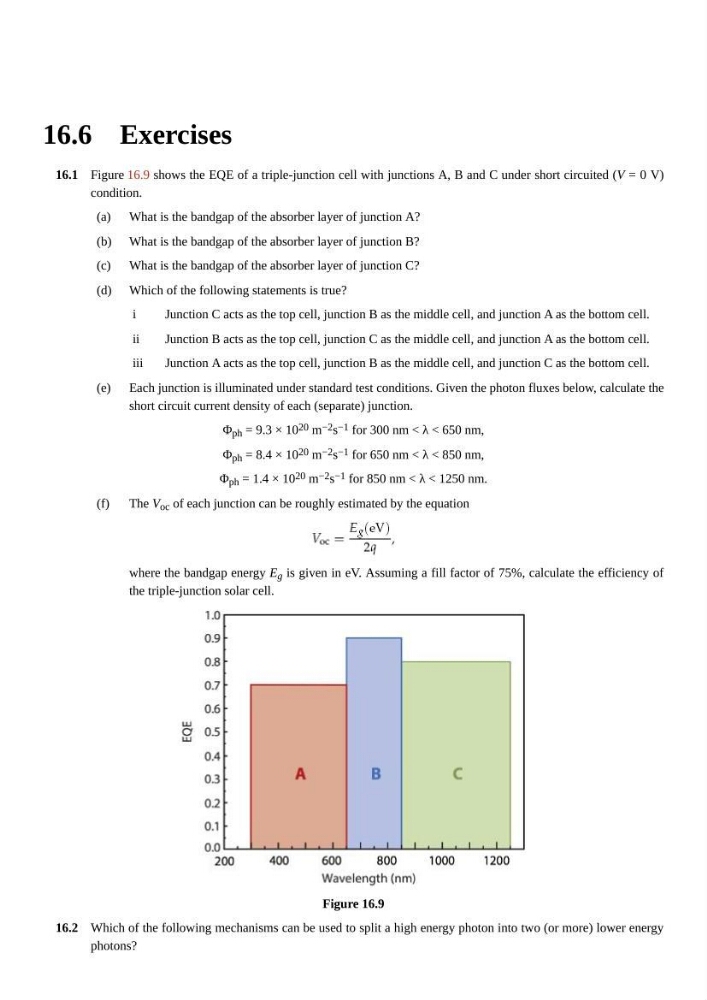
Figure 16.9 shows the EQE of a triple-junction cell with junctions A, B and C under short circuited (V = 0 V)
condition.
What is the bandgap of the absorber layer of junction A?
What is the bandgap of the absorber layer of junction B?
What is the bandgap of the absorber layer of junction C?
Which of the following statements is true?
Junction C acts as the top cell, junction B as the middle cell, and junction A as the bottom cell.
Junction B acts as the top cell, junction C as the middle cell, and junction A as the bottom cell.
Junction A acts as the top cell, junction B as the middle cell, and junction C as the bottom cell.
Each junction is illuminated under standard test conditions. Given the photon fluxes below, calculate the
short circuit current density of each (separate) junction.
Φ ph = 9.3 × 10 20 m −2 s −1 for 300 nm < λ < 650 nm,
Φ ph = 8.4 × 10 20 m −2 s −1 for 650 nm < λ < 850 nm,
Φ ph = 1.4 × 10 20 m −2 s −1 for 850 nm < λ < 1250 nm.
The V oc of each junction can be roughly estimated by the equation
where the bandgap energy E g is given in eV. Assuming a fill factor of 75%, calculate the efficiency of
the triple-junction solar cell.
Figure 16.9
Which of the following mechanisms can be used to split a high energy photon into two (or more) lower energy
photons?
16.1
(a)
(b)
(c)
(d)
i
ii
iii
(e)
(f)
16.2
Exercises
Figure 16.9 shows the EQE of a triple-junction cell with junctions A, B and C under short circuited (V = 0 V)
condition.
What is the bandgap of the absorber layer of junction A?
What is the bandgap of the absorber layer of junction B?
What is the bandgap of the absorber layer of junction C?
Which of the following statements is true?
Junction C acts as the top cell, junction B as the middle cell, and junction A as the bottom cell.
Junction B acts as the top cell, junction C as the middle cell, and junction A as the bottom cell.
Junction A acts as the top cell, junction B as the middle cell, and junction C as the bottom cell.
Each junction is illuminated under standard test conditions. Given the photon fluxes below, calculate the
short circuit current density of each (separate) junction.
Φ ph = 9.3 × 10 20 m −2 s −1 for 300 nm < λ < 650 nm,
Φ ph = 8.4 × 10 20 m −2 s −1 for 650 nm < λ < 850 nm,
Φ ph = 1.4 × 10 20 m −2 s −1 for 850 nm < λ < 1250 nm.
The V oc of each junction can be roughly estimated by the equation
where the bandgap energy E g is given in eV. Assuming a fill factor of 75%, calculate the efficiency of
the triple-junction solar cell.
Figure 16.9
Which of the following mechanisms can be used to split a high energy photon into two (or more) lower energy
photons?