

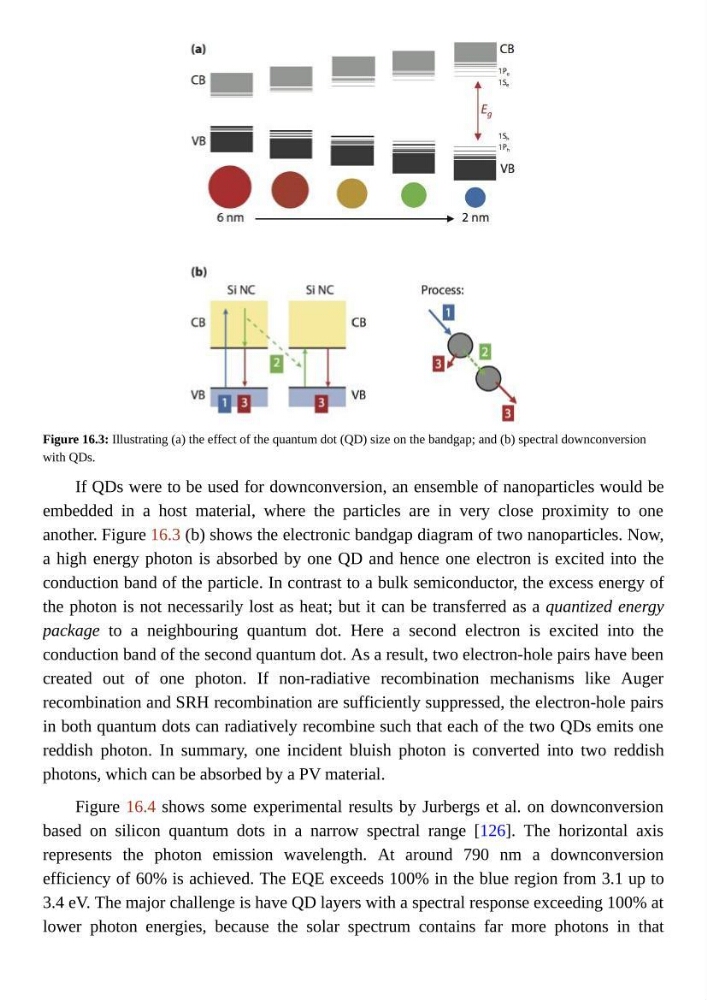
Figure 16.3: Illustrating (a) the effect of the quantum dot (QD) size on the bandgap; and (b) spectral downconversion
with QDs.
If QDs were to be used for downconversion, an ensemble of nanoparticles would be
embedded in a host material, where the particles are in very close proximity to one
another. Figure 16.3 (b) shows the electronic bandgap diagram of two nanoparticles. Now,
a high energy photon is absorbed by one QD and hence one electron is excited into the
conduction band of the particle. In contrast to a bulk semiconductor, the excess energy of
the photon is not necessarily lost as heat; but it can be transferred as a quantized energy
package to a neighbouring quantum dot. Here a second electron is excited into the
conduction band of the second quantum dot. As a result, two electron-hole pairs have been
created out of one photon. If non-radiative recombination mechanisms like Auger
recombination and SRH recombination are sufficiently suppressed, the electron-hole pairs
in both quantum dots can radiatively recombine such that each of the two QDs emits one
reddish photon. In summary, one incident bluish photon is converted into two reddish
photons, which can be absorbed by a PV material.
Figure 16.4 shows some experimental results by Jurbergs et al. on downconversion
based on silicon quantum dots in a narrow spectral range [126]. The horizontal axis
represents the photon emission wavelength. At around 790 nm a downconversion
efficiency of 60% is achieved. The EQE exceeds 100% in the blue region from 3.1 up to
3.4 eV. The major challenge is have QD layers with a spectral response exceeding 100% at
lower photon energies, because the solar spectrum contains far more photons in that
with QDs.
If QDs were to be used for downconversion, an ensemble of nanoparticles would be
embedded in a host material, where the particles are in very close proximity to one
another. Figure 16.3 (b) shows the electronic bandgap diagram of two nanoparticles. Now,
a high energy photon is absorbed by one QD and hence one electron is excited into the
conduction band of the particle. In contrast to a bulk semiconductor, the excess energy of
the photon is not necessarily lost as heat; but it can be transferred as a quantized energy
package to a neighbouring quantum dot. Here a second electron is excited into the
conduction band of the second quantum dot. As a result, two electron-hole pairs have been
created out of one photon. If non-radiative recombination mechanisms like Auger
recombination and SRH recombination are sufficiently suppressed, the electron-hole pairs
in both quantum dots can radiatively recombine such that each of the two QDs emits one
reddish photon. In summary, one incident bluish photon is converted into two reddish
photons, which can be absorbed by a PV material.
Figure 16.4 shows some experimental results by Jurbergs et al. on downconversion
based on silicon quantum dots in a narrow spectral range [126]. The horizontal axis
represents the photon emission wavelength. At around 790 nm a downconversion
efficiency of 60% is achieved. The EQE exceeds 100% in the blue region from 3.1 up to
3.4 eV. The major challenge is have QD layers with a spectral response exceeding 100% at
lower photon energies, because the solar spectrum contains far more photons in that