

16.2.2
Spectral downconversion
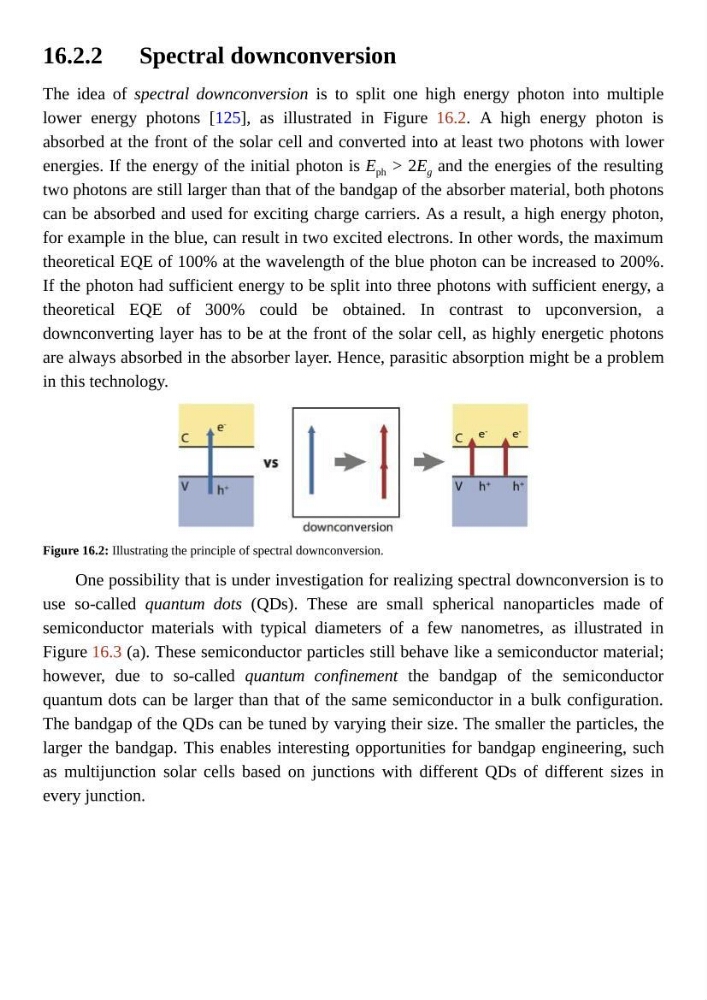
The idea of spectral downconversion is to split one high energy photon into multiple
lower energy photons [125], as illustrated in Figure 16.2. A high energy photon is
absorbed at the front of the solar cell and converted into at least two photons with lower
energies. If the energy of the initial photon is E ph > 2E g and the energies of the resulting
two photons are still larger than that of the bandgap of the absorber material, both photons
can be absorbed and used for exciting charge carriers. As a result, a high energy photon,
for example in the blue, can result in two excited electrons. In other words, the maximum
theoretical EQE of 100% at the wavelength of the blue photon can be increased to 200%.
If the photon had sufficient energy to be split into three photons with sufficient energy, a
theoretical EQE of 300% could be obtained. In contrast to upconversion, a
downconverting layer has to be at the front of the solar cell, as highly energetic photons
are always absorbed in the absorber layer. Hence, parasitic absorption might be a problem
in this technology.
Figure 16.2: Illustrating the principle of spectral downconversion.
One possibility that is under investigation for realizing spectral downconversion is to
use so-called quantum dots (QDs). These are small spherical nanoparticles made of
semiconductor materials with typical diameters of a few nanometres, as illustrated in
Figure 16.3 (a). These semiconductor particles still behave like a semiconductor material;
however, due to so-called quantum confinement the bandgap of the semiconductor
quantum dots can be larger than that of the same semiconductor in a bulk configuration.
The bandgap of the QDs can be tuned by varying their size. The smaller the particles, the
larger the bandgap. This enables interesting opportunities for bandgap engineering, such
as multijunction solar cells based on junctions with different QDs of different sizes in
every junction.
Spectral downconversion
The idea of spectral downconversion is to split one high energy photon into multiple
lower energy photons [125], as illustrated in Figure 16.2. A high energy photon is
absorbed at the front of the solar cell and converted into at least two photons with lower
energies. If the energy of the initial photon is E ph > 2E g and the energies of the resulting
two photons are still larger than that of the bandgap of the absorber material, both photons
can be absorbed and used for exciting charge carriers. As a result, a high energy photon,
for example in the blue, can result in two excited electrons. In other words, the maximum
theoretical EQE of 100% at the wavelength of the blue photon can be increased to 200%.
If the photon had sufficient energy to be split into three photons with sufficient energy, a
theoretical EQE of 300% could be obtained. In contrast to upconversion, a
downconverting layer has to be at the front of the solar cell, as highly energetic photons
are always absorbed in the absorber layer. Hence, parasitic absorption might be a problem
in this technology.
Figure 16.2: Illustrating the principle of spectral downconversion.
One possibility that is under investigation for realizing spectral downconversion is to
use so-called quantum dots (QDs). These are small spherical nanoparticles made of
semiconductor materials with typical diameters of a few nanometres, as illustrated in
Figure 16.3 (a). These semiconductor particles still behave like a semiconductor material;
however, due to so-called quantum confinement the bandgap of the semiconductor
quantum dots can be larger than that of the same semiconductor in a bulk configuration.
The bandgap of the QDs can be tuned by varying their size. The smaller the particles, the
larger the bandgap. This enables interesting opportunities for bandgap engineering, such
as multijunction solar cells based on junctions with different QDs of different sizes in
every junction.