

16.3
spectral range. In practice, only small enhancements in efficiency due to
up/downconverters have been reported [127].
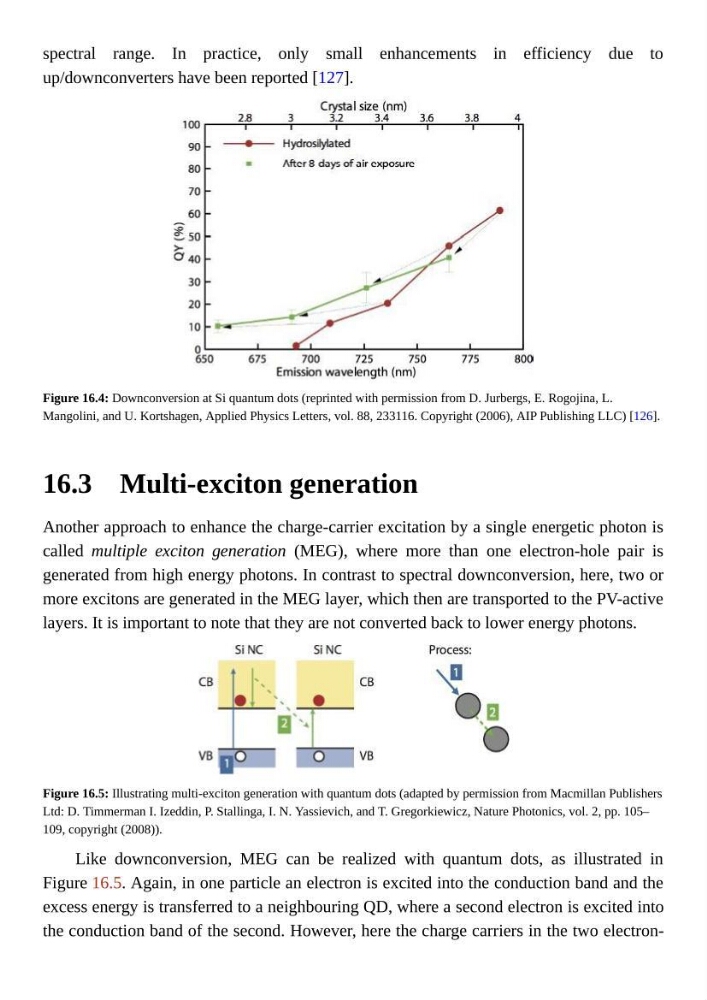
Figure 16.4: Downconversion at Si quantum dots (reprinted with permission from D. Jurbergs, E. Rogojina, L.
Mangolini, and U. Kortshagen, Applied Physics Letters, vol. 88, 233116. Copyright (2006), AIP Publishing LLC) [126].
Multi-exciton generation
Another approach to enhance the charge-carrier excitation by a single energetic photon is
called multiple exciton generation (MEG), where more than one electron-hole pair is
generated from high energy photons. In contrast to spectral downconversion, here, two or
more excitons are generated in the MEG layer, which then are transported to the PV-active
layers. It is important to note that they are not converted back to lower energy photons.
Figure 16.5: Illustrating multi-exciton generation with quantum dots (adapted by permission from Macmillan Publishers
Ltd: D. Timmerman I. Izeddin, P. Stallinga, I. N. Yassievich, and T. Gregorkiewicz, Nature Photonics, vol. 2, pp. 105–
109, copyright (2008)).
Like downconversion, MEG can be realized with quantum dots, as illustrated in
Figure 16.5. Again, in one particle an electron is excited into the conduction band and the
excess energy is transferred to a neighbouring QD, where a second electron is excited into
the conduction band of the second. However, here the charge carriers in the two electron-
spectral range. In practice, only small enhancements in efficiency due to
up/downconverters have been reported [127].
Figure 16.4: Downconversion at Si quantum dots (reprinted with permission from D. Jurbergs, E. Rogojina, L.
Mangolini, and U. Kortshagen, Applied Physics Letters, vol. 88, 233116. Copyright (2006), AIP Publishing LLC) [126].
Multi-exciton generation
Another approach to enhance the charge-carrier excitation by a single energetic photon is
called multiple exciton generation (MEG), where more than one electron-hole pair is
generated from high energy photons. In contrast to spectral downconversion, here, two or
more excitons are generated in the MEG layer, which then are transported to the PV-active
layers. It is important to note that they are not converted back to lower energy photons.
Figure 16.5: Illustrating multi-exciton generation with quantum dots (adapted by permission from Macmillan Publishers
Ltd: D. Timmerman I. Izeddin, P. Stallinga, I. N. Yassievich, and T. Gregorkiewicz, Nature Photonics, vol. 2, pp. 105–
109, copyright (2008)).
Like downconversion, MEG can be realized with quantum dots, as illustrated in
Figure 16.5. Again, in one particle an electron is excited into the conduction band and the
excess energy is transferred to a neighbouring QD, where a second electron is excited into
the conduction band of the second. However, here the charge carriers in the two electron-