

molecular π orbital. They can make bonding and anti-bonding π states. Therefore,
conjugated molecules can have similar properties as semiconductor materials.
At room temperature, most electrons are in the bonding state, which is also called the
highest occupied molecular orbital (HOMO). The anti-bonding state can be considered as
the lowest unoccupied molecular orbital (LUMO). As the conjugated molecules are
getting longer, the HOMO and LUMO will broaden and act similarly to valence and
conduction band in conventional semiconductors. The energy difference between the
HOMO and LUMO levels can be considered as the bandgap of the polymer material.
To discuss whether an organic material is p type or n type, we first have to introduce
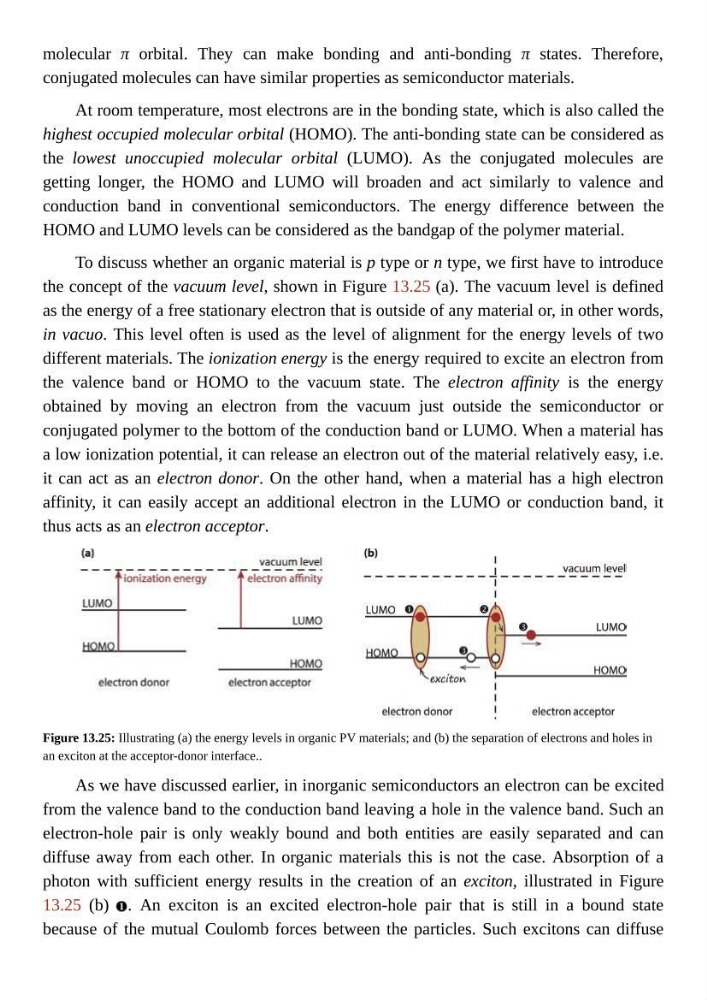
the concept of the vacuum level, shown in Figure 13.25 (a). The vacuum level is defined
as the energy of a free stationary electron that is outside of any material or, in other words,
in vacuo. This level often is used as the level of alignment for the energy levels of two
different materials. The ionization energy is the energy required to excite an electron from
the valence band or HOMO to the vacuum state. The electron affinity is the energy
obtained by moving an electron from the vacuum just outside the semiconductor or
conjugated polymer to the bottom of the conduction band or LUMO. When a material has
a low ionization potential, it can release an electron out of the material relatively easy, i.e.
it can act as an electron donor. On the other hand, when a material has a high electron
affinity, it can easily accept an additional electron in the LUMO or conduction band, it
thus acts as an electron acceptor.
Figure 13.25: Illustrating (a) the energy levels in organic PV materials; and (b) the separation of electrons and holes in
an exciton at the acceptor-donor interface..
As we have discussed earlier, in inorganic semiconductors an electron can be excited
from the valence band to the conduction band leaving a hole in the valence band. Such an
electron-hole pair is only weakly bound and both entities are easily separated and can
diffuse away from each other. In organic materials this is not the case. Absorption of a
photon with sufficient energy results in the creation of an exciton, illustrated in Figure
13.25 (b) . An exciton is an excited electron-hole pair that is still in a bound state
because of the mutual Coulomb forces between the particles. Such excitons can diffuse
conjugated molecules can have similar properties as semiconductor materials.
At room temperature, most electrons are in the bonding state, which is also called the
highest occupied molecular orbital (HOMO). The anti-bonding state can be considered as
the lowest unoccupied molecular orbital (LUMO). As the conjugated molecules are
getting longer, the HOMO and LUMO will broaden and act similarly to valence and
conduction band in conventional semiconductors. The energy difference between the
HOMO and LUMO levels can be considered as the bandgap of the polymer material.
To discuss whether an organic material is p type or n type, we first have to introduce
the concept of the vacuum level, shown in Figure 13.25 (a). The vacuum level is defined
as the energy of a free stationary electron that is outside of any material or, in other words,
in vacuo. This level often is used as the level of alignment for the energy levels of two
different materials. The ionization energy is the energy required to excite an electron from
the valence band or HOMO to the vacuum state. The electron affinity is the energy
obtained by moving an electron from the vacuum just outside the semiconductor or
conjugated polymer to the bottom of the conduction band or LUMO. When a material has
a low ionization potential, it can release an electron out of the material relatively easy, i.e.
it can act as an electron donor. On the other hand, when a material has a high electron
affinity, it can easily accept an additional electron in the LUMO or conduction band, it
thus acts as an electron acceptor.
Figure 13.25: Illustrating (a) the energy levels in organic PV materials; and (b) the separation of electrons and holes in
an exciton at the acceptor-donor interface..
As we have discussed earlier, in inorganic semiconductors an electron can be excited
from the valence band to the conduction band leaving a hole in the valence band. Such an
electron-hole pair is only weakly bound and both entities are easily separated and can
diffuse away from each other. In organic materials this is not the case. Absorption of a
photon with sufficient energy results in the creation of an exciton, illustrated in Figure
13.25 (b) . An exciton is an excited electron-hole pair that is still in a bound state
because of the mutual Coulomb forces between the particles. Such excitons can diffuse