

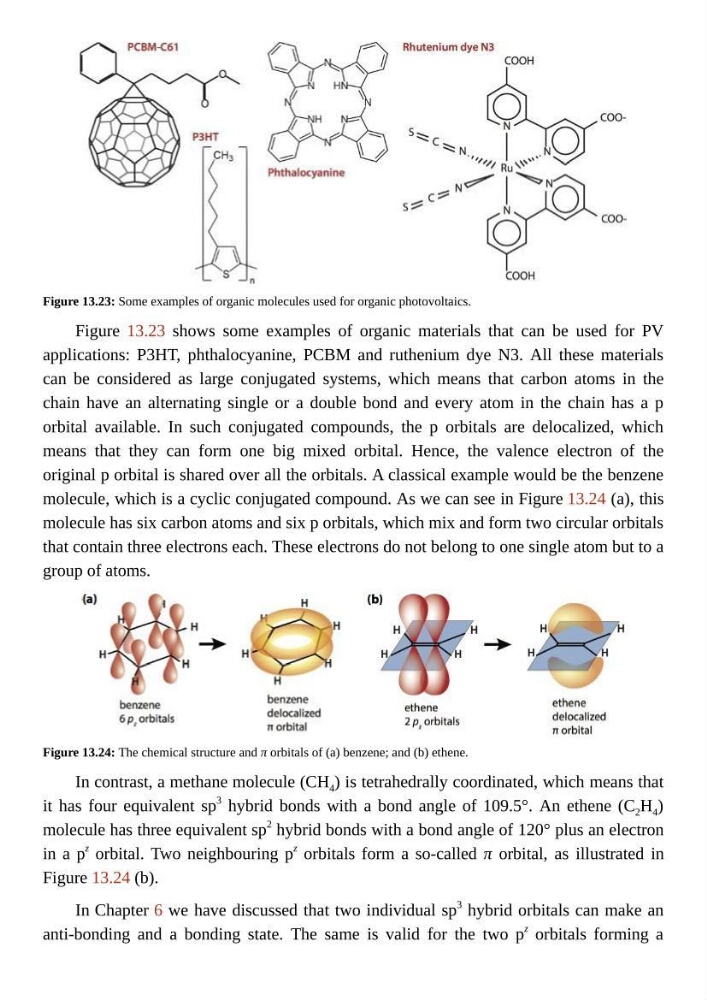
Figure 13.23: Some examples of organic molecules used for organic photovoltaics.
Figure 13.23 shows some examples of organic materials that can be used for PV
applications: P3HT, phthalocyanine, PCBM and ruthenium dye N3. All these materials
can be considered as large conjugated systems, which means that carbon atoms in the
chain have an alternating single or a double bond and every atom in the chain has a p
orbital available. In such conjugated compounds, the p orbitals are delocalized, which
means that they can form one big mixed orbital. Hence, the valence electron of the
original p orbital is shared over all the orbitals. A classical example would be the benzene
molecule, which is a cyclic conjugated compound. As we can see in Figure 13.24 (a), this
molecule has six carbon atoms and six p orbitals, which mix and form two circular orbitals
that contain three electrons each. These electrons do not belong to one single atom but to a
group of atoms.
Figure 13.24: The chemical structure and π orbitals of (a) benzene; and (b) ethene.
In contrast, a methane molecule (CH 4 ) is tetrahedrally coordinated, which means that
it has four equivalent sp
3 hybrid bonds with a bond angle of 109.5°. An ethene (C 2 H 4 )
molecule has three equivalent sp
2
hybrid bonds with a bond angle of 120° plus an electron
in a p
z
orbital. Two neighbouring p
z
orbitals form a so-called π orbital, as illustrated in
Figure 13.24 (b).
In Chapter 6 we have discussed that two individual sp
3
hybrid orbitals can make an
anti-bonding and a bonding state. The same is valid for the two p
z
orbitals forming a
Figure 13.23 shows some examples of organic materials that can be used for PV
applications: P3HT, phthalocyanine, PCBM and ruthenium dye N3. All these materials
can be considered as large conjugated systems, which means that carbon atoms in the
chain have an alternating single or a double bond and every atom in the chain has a p
orbital available. In such conjugated compounds, the p orbitals are delocalized, which
means that they can form one big mixed orbital. Hence, the valence electron of the
original p orbital is shared over all the orbitals. A classical example would be the benzene
molecule, which is a cyclic conjugated compound. As we can see in Figure 13.24 (a), this
molecule has six carbon atoms and six p orbitals, which mix and form two circular orbitals
that contain three electrons each. These electrons do not belong to one single atom but to a
group of atoms.
Figure 13.24: The chemical structure and π orbitals of (a) benzene; and (b) ethene.
In contrast, a methane molecule (CH 4 ) is tetrahedrally coordinated, which means that
it has four equivalent sp
3 hybrid bonds with a bond angle of 109.5°. An ethene (C 2 H 4 )
molecule has three equivalent sp
2
hybrid bonds with a bond angle of 120° plus an electron
in a p
z
orbital. Two neighbouring p
z
orbitals form a so-called π orbital, as illustrated in
Figure 13.24 (b).
In Chapter 6 we have discussed that two individual sp
3
hybrid orbitals can make an
anti-bonding and a bonding state. The same is valid for the two p
z
orbitals forming a