

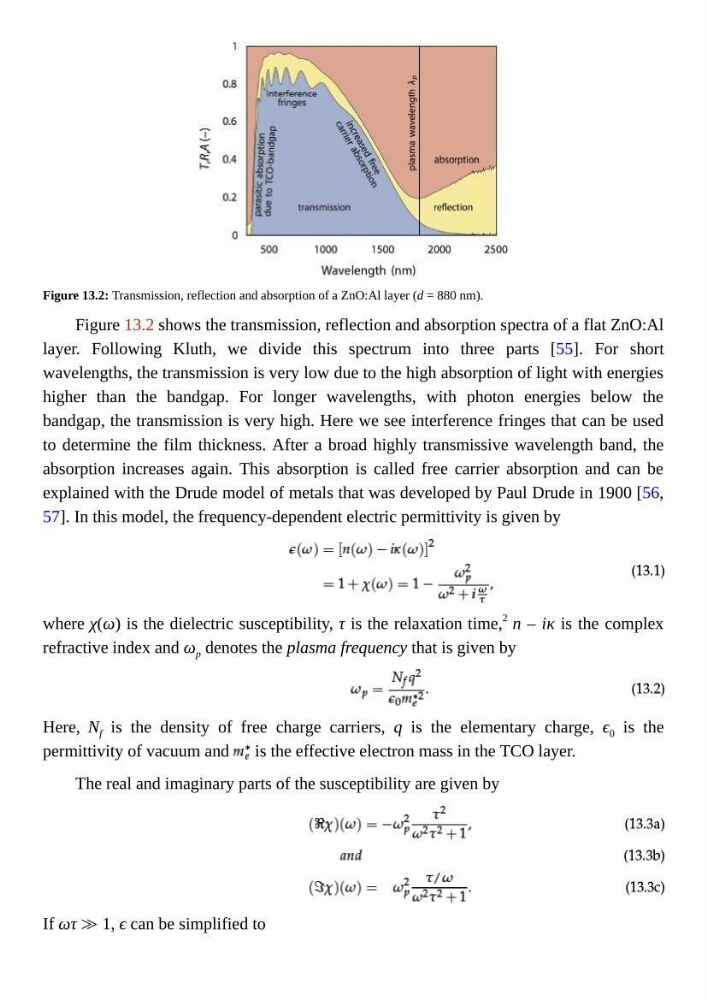
Figure 13.2: Transmission, reflection and absorption of a ZnO:Al layer (d = 880 nm).
Figure 13.2 shows the transmission, reflection and absorption spectra of a flat ZnO:Al
layer. Following Kluth, we divide this spectrum into three parts [55]. For short
wavelengths, the transmission is very low due to the high absorption of light with energies
higher than the bandgap. For longer wavelengths, with photon energies below the
bandgap, the transmission is very high. Here we see interference fringes that can be used
to determine the film thickness. After a broad highly transmissive wavelength band, the
absorption increases again. This absorption is called free carrier absorption and can be
explained with the Drude model of metals that was developed by Paul Drude in 1900 [56,
57]. In this model, the frequency-dependent electric permittivity is given by
where χ(ω) is the dielectric susceptibility, τ is the relaxation time,
2
n – iκ is the complex
refractive index and ω p denotes the plasma frequency that is given by
Here, N f is the density of free charge carriers, q is the elementary charge, ϵ 0 is the
permittivity of vacuum and is the effective electron mass in the TCO layer.
The real and imaginary parts of the susceptibility are given by
If ωτ ≫ 1, ϵ can be simplified to
Figure 13.2 shows the transmission, reflection and absorption spectra of a flat ZnO:Al
layer. Following Kluth, we divide this spectrum into three parts [55]. For short
wavelengths, the transmission is very low due to the high absorption of light with energies
higher than the bandgap. For longer wavelengths, with photon energies below the
bandgap, the transmission is very high. Here we see interference fringes that can be used
to determine the film thickness. After a broad highly transmissive wavelength band, the
absorption increases again. This absorption is called free carrier absorption and can be
explained with the Drude model of metals that was developed by Paul Drude in 1900 [56,
57]. In this model, the frequency-dependent electric permittivity is given by
where χ(ω) is the dielectric susceptibility, τ is the relaxation time,
2
n – iκ is the complex
refractive index and ω p denotes the plasma frequency that is given by
Here, N f is the density of free charge carriers, q is the elementary charge, ϵ 0 is the
permittivity of vacuum and is the effective electron mass in the TCO layer.
The real and imaginary parts of the susceptibility are given by
If ωτ ≫ 1, ϵ can be simplified to