

12.2
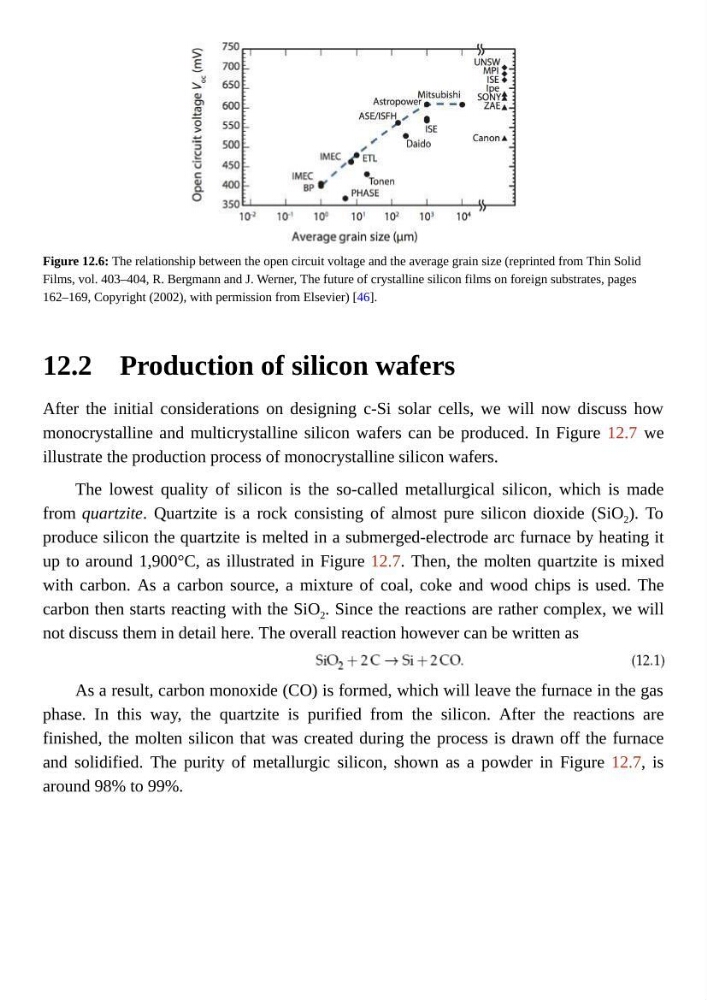
Figure 12.6: The relationship between the open circuit voltage and the average grain size (reprinted from Thin Solid
Films, vol. 403–404, R. Bergmann and J. Werner, The future of crystalline silicon films on foreign substrates, pages
162–169, Copyright (2002), with permission from Elsevier) [46].
Production of silicon wafers
After the initial considerations on designing c-Si solar cells, we will now discuss how
monocrystalline and multicrystalline silicon wafers can be produced. In Figure 12.7 we
illustrate the production process of monocrystalline silicon wafers.
The lowest quality of silicon is the so-called metallurgical silicon, which is made
from quartzite. Quartzite is a rock consisting of almost pure silicon dioxide (SiO 2 ). To
produce silicon the quartzite is melted in a submerged-electrode arc furnace by heating it
up to around 1,900°C, as illustrated in Figure 12.7. Then, the molten quartzite is mixed
with carbon. As a carbon source, a mixture of coal, coke and wood chips is used. The
carbon then starts reacting with the SiO 2 . Since the reactions are rather complex, we will
not discuss them in detail here. The overall reaction however can be written as
As a result, carbon monoxide (CO) is formed, which will leave the furnace in the gas
phase. In this way, the quartzite is purified from the silicon. After the reactions are
finished, the molten silicon that was created during the process is drawn off the furnace
and solidified. The purity of metallurgic silicon, shown as a powder in Figure 12.7, is
around 98% to 99%.
Figure 12.6: The relationship between the open circuit voltage and the average grain size (reprinted from Thin Solid
Films, vol. 403–404, R. Bergmann and J. Werner, The future of crystalline silicon films on foreign substrates, pages
162–169, Copyright (2002), with permission from Elsevier) [46].
Production of silicon wafers
After the initial considerations on designing c-Si solar cells, we will now discuss how
monocrystalline and multicrystalline silicon wafers can be produced. In Figure 12.7 we
illustrate the production process of monocrystalline silicon wafers.
The lowest quality of silicon is the so-called metallurgical silicon, which is made
from quartzite. Quartzite is a rock consisting of almost pure silicon dioxide (SiO 2 ). To
produce silicon the quartzite is melted in a submerged-electrode arc furnace by heating it
up to around 1,900°C, as illustrated in Figure 12.7. Then, the molten quartzite is mixed
with carbon. As a carbon source, a mixture of coal, coke and wood chips is used. The
carbon then starts reacting with the SiO 2 . Since the reactions are rather complex, we will
not discuss them in detail here. The overall reaction however can be written as
As a result, carbon monoxide (CO) is formed, which will leave the furnace in the gas
phase. In this way, the quartzite is purified from the silicon. After the reactions are
finished, the molten silicon that was created during the process is drawn off the furnace
and solidified. The purity of metallurgic silicon, shown as a powder in Figure 12.7, is
around 98% to 99%.