

too expensive and stopped funding Mouchot’s research.
In 1876, the British natural philosopher William Grylls Adams together with his
student Richard Evans Day demonstrated the photovoltaic effect in a junction based on
platinum and the semiconductor selenium, however with a very poor performance. Seven
years later, the American inventor Charles Fritts managed to make a PV device based on a
goldselenium junction. The energy conversion efficiency of that device was 1%.
In 1887, the German physicist Heinrich Hertz discovered the photoelectric effect,
already briefly mentioned in Chapter 3. In this effect, electrons are emitted from a material
that has absorbed light with a frequency exceeding a material-dependent threshold
frequency. In 1905 Albert Einstein published a paper in which he explained the
photoelectric effect by assuming that light energy was being carried with quantized
packages of energy [23], which we nowadays call photons.
In 1918 the Polish chemist Jan Czochralski invented a method to grow high quality
crystalline materials. Nowadays this technique is very important for growing
monocrystalline silicon used for high quality silicon solar cells that we will study in detail
in Chapter 12. The development of the c-Si technology started in the second half of the
20th century.
In 1953, the American chemist Dan Trivich was the first one to perform theoretical
calculations on the solar cell performance for materials with different bandgaps.
The real development of solar cells as we know them today, started at the Bell
Laboratories in the United States. In 1954, their scientists Daryl M. Chapin, Calvin S.
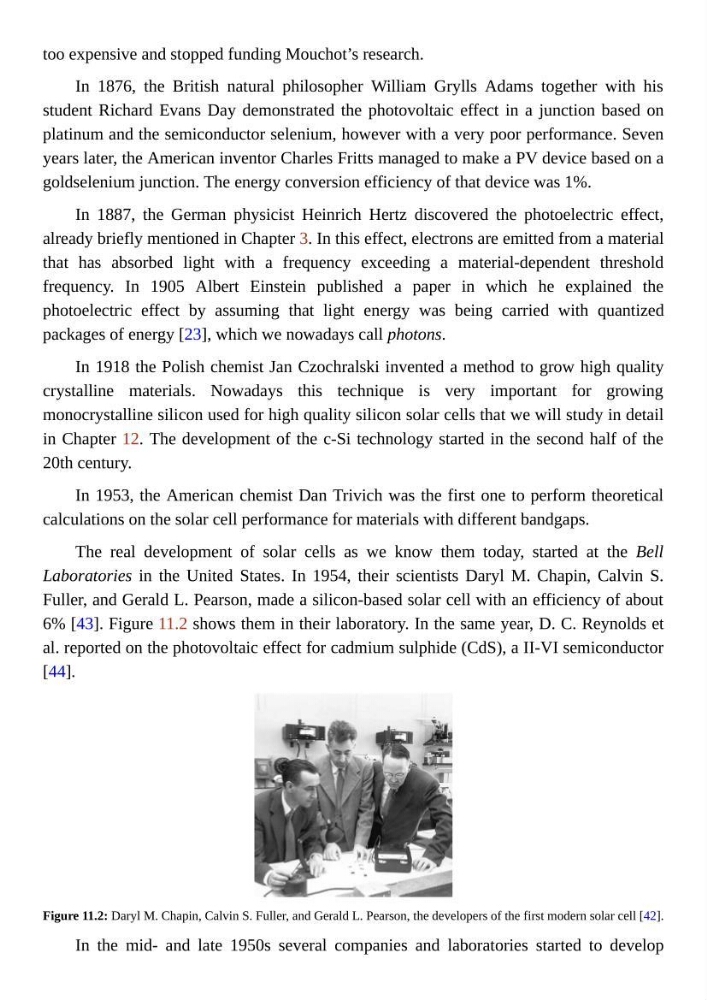
Fuller, and Gerald L. Pearson, made a silicon-based solar cell with an efficiency of about
6% [43]. Figure 11.2 shows them in their laboratory. In the same year, D. C. Reynolds et
al. reported on the photovoltaic effect for cadmium sulphide (CdS), a II-VI semiconductor
[44].
Figure 11.2: Daryl M. Chapin, Calvin S. Fuller, and Gerald L. Pearson, the developers of the first modern solar cell [42].
In the mid- and late 1950s several companies and laboratories started to develop
In 1876, the British natural philosopher William Grylls Adams together with his
student Richard Evans Day demonstrated the photovoltaic effect in a junction based on
platinum and the semiconductor selenium, however with a very poor performance. Seven
years later, the American inventor Charles Fritts managed to make a PV device based on a
goldselenium junction. The energy conversion efficiency of that device was 1%.
In 1887, the German physicist Heinrich Hertz discovered the photoelectric effect,
already briefly mentioned in Chapter 3. In this effect, electrons are emitted from a material
that has absorbed light with a frequency exceeding a material-dependent threshold
frequency. In 1905 Albert Einstein published a paper in which he explained the
photoelectric effect by assuming that light energy was being carried with quantized
packages of energy [23], which we nowadays call photons.
In 1918 the Polish chemist Jan Czochralski invented a method to grow high quality
crystalline materials. Nowadays this technique is very important for growing
monocrystalline silicon used for high quality silicon solar cells that we will study in detail
in Chapter 12. The development of the c-Si technology started in the second half of the
20th century.
In 1953, the American chemist Dan Trivich was the first one to perform theoretical
calculations on the solar cell performance for materials with different bandgaps.
The real development of solar cells as we know them today, started at the Bell
Laboratories in the United States. In 1954, their scientists Daryl M. Chapin, Calvin S.
Fuller, and Gerald L. Pearson, made a silicon-based solar cell with an efficiency of about
6% [43]. Figure 11.2 shows them in their laboratory. In the same year, D. C. Reynolds et
al. reported on the photovoltaic effect for cadmium sulphide (CdS), a II-VI semiconductor
[44].
Figure 11.2: Daryl M. Chapin, Calvin S. Fuller, and Gerald L. Pearson, the developers of the first modern solar cell [42].
In the mid- and late 1950s several companies and laboratories started to develop