

11
A short history of solar cells
We will start our discussion on PV technology with a brief summary of the history of solar
energy. In the seventh century BCE, humans were already using magnifying glasses to
concentrate sunlight and hence to make fire. Later, the ancient Greeks and Romans used
concentrating mirrors for the same purpose.
In the 18th century the Swiss physicist Horace-Bénédict de Saussure built heat traps,
which are a kind of miniature greenhouse. He constructed hot boxes, consisting of a glass
box within another bigger glass box, with a total number of up to five boxes. When
exposed to direct solar irradiation, the temperature in the innermost box could rise up to
108°C; warm enough to boil water and cook food. These boxes can be considered as the
World’s first solar collectors.
In 1839, the French physicist Alexandre-Edmond Becquerel discovered the
photovoltaic effect at the age of only 19 years. He observed this effect in an electrolytic
cell, which was made out of two platinum electrodes, placed in an electrolyte. An
electrolyte is an electrically conducting solution; Becquerel used silver chloride dissolved
in an acidic solution. He observed that the current of the cell was enhanced when his setup
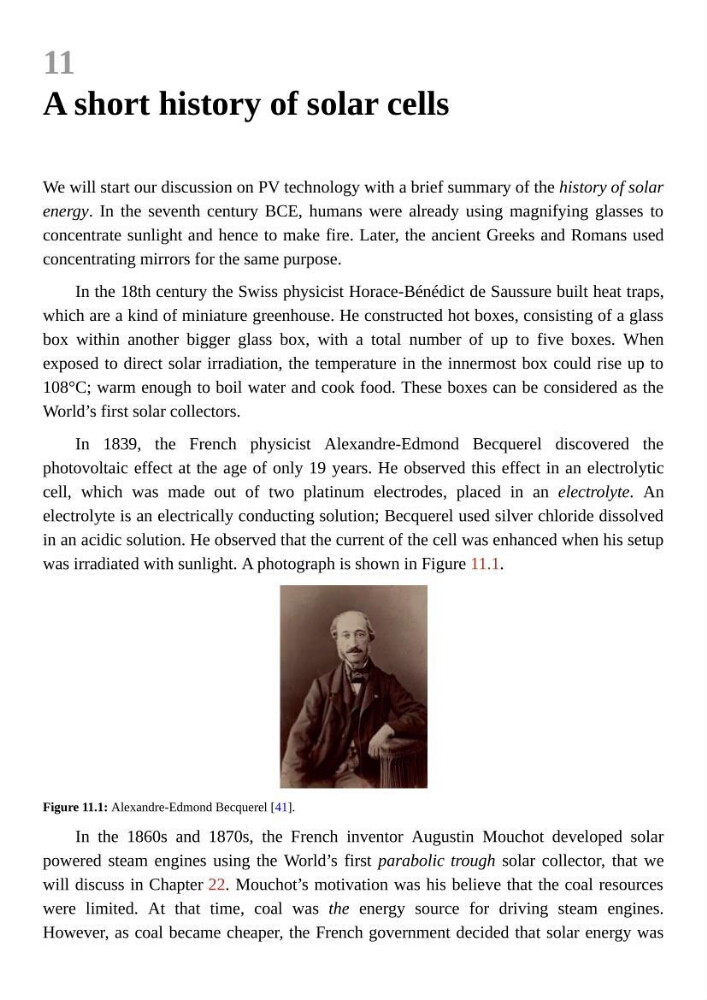
was irradiated with sunlight. A photograph is shown in Figure 11.1.
Figure 11.1: Alexandre-Edmond Becquerel [41].
In the 1860s and 1870s, the French inventor Augustin Mouchot developed solar
powered steam engines using the World’s first parabolic trough solar collector, that we
will discuss in Chapter 22. Mouchot’s motivation was his believe that the coal resources
were limited. At that time, coal was the energy source for driving steam engines.
However, as coal became cheaper, the French government decided that solar energy was
A short history of solar cells
We will start our discussion on PV technology with a brief summary of the history of solar
energy. In the seventh century BCE, humans were already using magnifying glasses to
concentrate sunlight and hence to make fire. Later, the ancient Greeks and Romans used
concentrating mirrors for the same purpose.
In the 18th century the Swiss physicist Horace-Bénédict de Saussure built heat traps,
which are a kind of miniature greenhouse. He constructed hot boxes, consisting of a glass
box within another bigger glass box, with a total number of up to five boxes. When
exposed to direct solar irradiation, the temperature in the innermost box could rise up to
108°C; warm enough to boil water and cook food. These boxes can be considered as the
World’s first solar collectors.
In 1839, the French physicist Alexandre-Edmond Becquerel discovered the
photovoltaic effect at the age of only 19 years. He observed this effect in an electrolytic
cell, which was made out of two platinum electrodes, placed in an electrolyte. An
electrolyte is an electrically conducting solution; Becquerel used silver chloride dissolved
in an acidic solution. He observed that the current of the cell was enhanced when his setup
was irradiated with sunlight. A photograph is shown in Figure 11.1.
Figure 11.1: Alexandre-Edmond Becquerel [41].
In the 1860s and 1870s, the French inventor Augustin Mouchot developed solar
powered steam engines using the World’s first parabolic trough solar collector, that we
will discuss in Chapter 22. Mouchot’s motivation was his believe that the coal resources
were limited. At that time, coal was the energy source for driving steam engines.
However, as coal became cheaper, the French government decided that solar energy was