

silicon-based solar cells in order to power satellites orbiting the Earth. Among these were
RCA Corporation, Hoffman Electronics Corporation but also the United States Army
Signal Corps. In those days, research on PV technology was mainly driven by supplying
space applications with energy. For example, the American satellite Vanguard 1, which
was launched by the US Navy in 1958, was powered by solar cells from Hoffman
Electronics. It was the fourth artificial Earth satellite and the first one to be powered with
solar cells. It was operating until 1964 and still is orbiting Earth. In 1962 Bell Telephone
Laboratories launched the first solar powered telecommunications satellite and in 1966
NASA launched the first Orbiting Astronomical Observatory, which was powered by a 1
kW photovoltaic solar array.
In 1968, the Italian scientist Giovanni Francia built the first concentrated solar power
plant near Genoa, Italy. The plant was able to produce 1 MW with superheated steam at
100 bar and 500 °C.
In 1970, the Soviet physicist Zhores Alferov developed solar cells based on a gallium
arsenide heterojunction. This was the first solar cell based on III-V semiconductor
materials which we will discuss in Section 13.2. In 1976, Dave E. Carlson and Chris R.
Wronski developed the first thin-film photovoltaic devices based on amorphous silicon at
RCA Laboratories. We will discuss this technology in Section 13.3. In 1978, the Japanese
companies SHARP and Tokyo Electronic Application Laboratory brought the first solar
powered calculators on the market.
Because of the 1970s oil crisis, which led to sharply rising oil prices, the public
interest in photovoltaic technology for terrestrial application increased in that decade. In
that time, PV technology moved from a niche technology for space application to a
technology applicable for terrestrial applications. In the late 1970s and 1980s many
companies started to develop PV modules and systems for terrestrial applications. Solar
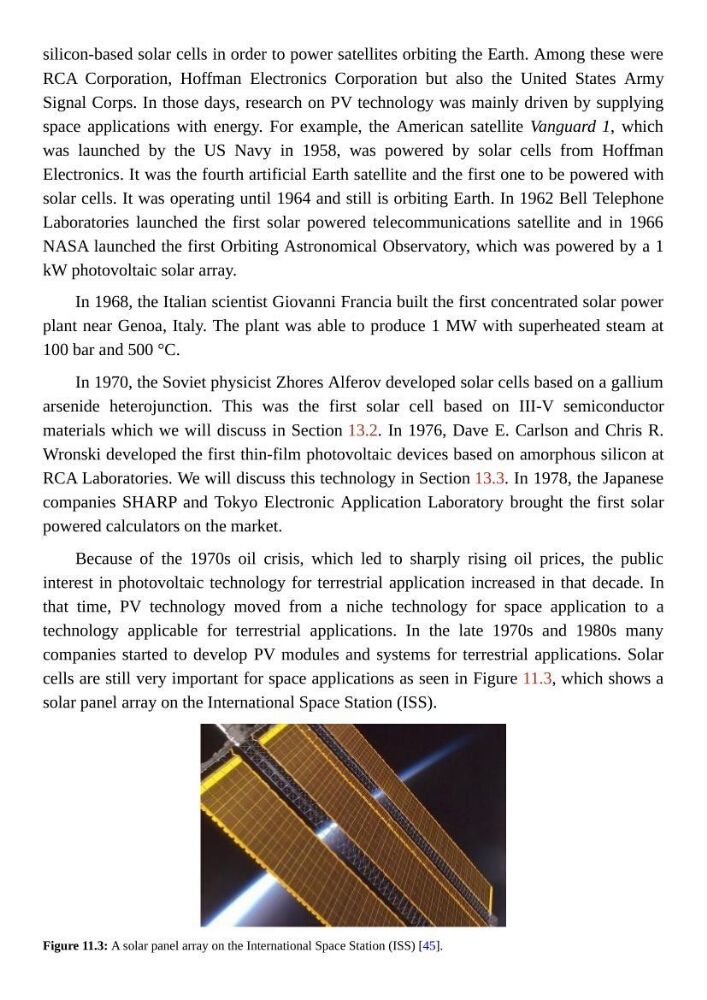
cells are still very important for space applications as seen in Figure 11.3, which shows a
solar panel array on the International Space Station (ISS).
Figure 11.3: A solar panel array on the International Space Station (ISS) [45].
RCA Corporation, Hoffman Electronics Corporation but also the United States Army
Signal Corps. In those days, research on PV technology was mainly driven by supplying
space applications with energy. For example, the American satellite Vanguard 1, which
was launched by the US Navy in 1958, was powered by solar cells from Hoffman
Electronics. It was the fourth artificial Earth satellite and the first one to be powered with
solar cells. It was operating until 1964 and still is orbiting Earth. In 1962 Bell Telephone
Laboratories launched the first solar powered telecommunications satellite and in 1966
NASA launched the first Orbiting Astronomical Observatory, which was powered by a 1
kW photovoltaic solar array.
In 1968, the Italian scientist Giovanni Francia built the first concentrated solar power
plant near Genoa, Italy. The plant was able to produce 1 MW with superheated steam at
100 bar and 500 °C.
In 1970, the Soviet physicist Zhores Alferov developed solar cells based on a gallium
arsenide heterojunction. This was the first solar cell based on III-V semiconductor
materials which we will discuss in Section 13.2. In 1976, Dave E. Carlson and Chris R.
Wronski developed the first thin-film photovoltaic devices based on amorphous silicon at
RCA Laboratories. We will discuss this technology in Section 13.3. In 1978, the Japanese
companies SHARP and Tokyo Electronic Application Laboratory brought the first solar
powered calculators on the market.
Because of the 1970s oil crisis, which led to sharply rising oil prices, the public
interest in photovoltaic technology for terrestrial application increased in that decade. In
that time, PV technology moved from a niche technology for space application to a
technology applicable for terrestrial applications. In the late 1970s and 1980s many
companies started to develop PV modules and systems for terrestrial applications. Solar
cells are still very important for space applications as seen in Figure 11.3, which shows a
solar panel array on the International Space Station (ISS).
Figure 11.3: A solar panel array on the International Space Station (ISS) [45].