

10.4.2
10.4.3
recombination mechanism. The dominance of radiative, Auger or Shockley–Reed–Hall
recombination depends on the type of semiconductor materials used in the solar cell and
the illumination conditions. We will discuss several different cases on Part III on PV
technology.
Spectral utilization
The spectral utilization is mainly determined by the choice of materials from which the
solar cell is made. As we have seen in Section 10.2, and mainly Eq. (10.13), the
photocurrent density is determined by the bandgap of the material. For a bandgap of 0.62
eV corresponding to a wavelength of 2,000 nm, we could theoretically generate a short
circuit current density of 62 mA/cm
2
. If we consider c-Si, having a band gap of 1.12 eV
(1107 nm), we arrive at a theoretical current density of 44 mA/cm
2 .
The optimal bandgap for single-junction solar cells is determined by the Shockley–
Queisser limit, as illustrated in Figure 10.6. For single-junction solar cells, semiconductor
materials such as silicon, gallium arsenide and cadmium telluride have a band gap close to
the optimum.
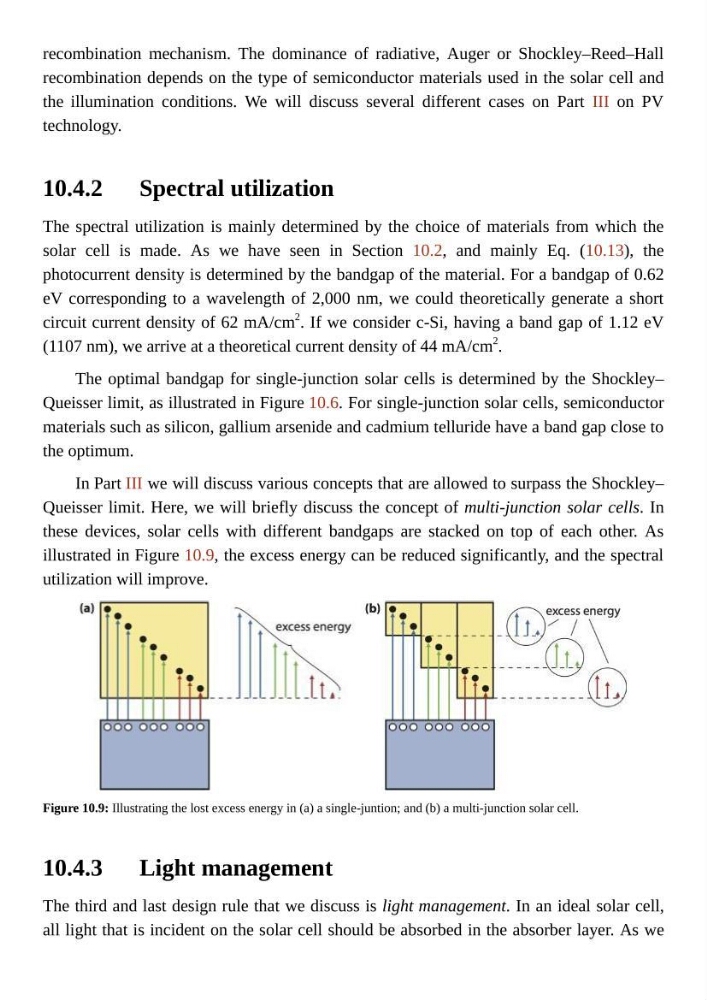
In Part III we will discuss various concepts that are allowed to surpass the Shockley–
Queisser limit. Here, we will briefly discuss the concept of multi-junction solar cells. In
these devices, solar cells with different bandgaps are stacked on top of each other. As
illustrated in Figure 10.9, the excess energy can be reduced significantly, and the spectral
utilization will improve.
Figure 10.9: Illustrating the lost excess energy in (a) a single-juntion; and (b) a multi-junction solar cell.
Light management
The third and last design rule that we discuss is light management. In an ideal solar cell,
all light that is incident on the solar cell should be absorbed in the absorber layer. As we
10.4.3
recombination mechanism. The dominance of radiative, Auger or Shockley–Reed–Hall
recombination depends on the type of semiconductor materials used in the solar cell and
the illumination conditions. We will discuss several different cases on Part III on PV
technology.
Spectral utilization
The spectral utilization is mainly determined by the choice of materials from which the
solar cell is made. As we have seen in Section 10.2, and mainly Eq. (10.13), the
photocurrent density is determined by the bandgap of the material. For a bandgap of 0.62
eV corresponding to a wavelength of 2,000 nm, we could theoretically generate a short
circuit current density of 62 mA/cm
2
. If we consider c-Si, having a band gap of 1.12 eV
(1107 nm), we arrive at a theoretical current density of 44 mA/cm
2 .
The optimal bandgap for single-junction solar cells is determined by the Shockley–
Queisser limit, as illustrated in Figure 10.6. For single-junction solar cells, semiconductor
materials such as silicon, gallium arsenide and cadmium telluride have a band gap close to
the optimum.
In Part III we will discuss various concepts that are allowed to surpass the Shockley–
Queisser limit. Here, we will briefly discuss the concept of multi-junction solar cells. In
these devices, solar cells with different bandgaps are stacked on top of each other. As
illustrated in Figure 10.9, the excess energy can be reduced significantly, and the spectral
utilization will improve.
Figure 10.9: Illustrating the lost excess energy in (a) a single-juntion; and (b) a multi-junction solar cell.
Light management
The third and last design rule that we discuss is light management. In an ideal solar cell,
all light that is incident on the solar cell should be absorbed in the absorber layer. As we