

starts to play a role as well.
To summarize, we find that in the defect-rich solar cells, the open circuit voltage is
limited by the SRH recombination. In low-defect solar cells based on indirect bandgap
materials, the open circuit voltage is limited by Auger recombination. In low-defect solar
cells based on direct bandgap materials, the open circuit voltage is limited by radiative
recombination.
Besides bandgap utilization, it is also important to discuss the relationship between
the maximum thickness for the absorber layer of a solar cell and the dominant
recombination mechanism. As we have seen in Chapter 7, the recombination mechanism
also affects the diffusion length of the minority charge carrier. The diffusion length L n of
minority electrons is given by
where D n is the diffusion coefficient and τ is the lifetime of the minority charge carrier.
Similarly, we can formulate the diffusion length for minority holes, L p .
It is important to realise that ideally the thickness of the absorber layer should not
exceed the diffusion length. In order to understand this requirement, we consider photons
that penetrate far into the absorber layer before being absorbed and generating charge
carriers. The charge carriers generated deep in the absorber need to diffuse to the p-n
junction or the back contact for separation and collection. If the distance these charge
carriers need to diffuse exceeds the diffusion length, these excited charge carriers will
likely recombine before arriving at the p-n junction or back contact. This means that a
substantial fraction of the charge carriers generated at a distance greater than the diffusion
length from the p-n junction or the back contact will not be collected and hence is lost.
Only a fraction of the generated carrier density smaller than 1/e is collected, where e is the
base of the natural logarithm. If the charge carriers are generated within the diffusion
length of the p-n junction or back contact, the likelihood for collection is much greater.
This means that the minority carrier diffusion length limits the maximum thickness of the
solar cell.
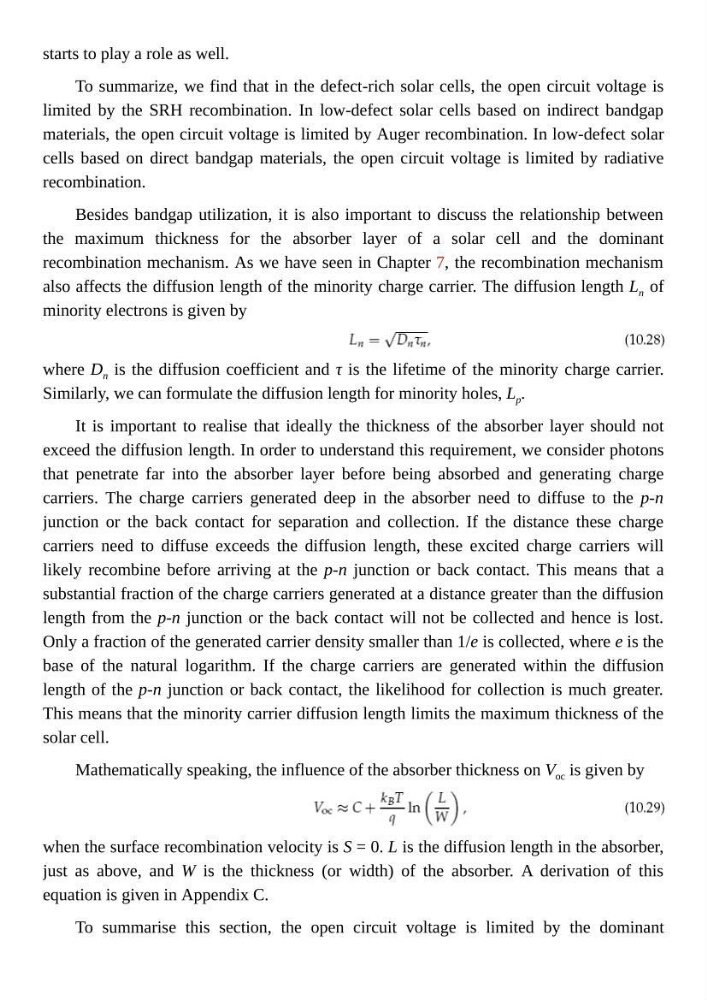
Mathematically speaking, the influence of the absorber thickness on V oc is given by
when the surface recombination velocity is S = 0. L is the diffusion length in the absorber,
just as above, and W is the thickness (or width) of the absorber. A derivation of this
equation is given in Appendix C.
To summarise this section, the open circuit voltage is limited by the dominant
To summarize, we find that in the defect-rich solar cells, the open circuit voltage is
limited by the SRH recombination. In low-defect solar cells based on indirect bandgap
materials, the open circuit voltage is limited by Auger recombination. In low-defect solar
cells based on direct bandgap materials, the open circuit voltage is limited by radiative
recombination.
Besides bandgap utilization, it is also important to discuss the relationship between
the maximum thickness for the absorber layer of a solar cell and the dominant
recombination mechanism. As we have seen in Chapter 7, the recombination mechanism
also affects the diffusion length of the minority charge carrier. The diffusion length L n of
minority electrons is given by
where D n is the diffusion coefficient and τ is the lifetime of the minority charge carrier.
Similarly, we can formulate the diffusion length for minority holes, L p .
It is important to realise that ideally the thickness of the absorber layer should not
exceed the diffusion length. In order to understand this requirement, we consider photons
that penetrate far into the absorber layer before being absorbed and generating charge
carriers. The charge carriers generated deep in the absorber need to diffuse to the p-n
junction or the back contact for separation and collection. If the distance these charge
carriers need to diffuse exceeds the diffusion length, these excited charge carriers will
likely recombine before arriving at the p-n junction or back contact. This means that a
substantial fraction of the charge carriers generated at a distance greater than the diffusion
length from the p-n junction or the back contact will not be collected and hence is lost.
Only a fraction of the generated carrier density smaller than 1/e is collected, where e is the
base of the natural logarithm. If the charge carriers are generated within the diffusion
length of the p-n junction or back contact, the likelihood for collection is much greater.
This means that the minority carrier diffusion length limits the maximum thickness of the
solar cell.
Mathematically speaking, the influence of the absorber thickness on V oc is given by
when the surface recombination velocity is S = 0. L is the diffusion length in the absorber,
just as above, and W is the thickness (or width) of the absorber. A derivation of this
equation is given in Appendix C.
To summarise this section, the open circuit voltage is limited by the dominant