

voltage, for example expressed in Eq. (10.17) can also be expressed in terms of the
generation rate G L , the life time τ 0 of the minority charge carriers and the intrinsic density
of the charge carriers n i in the semiconductor material. Under the assumption that G L is
spatially homogeneous across the junction, we find
The derivation of this equation is outside the scope of this book.
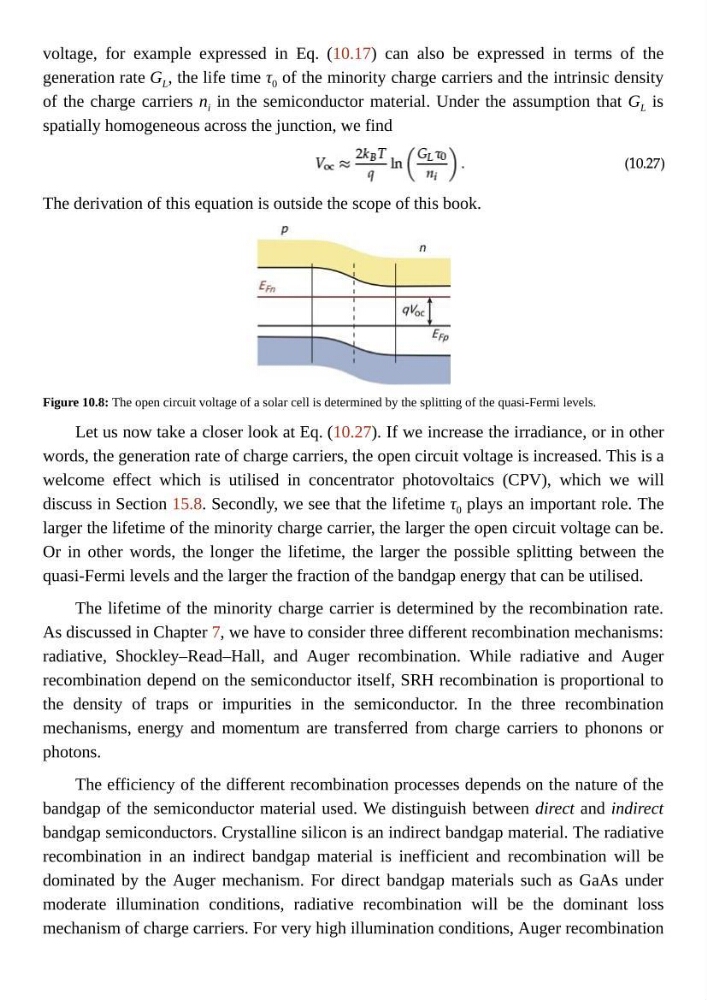
Figure 10.8: The open circuit voltage of a solar cell is determined by the splitting of the quasi-Fermi levels.
Let us now take a closer look at Eq. (10.27). If we increase the irradiance, or in other
words, the generation rate of charge carriers, the open circuit voltage is increased. This is a
welcome effect which is utilised in concentrator photovoltaics (CPV), which we will
discuss in Section 15.8. Secondly, we see that the lifetime τ 0 plays an important role. The
larger the lifetime of the minority charge carrier, the larger the open circuit voltage can be.
Or in other words, the longer the lifetime, the larger the possible splitting between the
quasi-Fermi levels and the larger the fraction of the bandgap energy that can be utilised.
The lifetime of the minority charge carrier is determined by the recombination rate.
As discussed in Chapter 7, we have to consider three different recombination mechanisms:
radiative, Shockley–Read–Hall, and Auger recombination. While radiative and Auger
recombination depend on the semiconductor itself, SRH recombination is proportional to
the density of traps or impurities in the semiconductor. In the three recombination
mechanisms, energy and momentum are transferred from charge carriers to phonons or
photons.
The efficiency of the different recombination processes depends on the nature of the
bandgap of the semiconductor material used. We distinguish between direct and indirect
bandgap semiconductors. Crystalline silicon is an indirect bandgap material. The radiative
recombination in an indirect bandgap material is inefficient and recombination will be
dominated by the Auger mechanism. For direct bandgap materials such as GaAs under
moderate illumination conditions, radiative recombination will be the dominant loss
mechanism of charge carriers. For very high illumination conditions, Auger recombination
generation rate G L , the life time τ 0 of the minority charge carriers and the intrinsic density
of the charge carriers n i in the semiconductor material. Under the assumption that G L is
spatially homogeneous across the junction, we find
The derivation of this equation is outside the scope of this book.
Figure 10.8: The open circuit voltage of a solar cell is determined by the splitting of the quasi-Fermi levels.
Let us now take a closer look at Eq. (10.27). If we increase the irradiance, or in other
words, the generation rate of charge carriers, the open circuit voltage is increased. This is a
welcome effect which is utilised in concentrator photovoltaics (CPV), which we will
discuss in Section 15.8. Secondly, we see that the lifetime τ 0 plays an important role. The
larger the lifetime of the minority charge carrier, the larger the open circuit voltage can be.
Or in other words, the longer the lifetime, the larger the possible splitting between the
quasi-Fermi levels and the larger the fraction of the bandgap energy that can be utilised.
The lifetime of the minority charge carrier is determined by the recombination rate.
As discussed in Chapter 7, we have to consider three different recombination mechanisms:
radiative, Shockley–Read–Hall, and Auger recombination. While radiative and Auger
recombination depend on the semiconductor itself, SRH recombination is proportional to
the density of traps or impurities in the semiconductor. In the three recombination
mechanisms, energy and momentum are transferred from charge carriers to phonons or
photons.
The efficiency of the different recombination processes depends on the nature of the
bandgap of the semiconductor material used. We distinguish between direct and indirect
bandgap semiconductors. Crystalline silicon is an indirect bandgap material. The radiative
recombination in an indirect bandgap material is inefficient and recombination will be
dominated by the Auger mechanism. For direct bandgap materials such as GaAs under
moderate illumination conditions, radiative recombination will be the dominant loss
mechanism of charge carriers. For very high illumination conditions, Auger recombination