

have discussed in Section 4.4, the intensity of light decreases exponentially as it travels
through an absorptive medium. This is described by the Lambert–Beer law that we
formulated in Eq. (4.25),
From the Lambert–Beer law it follows that at the side at which the light is entering the
film, more light is absorbed relative to the back side. The total fraction of the incident
light absorbed in the material is equal to the light intensity entering the absorber layer
minus the intensity transmitted through the absorber layer,
Ideally, we would like a solar cell to absorb 100% of the incident light. Such an
absorber is called optically thick and has a transmissivity very close to 0. As we can see
from the Lambert–Beer law, this can be achieved either by absorbers with a large
thickness d or with very large absorption coefficients α.
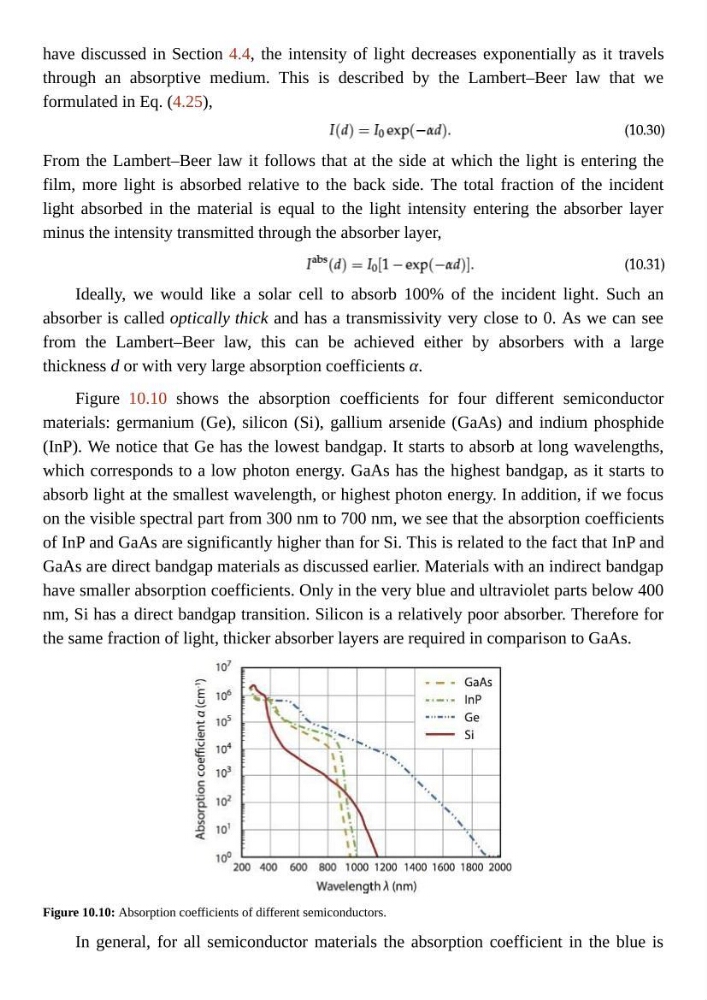
Figure 10.10 shows the absorption coefficients for four different semiconductor
materials: germanium (Ge), silicon (Si), gallium arsenide (GaAs) and indium phosphide
(InP). We notice that Ge has the lowest bandgap. It starts to absorb at long wavelengths,
which corresponds to a low photon energy. GaAs has the highest bandgap, as it starts to
absorb light at the smallest wavelength, or highest photon energy. In addition, if we focus
on the visible spectral part from 300 nm to 700 nm, we see that the absorption coefficients
of InP and GaAs are significantly higher than for Si. This is related to the fact that InP and
GaAs are direct bandgap materials as discussed earlier. Materials with an indirect bandgap
have smaller absorption coefficients. Only in the very blue and ultraviolet parts below 400
nm, Si has a direct bandgap transition. Silicon is a relatively poor absorber. Therefore for
the same fraction of light, thicker absorber layers are required in comparison to GaAs.
Figure 10.10: Absorption coefficients of different semiconductors.
In general, for all semiconductor materials the absorption coefficient in the blue is
through an absorptive medium. This is described by the Lambert–Beer law that we
formulated in Eq. (4.25),
From the Lambert–Beer law it follows that at the side at which the light is entering the
film, more light is absorbed relative to the back side. The total fraction of the incident
light absorbed in the material is equal to the light intensity entering the absorber layer
minus the intensity transmitted through the absorber layer,
Ideally, we would like a solar cell to absorb 100% of the incident light. Such an
absorber is called optically thick and has a transmissivity very close to 0. As we can see
from the Lambert–Beer law, this can be achieved either by absorbers with a large
thickness d or with very large absorption coefficients α.
Figure 10.10 shows the absorption coefficients for four different semiconductor
materials: germanium (Ge), silicon (Si), gallium arsenide (GaAs) and indium phosphide
(InP). We notice that Ge has the lowest bandgap. It starts to absorb at long wavelengths,
which corresponds to a low photon energy. GaAs has the highest bandgap, as it starts to
absorb light at the smallest wavelength, or highest photon energy. In addition, if we focus
on the visible spectral part from 300 nm to 700 nm, we see that the absorption coefficients
of InP and GaAs are significantly higher than for Si. This is related to the fact that InP and
GaAs are direct bandgap materials as discussed earlier. Materials with an indirect bandgap
have smaller absorption coefficients. Only in the very blue and ultraviolet parts below 400
nm, Si has a direct bandgap transition. Silicon is a relatively poor absorber. Therefore for
the same fraction of light, thicker absorber layers are required in comparison to GaAs.
Figure 10.10: Absorption coefficients of different semiconductors.
In general, for all semiconductor materials the absorption coefficient in the blue is