

10.2.2
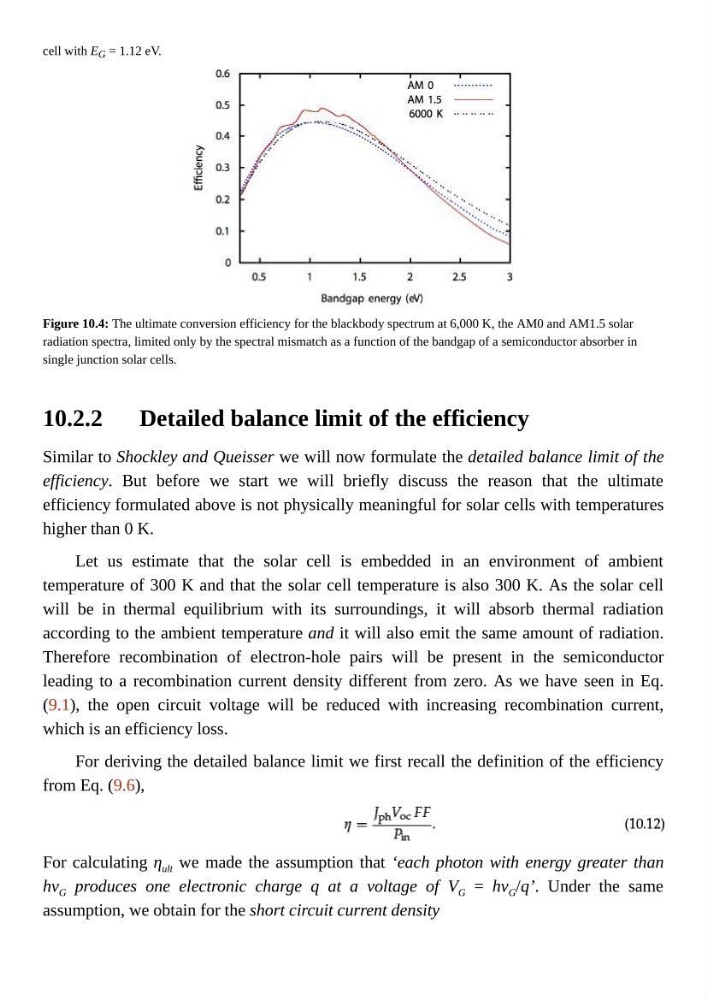
cell with E G = 1.12 eV.
Figure 10.4: The ultimate conversion efficiency for the blackbody spectrum at 6,000 K, the AM0 and AM1.5 solar
radiation spectra, limited only by the spectral mismatch as a function of the bandgap of a semiconductor absorber in
single junction solar cells.
Detailed balance limit of the efficiency
Similar to Shockley and Queisser we will now formulate the detailed balance limit of the
efficiency. But before we start we will briefly discuss the reason that the ultimate
efficiency formulated above is not physically meaningful for solar cells with temperatures
higher than 0 K.
Let us estimate that the solar cell is embedded in an environment of ambient
temperature of 300 K and that the solar cell temperature is also 300 K. As the solar cell
will be in thermal equilibrium with its surroundings, it will absorb thermal radiation
according to the ambient temperature and it will also emit the same amount of radiation.
Therefore recombination of electron-hole pairs will be present in the semiconductor
leading to a recombination current density different from zero. As we have seen in Eq.
(9.1), the open circuit voltage will be reduced with increasing recombination current,
which is an efficiency loss.
For deriving the detailed balance limit we first recall the definition of the efficiency
from Eq. (9.6),
For calculating η ult we made the assumption that ‘each photon with energy greater than
hν G produces one electronic charge q at a voltage of V G = hν G /q’. Under the same
assumption, we obtain for the short circuit current density
cell with E G = 1.12 eV.
Figure 10.4: The ultimate conversion efficiency for the blackbody spectrum at 6,000 K, the AM0 and AM1.5 solar
radiation spectra, limited only by the spectral mismatch as a function of the bandgap of a semiconductor absorber in
single junction solar cells.
Detailed balance limit of the efficiency
Similar to Shockley and Queisser we will now formulate the detailed balance limit of the
efficiency. But before we start we will briefly discuss the reason that the ultimate
efficiency formulated above is not physically meaningful for solar cells with temperatures
higher than 0 K.
Let us estimate that the solar cell is embedded in an environment of ambient
temperature of 300 K and that the solar cell temperature is also 300 K. As the solar cell
will be in thermal equilibrium with its surroundings, it will absorb thermal radiation
according to the ambient temperature and it will also emit the same amount of radiation.
Therefore recombination of electron-hole pairs will be present in the semiconductor
leading to a recombination current density different from zero. As we have seen in Eq.
(9.1), the open circuit voltage will be reduced with increasing recombination current,
which is an efficiency loss.
For deriving the detailed balance limit we first recall the definition of the efficiency
from Eq. (9.6),
For calculating η ult we made the assumption that ‘each photon with energy greater than
hν G produces one electronic charge q at a voltage of V G = hν G /q’. Under the same
assumption, we obtain for the short circuit current density