

where Φ ph, λ is the spectral photon flux of the incident light as defined in Chapter 5. The
fraction of the absorbed photon energy exceeding the bandgap energy is lost because of
thermalization. The fraction of the absorbed energy that the solar cell can deliver as useful
energy is then given by
By combining Eqs. (10.9) and (10.10), we can determine the ultimate conversion
efficiency,
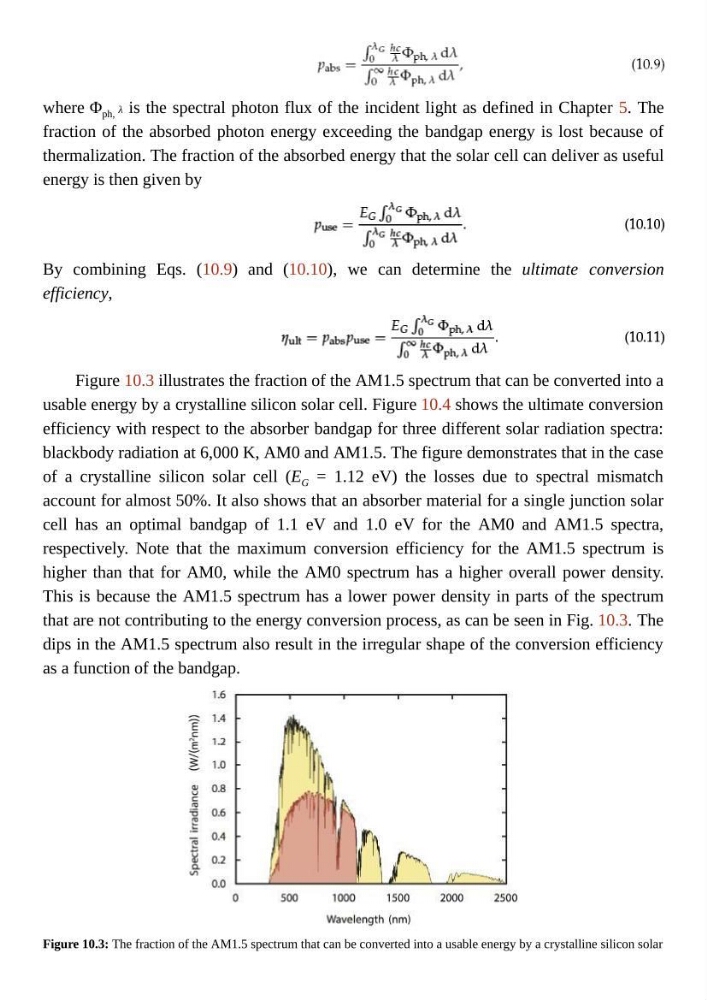
Figure 10.3 illustrates the fraction of the AM1.5 spectrum that can be converted into a
usable energy by a crystalline silicon solar cell. Figure 10.4 shows the ultimate conversion
efficiency with respect to the absorber bandgap for three different solar radiation spectra:
blackbody radiation at 6,000 K, AM0 and AM1.5. The figure demonstrates that in the case
of a crystalline silicon solar cell (E G = 1.12 eV) the losses due to spectral mismatch
account for almost 50%. It also shows that an absorber material for a single junction solar
cell has an optimal bandgap of 1.1 eV and 1.0 eV for the AM0 and AM1.5 spectra,
respectively. Note that the maximum conversion efficiency for the AM1.5 spectrum is
higher than that for AM0, while the AM0 spectrum has a higher overall power density.
This is because the AM1.5 spectrum has a lower power density in parts of the spectrum
that are not contributing to the energy conversion process, as can be seen in Fig. 10.3. The
dips in the AM1.5 spectrum also result in the irregular shape of the conversion efficiency
as a function of the bandgap.
Figure 10.3: The fraction of the AM1.5 spectrum that can be converted into a usable energy by a crystalline silicon solar
fraction of the absorbed photon energy exceeding the bandgap energy is lost because of
thermalization. The fraction of the absorbed energy that the solar cell can deliver as useful
energy is then given by
By combining Eqs. (10.9) and (10.10), we can determine the ultimate conversion
efficiency,
Figure 10.3 illustrates the fraction of the AM1.5 spectrum that can be converted into a
usable energy by a crystalline silicon solar cell. Figure 10.4 shows the ultimate conversion
efficiency with respect to the absorber bandgap for three different solar radiation spectra:
blackbody radiation at 6,000 K, AM0 and AM1.5. The figure demonstrates that in the case
of a crystalline silicon solar cell (E G = 1.12 eV) the losses due to spectral mismatch
account for almost 50%. It also shows that an absorber material for a single junction solar
cell has an optimal bandgap of 1.1 eV and 1.0 eV for the AM0 and AM1.5 spectra,
respectively. Note that the maximum conversion efficiency for the AM1.5 spectrum is
higher than that for AM0, while the AM0 spectrum has a higher overall power density.
This is because the AM1.5 spectrum has a lower power density in parts of the spectrum
that are not contributing to the energy conversion process, as can be seen in Fig. 10.3. The
dips in the AM1.5 spectrum also result in the irregular shape of the conversion efficiency
as a function of the bandgap.
Figure 10.3: The fraction of the AM1.5 spectrum that can be converted into a usable energy by a crystalline silicon solar