

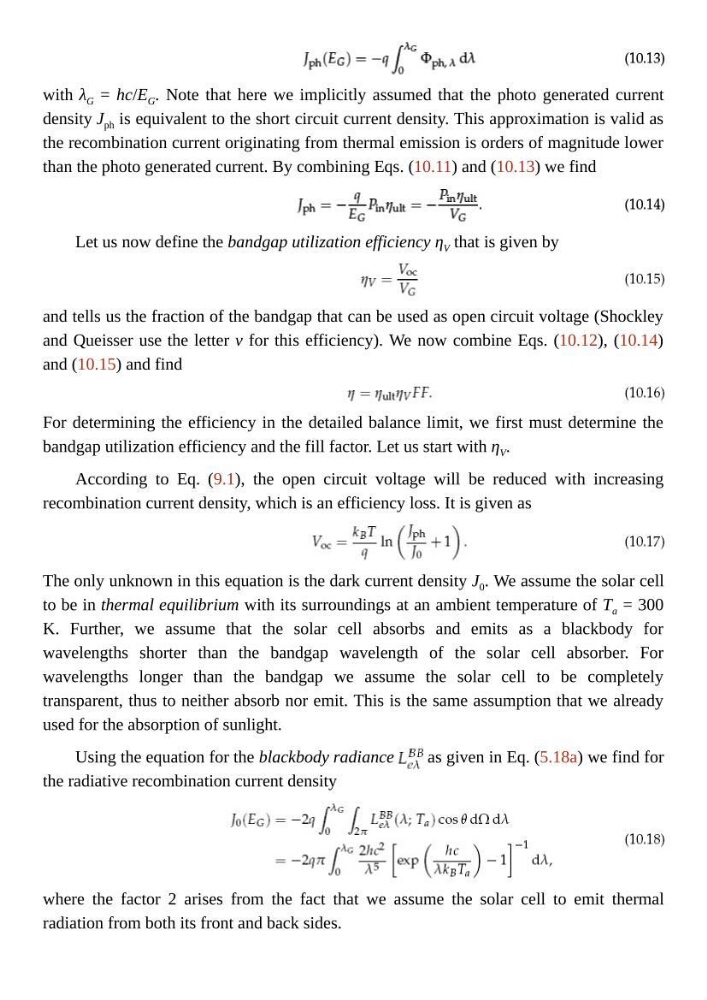
with λ G = hc/E G . Note that here we implicitly assumed that the photo generated current
density J ph is equivalent to the short circuit current density. This approximation is valid as
the recombination current originating from thermal emission is orders of magnitude lower
than the photo generated current. By combining Eqs. (10.11) and (10.13) we find
Let us now define the bandgap utilization efficiency η V that is given by
and tells us the fraction of the bandgap that can be used as open circuit voltage (Shockley
and Queisser use the letter v for this efficiency). We now combine Eqs. (10.12), (10.14)
and (10.15) and find
For determining the efficiency in the detailed balance limit, we first must determine the
bandgap utilization efficiency and the fill factor. Let us start with η V .
According to Eq. (9.1), the open circuit voltage will be reduced with increasing
recombination current density, which is an efficiency loss. It is given as
The only unknown in this equation is the dark current density J 0 . We assume the solar cell
to be in thermal equilibrium with its surroundings at an ambient temperature of T a = 300
K. Further, we assume that the solar cell absorbs and emits as a blackbody for
wavelengths shorter than the bandgap wavelength of the solar cell absorber. For
wavelengths longer than the bandgap we assume the solar cell to be completely
transparent, thus to neither absorb nor emit. This is the same assumption that we already
used for the absorption of sunlight.
Using the equation for the blackbody radiance as given in Eq. (5.18a) we find for
the radiative recombination current density
where the factor 2 arises from the fact that we assume the solar cell to emit thermal
radiation from both its front and back sides.
density J ph is equivalent to the short circuit current density. This approximation is valid as
the recombination current originating from thermal emission is orders of magnitude lower
than the photo generated current. By combining Eqs. (10.11) and (10.13) we find
Let us now define the bandgap utilization efficiency η V that is given by
and tells us the fraction of the bandgap that can be used as open circuit voltage (Shockley
and Queisser use the letter v for this efficiency). We now combine Eqs. (10.12), (10.14)
and (10.15) and find
For determining the efficiency in the detailed balance limit, we first must determine the
bandgap utilization efficiency and the fill factor. Let us start with η V .
According to Eq. (9.1), the open circuit voltage will be reduced with increasing
recombination current density, which is an efficiency loss. It is given as
The only unknown in this equation is the dark current density J 0 . We assume the solar cell
to be in thermal equilibrium with its surroundings at an ambient temperature of T a = 300
K. Further, we assume that the solar cell absorbs and emits as a blackbody for
wavelengths shorter than the bandgap wavelength of the solar cell absorber. For
wavelengths longer than the bandgap we assume the solar cell to be completely
transparent, thus to neither absorb nor emit. This is the same assumption that we already
used for the absorption of sunlight.
Using the equation for the blackbody radiance as given in Eq. (5.18a) we find for
the radiative recombination current density
where the factor 2 arises from the fact that we assume the solar cell to emit thermal
radiation from both its front and back sides.