

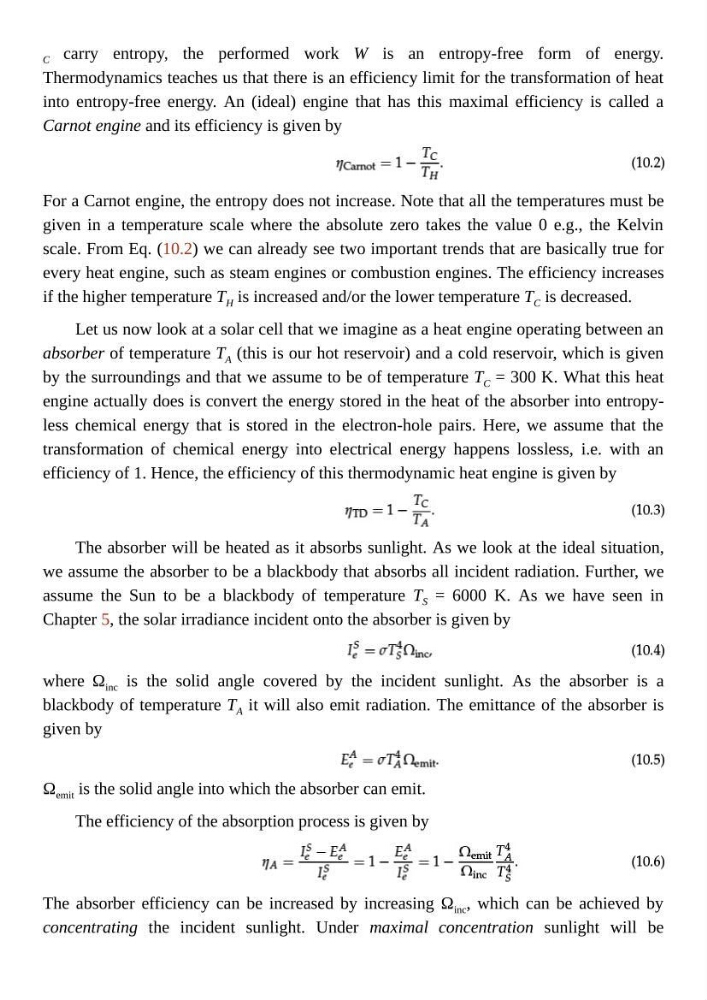
C carry entropy, the performed work W is an entropy-free form of energy.
Thermodynamics teaches us that there is an efficiency limit for the transformation of heat
into entropy-free energy. An (ideal) engine that has this maximal efficiency is called a
Carnot engine and its efficiency is given by
For a Carnot engine, the entropy does not increase. Note that all the temperatures must be
given in a temperature scale where the absolute zero takes the value 0 e.g., the Kelvin
scale. From Eq. (10.2) we can already see two important trends that are basically true for
every heat engine, such as steam engines or combustion engines. The efficiency increases
if the higher temperature T H is increased and/or the lower temperature T C is decreased.
Let us now look at a solar cell that we imagine as a heat engine operating between an
absorber of temperature T A (this is our hot reservoir) and a cold reservoir, which is given
by the surroundings and that we assume to be of temperature T C = 300 K. What this heat
engine actually does is convert the energy stored in the heat of the absorber into entropyless chemical energy that is stored in the electron-hole pairs. Here, we assume that the
transformation of chemical energy into electrical energy happens lossless, i.e. with an
efficiency of 1. Hence, the efficiency of this thermodynamic heat engine is given by
The absorber will be heated as it absorbs sunlight. As we look at the ideal situation,
we assume the absorber to be a blackbody that absorbs all incident radiation. Further, we
assume the Sun to be a blackbody of temperature T S = 6000 K. As we have seen in
Chapter 5, the solar irradiance incident onto the absorber is given by
where Ω inc is the solid angle covered by the incident sunlight. As the absorber is a
blackbody of temperature T A it will also emit radiation. The emittance of the absorber is
given by
Ω emit is the solid angle into which the absorber can emit.
The efficiency of the absorption process is given by
The absorber efficiency can be increased by increasing Ω inc , which can be achieved by
concentrating the incident sunlight. Under maximal concentration sunlight will be
Thermodynamics teaches us that there is an efficiency limit for the transformation of heat
into entropy-free energy. An (ideal) engine that has this maximal efficiency is called a
Carnot engine and its efficiency is given by
For a Carnot engine, the entropy does not increase. Note that all the temperatures must be
given in a temperature scale where the absolute zero takes the value 0 e.g., the Kelvin
scale. From Eq. (10.2) we can already see two important trends that are basically true for
every heat engine, such as steam engines or combustion engines. The efficiency increases
if the higher temperature T H is increased and/or the lower temperature T C is decreased.
Let us now look at a solar cell that we imagine as a heat engine operating between an
absorber of temperature T A (this is our hot reservoir) and a cold reservoir, which is given
by the surroundings and that we assume to be of temperature T C = 300 K. What this heat
engine actually does is convert the energy stored in the heat of the absorber into entropyless chemical energy that is stored in the electron-hole pairs. Here, we assume that the
transformation of chemical energy into electrical energy happens lossless, i.e. with an
efficiency of 1. Hence, the efficiency of this thermodynamic heat engine is given by
The absorber will be heated as it absorbs sunlight. As we look at the ideal situation,
we assume the absorber to be a blackbody that absorbs all incident radiation. Further, we
assume the Sun to be a blackbody of temperature T S = 6000 K. As we have seen in
Chapter 5, the solar irradiance incident onto the absorber is given by
where Ω inc is the solid angle covered by the incident sunlight. As the absorber is a
blackbody of temperature T A it will also emit radiation. The emittance of the absorber is
given by
Ω emit is the solid angle into which the absorber can emit.
The efficiency of the absorption process is given by
The absorber efficiency can be increased by increasing Ω inc , which can be achieved by
concentrating the incident sunlight. Under maximal concentration sunlight will be