

10.2
incident onto the absorber from all angles of the hemisphere, i.e.
. We assume
the absorber to be open towards the surroundings and hence the Sun will be on the top
side. Its bottom side is connected to the heat engine such that radiative loss only can
happen via the top side. Therefore, also Ω emit = 2π. Hence, the maximal absorber
efficiency is achieved under maximal concentration and it is given by
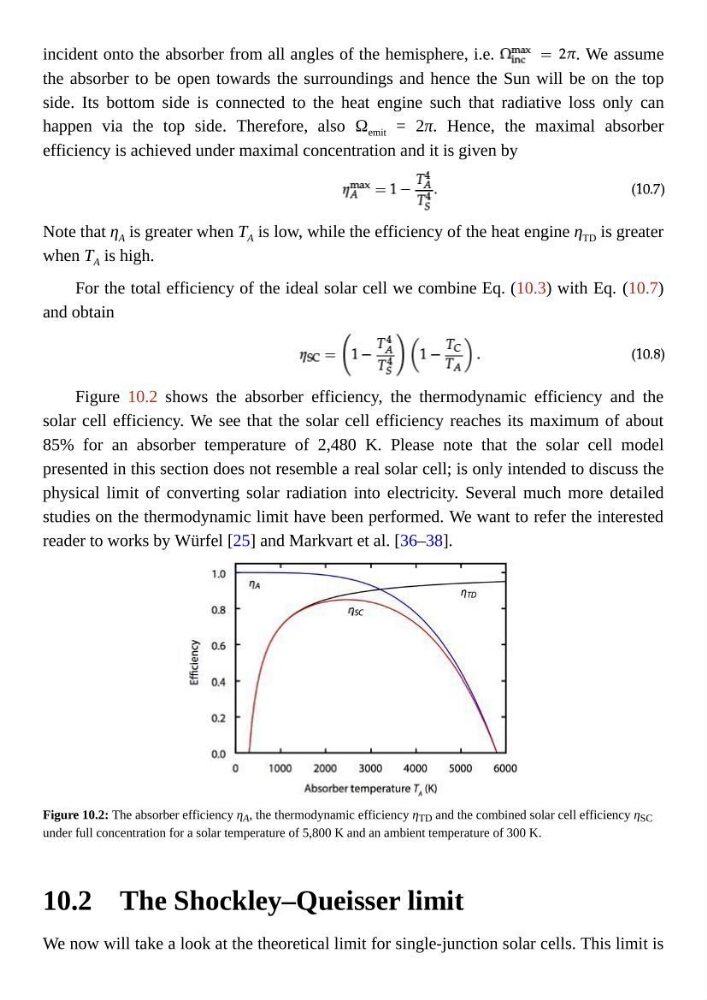
Note that η A is greater when T A is low, while the efficiency of the heat engine η TD is greater
when T A is high.
For the total efficiency of the ideal solar cell we combine Eq. (10.3) with Eq. (10.7)
and obtain
Figure 10.2 shows the absorber efficiency, the thermodynamic efficiency and the
solar cell efficiency. We see that the solar cell efficiency reaches its maximum of about
85% for an absorber temperature of 2,480 K. Please note that the solar cell model
presented in this section does not resemble a real solar cell; is only intended to discuss the
physical limit of converting solar radiation into electricity. Several much more detailed
studies on the thermodynamic limit have been performed. We want to refer the interested
reader to works by Würfel [25] and Markvart et al. [36–38].
Figure 10.2: The absorber efficiency η A , the thermodynamic efficiency η TD and the combined solar cell efficiency η SC
under full concentration for a solar temperature of 5,800 K and an ambient temperature of 300 K.
The Shockley–Queisser limit
We now will take a look at the theoretical limit for single-junction solar cells. This limit is
incident onto the absorber from all angles of the hemisphere, i.e.
. We assume
the absorber to be open towards the surroundings and hence the Sun will be on the top
side. Its bottom side is connected to the heat engine such that radiative loss only can
happen via the top side. Therefore, also Ω emit = 2π. Hence, the maximal absorber
efficiency is achieved under maximal concentration and it is given by
Note that η A is greater when T A is low, while the efficiency of the heat engine η TD is greater
when T A is high.
For the total efficiency of the ideal solar cell we combine Eq. (10.3) with Eq. (10.7)
and obtain
Figure 10.2 shows the absorber efficiency, the thermodynamic efficiency and the
solar cell efficiency. We see that the solar cell efficiency reaches its maximum of about
85% for an absorber temperature of 2,480 K. Please note that the solar cell model
presented in this section does not resemble a real solar cell; is only intended to discuss the
physical limit of converting solar radiation into electricity. Several much more detailed
studies on the thermodynamic limit have been performed. We want to refer the interested
reader to works by Würfel [25] and Markvart et al. [36–38].
Figure 10.2: The absorber efficiency η A , the thermodynamic efficiency η TD and the combined solar cell efficiency η SC
under full concentration for a solar temperature of 5,800 K and an ambient temperature of 300 K.
The Shockley–Queisser limit
We now will take a look at the theoretical limit for single-junction solar cells. This limit is