

10.1
10
Losses and efficiency limits
In the previous chapters we have learned the basic physical principles of solar cells. In this
chapter we will bring the different building blocks together and analyse how efficient a
solar cell can be in theory. After discussing different efficiency limits and the major loss
mechanisms, we will finalise this chapter with the formulation of three design rules that
should always be kept in mind when designing solar cells.
It is very important to understand why a solar cell cannot convert 100% of the
incident light into electricity. Different efficiency limits can be formulated, each taking
different effects into account.
The thermodynamic limit
The most general efficiency limit is the thermodynamic efficiency limit. In this limit, the
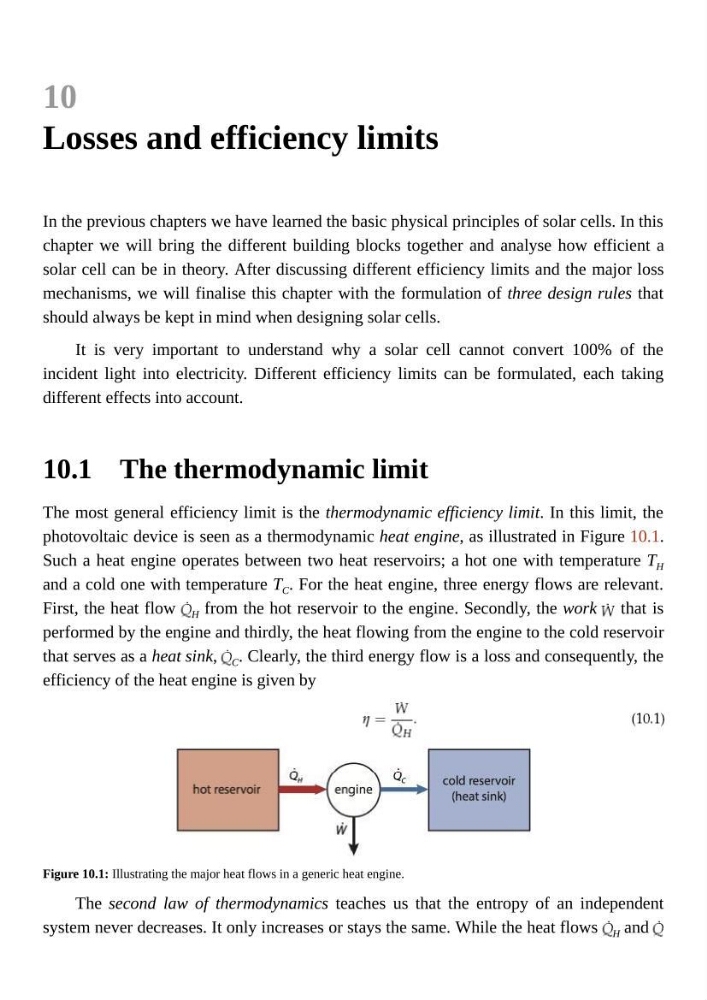
photovoltaic device is seen as a thermodynamic heat engine, as illustrated in Figure 10.1.
Such a heat engine operates between two heat reservoirs; a hot one with temperature T H
and a cold one with temperature T C . For the heat engine, three energy flows are relevant.
First, the heat flow H from the hot reservoir to the engine. Secondly, the work that is
performed by the engine and thirdly, the heat flowing from the engine to the cold reservoir
that serves as a heat sink, C . Clearly, the third energy flow is a loss and consequently, the
efficiency of the heat engine is given by
Figure 10.1: Illustrating the major heat flows in a generic heat engine.
The second law of thermodynamics teaches us that the entropy of an independent
system never decreases. It only increases or stays the same. While the heat flows H and
10
Losses and efficiency limits
In the previous chapters we have learned the basic physical principles of solar cells. In this
chapter we will bring the different building blocks together and analyse how efficient a
solar cell can be in theory. After discussing different efficiency limits and the major loss
mechanisms, we will finalise this chapter with the formulation of three design rules that
should always be kept in mind when designing solar cells.
It is very important to understand why a solar cell cannot convert 100% of the
incident light into electricity. Different efficiency limits can be formulated, each taking
different effects into account.
The thermodynamic limit
The most general efficiency limit is the thermodynamic efficiency limit. In this limit, the
photovoltaic device is seen as a thermodynamic heat engine, as illustrated in Figure 10.1.
Such a heat engine operates between two heat reservoirs; a hot one with temperature T H
and a cold one with temperature T C . For the heat engine, three energy flows are relevant.
First, the heat flow H from the hot reservoir to the engine. Secondly, the work that is
performed by the engine and thirdly, the heat flowing from the engine to the cold reservoir
that serves as a heat sink, C . Clearly, the third energy flow is a loss and consequently, the
efficiency of the heat engine is given by
Figure 10.1: Illustrating the major heat flows in a generic heat engine.
The second law of thermodynamics teaches us that the entropy of an independent
system never decreases. It only increases or stays the same. While the heat flows H and