

iv.
(b)
i.
ii.
iii.
iv.
9.6
(a)
(b)
(c)
(d)
9.7
9.8
(a)
(b)
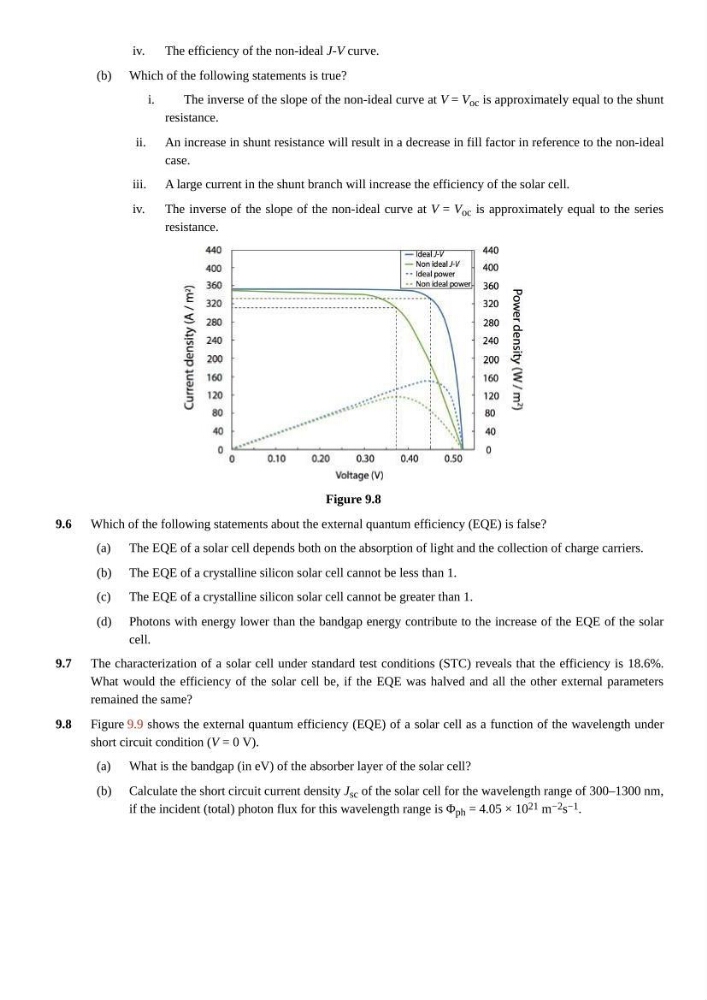
The efficiency of the non-ideal J-V curve.
Which of the following statements is true?
The inverse of the slope of the non-ideal curve at V = V oc is approximately equal to the shunt
resistance.
An increase in shunt resistance will result in a decrease in fill factor in reference to the non-ideal
case.
A large current in the shunt branch will increase the efficiency of the solar cell.
The inverse of the slope of the non-ideal curve at V = V oc is approximately equal to the series
resistance.
Figure 9.8
Which of the following statements about the external quantum efficiency (EQE) is false?
The EQE of a solar cell depends both on the absorption of light and the collection of charge carriers.
The EQE of a crystalline silicon solar cell cannot be less than 1.
The EQE of a crystalline silicon solar cell cannot be greater than 1.
Photons with energy lower than the bandgap energy contribute to the increase of the EQE of the solar
cell.
The characterization of a solar cell under standard test conditions (STC) reveals that the efficiency is 18.6%.
What would the efficiency of the solar cell be, if the EQE was halved and all the other external parameters
remained the same?
Figure 9.9 shows the external quantum efficiency (EQE) of a solar cell as a function of the wavelength under
short circuit condition (V = 0 V).
What is the bandgap (in eV) of the absorber layer of the solar cell?
Calculate the short circuit current density J sc of the solar cell for the wavelength range of 300–1300 nm,
if the incident (total) photon flux for this wavelength range is Φ ph = 4.05 × 10 21 m −2 s −1 .
(b)
i.
ii.
iii.
iv.
9.6
(a)
(b)
(c)
(d)
9.7
9.8
(a)
(b)
The efficiency of the non-ideal J-V curve.
Which of the following statements is true?
The inverse of the slope of the non-ideal curve at V = V oc is approximately equal to the shunt
resistance.
An increase in shunt resistance will result in a decrease in fill factor in reference to the non-ideal
case.
A large current in the shunt branch will increase the efficiency of the solar cell.
The inverse of the slope of the non-ideal curve at V = V oc is approximately equal to the series
resistance.
Figure 9.8
Which of the following statements about the external quantum efficiency (EQE) is false?
The EQE of a solar cell depends both on the absorption of light and the collection of charge carriers.
The EQE of a crystalline silicon solar cell cannot be less than 1.
The EQE of a crystalline silicon solar cell cannot be greater than 1.
Photons with energy lower than the bandgap energy contribute to the increase of the EQE of the solar
cell.
The characterization of a solar cell under standard test conditions (STC) reveals that the efficiency is 18.6%.
What would the efficiency of the solar cell be, if the EQE was halved and all the other external parameters
remained the same?
Figure 9.9 shows the external quantum efficiency (EQE) of a solar cell as a function of the wavelength under
short circuit condition (V = 0 V).
What is the bandgap (in eV) of the absorber layer of the solar cell?
Calculate the short circuit current density J sc of the solar cell for the wavelength range of 300–1300 nm,
if the incident (total) photon flux for this wavelength range is Φ ph = 4.05 × 10 21 m −2 s −1 .