

9.4
9.1
9.2
9.3
9.4
(a)
(b)
(c)
(d)
9.5
(a)
i.
ii.
iii.
Exercises
What is the fill factor of a solar cell having maximum power P max = 1.5 W? The open circuit voltage and the
short circuit current of the cell are V oc = 0.6 V and J sc = 2.8 A, respectively.
Calculate the efficiency of a silicon-based solar cell having short circuit current density of J sc = 42.2 mA/cm 2 ,
open circuit voltage V oc = 706 mV and fill factor FF = 0.828. Remember that the irradiation at standard test
conditions is 100 mW/cm 2 .
A solar cell with dimensions 12 cm × 12 cm is illuminated at standard test conditions. The cell has the
following external parameters: V oc = 0.8 V, I sc = 3 A, V MPP = 0.75 V, I MPP = 2.5 A. Calculate the fill factor and
efficiency of this solar cell.
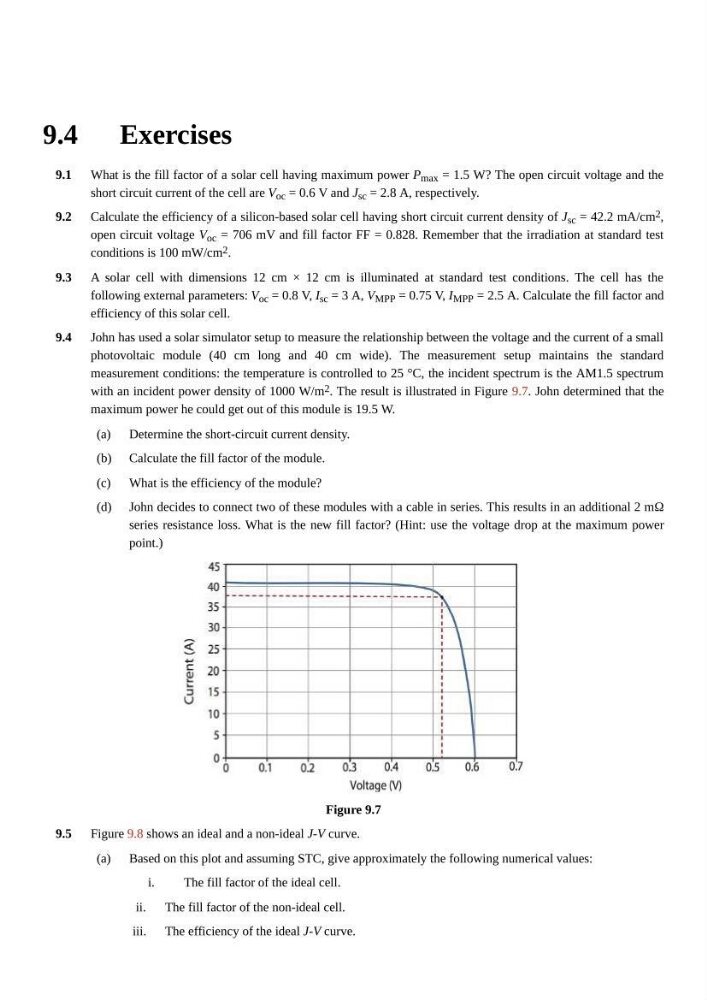
John has used a solar simulator setup to measure the relationship between the voltage and the current of a small
photovoltaic module (40 cm long and 40 cm wide). The measurement setup maintains the standard
measurement conditions: the temperature is controlled to 25 °C, the incident spectrum is the AM1.5 spectrum
with an incident power density of 1000 W/m 2 . The result is illustrated in Figure 9.7. John determined that the
maximum power he could get out of this module is 19.5 W.
Determine the short-circuit current density.
Calculate the fill factor of the module.
What is the efficiency of the module?
John decides to connect two of these modules with a cable in series. This results in an additional 2 mΩ
series resistance loss. What is the new fill factor? (Hint: use the voltage drop at the maximum power
point.)
Figure 9.7
Figure 9.8 shows an ideal and a non-ideal J-V curve.
Based on this plot and assuming STC, give approximately the following numerical values:
The fill factor of the ideal cell.
The fill factor of the non-ideal cell.
The efficiency of the ideal J-V curve.
9.1
9.2
9.3
9.4
(a)
(b)
(c)
(d)
9.5
(a)
i.
ii.
iii.
Exercises
What is the fill factor of a solar cell having maximum power P max = 1.5 W? The open circuit voltage and the
short circuit current of the cell are V oc = 0.6 V and J sc = 2.8 A, respectively.
Calculate the efficiency of a silicon-based solar cell having short circuit current density of J sc = 42.2 mA/cm 2 ,
open circuit voltage V oc = 706 mV and fill factor FF = 0.828. Remember that the irradiation at standard test
conditions is 100 mW/cm 2 .
A solar cell with dimensions 12 cm × 12 cm is illuminated at standard test conditions. The cell has the
following external parameters: V oc = 0.8 V, I sc = 3 A, V MPP = 0.75 V, I MPP = 2.5 A. Calculate the fill factor and
efficiency of this solar cell.
John has used a solar simulator setup to measure the relationship between the voltage and the current of a small
photovoltaic module (40 cm long and 40 cm wide). The measurement setup maintains the standard
measurement conditions: the temperature is controlled to 25 °C, the incident spectrum is the AM1.5 spectrum
with an incident power density of 1000 W/m 2 . The result is illustrated in Figure 9.7. John determined that the
maximum power he could get out of this module is 19.5 W.
Determine the short-circuit current density.
Calculate the fill factor of the module.
What is the efficiency of the module?
John decides to connect two of these modules with a cable in series. This results in an additional 2 mΩ
series resistance loss. What is the new fill factor? (Hint: use the voltage drop at the maximum power
point.)
Figure 9.7
Figure 9.8 shows an ideal and a non-ideal J-V curve.
Based on this plot and assuming STC, give approximately the following numerical values:
The fill factor of the ideal cell.
The fill factor of the non-ideal cell.
The efficiency of the ideal J-V curve.