

Figure 9.5: The equivalent circuit of a solar cell based on the two-diode model.
Operation of a solar cell
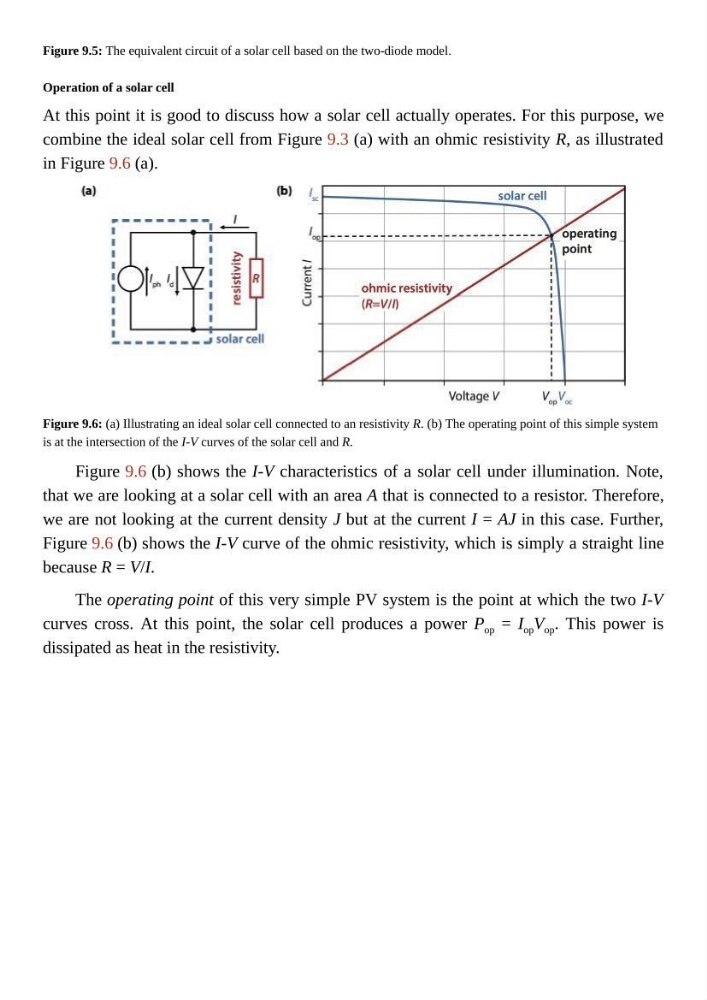
At this point it is good to discuss how a solar cell actually operates. For this purpose, we
combine the ideal solar cell from Figure 9.3 (a) with an ohmic resistivity R, as illustrated
in Figure 9.6 (a).
Figure 9.6: (a) Illustrating an ideal solar cell connected to an resistivity R. (b) The operating point of this simple system
is at the intersection of the I-V curves of the solar cell and R.
Figure 9.6 (b) shows the I-V characteristics of a solar cell under illumination. Note,
that we are looking at a solar cell with an area A that is connected to a resistor. Therefore,
we are not looking at the current density J but at the current I = AJ in this case. Further,
Figure 9.6 (b) shows the I-V curve of the ohmic resistivity, which is simply a straight line
because R = V/I.
The operating point of this very simple PV system is the point at which the two I-V
curves cross. At this point, the solar cell produces a power P op = I op V op . This power is
dissipated as heat in the resistivity.
Operation of a solar cell
At this point it is good to discuss how a solar cell actually operates. For this purpose, we
combine the ideal solar cell from Figure 9.3 (a) with an ohmic resistivity R, as illustrated
in Figure 9.6 (a).
Figure 9.6: (a) Illustrating an ideal solar cell connected to an resistivity R. (b) The operating point of this simple system
is at the intersection of the I-V curves of the solar cell and R.
Figure 9.6 (b) shows the I-V characteristics of a solar cell under illumination. Note,
that we are looking at a solar cell with an area A that is connected to a resistor. Therefore,
we are not looking at the current density J but at the current I = AJ in this case. Further,
Figure 9.6 (b) shows the I-V curve of the ohmic resistivity, which is simply a straight line
because R = V/I.
The operating point of this very simple PV system is the point at which the two I-V
curves cross. At this point, the solar cell produces a power P op = I op V op . This power is
dissipated as heat in the resistivity.