

detector and a current meter are usually required. The light source generally used is a
xenon gas discharge lamp that has a very broad spectrum covering all the wavelengths
important for the solar cell performance. With the help of filters and monochromators a
very narrow wavelength band of photon energies can be selected that can then be incident
on the solar cell.
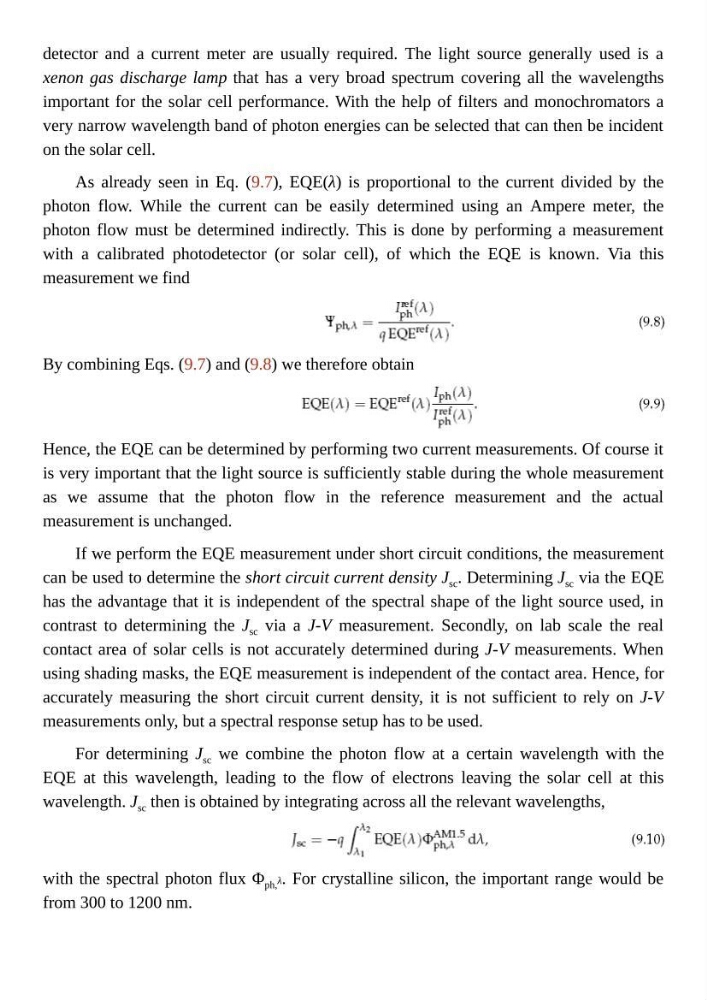
As already seen in Eq. (9.7), EQE(λ) is proportional to the current divided by the
photon flow. While the current can be easily determined using an Ampere meter, the
photon flow must be determined indirectly. This is done by performing a measurement
with a calibrated photodetector (or solar cell), of which the EQE is known. Via this
measurement we find
By combining Eqs. (9.7) and (9.8) we therefore obtain
Hence, the EQE can be determined by performing two current measurements. Of course it
is very important that the light source is sufficiently stable during the whole measurement
as we assume that the photon flow in the reference measurement and the actual
measurement is unchanged.
If we perform the EQE measurement under short circuit conditions, the measurement
can be used to determine the short circuit current density J sc . Determining J sc via the EQE
has the advantage that it is independent of the spectral shape of the light source used, in
contrast to determining the J sc via a J-V measurement. Secondly, on lab scale the real
contact area of solar cells is not accurately determined during J-V measurements. When
using shading masks, the EQE measurement is independent of the contact area. Hence, for
accurately measuring the short circuit current density, it is not sufficient to rely on J-V
measurements only, but a spectral response setup has to be used.
For determining J sc we combine the photon flow at a certain wavelength with the
EQE at this wavelength, leading to the flow of electrons leaving the solar cell at this
wavelength. J sc then is obtained by integrating across all the relevant wavelengths,
with the spectral photon flux Φ ph, λ. For crystalline silicon, the important range would be
from 300 to 1200 nm.
xenon gas discharge lamp that has a very broad spectrum covering all the wavelengths
important for the solar cell performance. With the help of filters and monochromators a
very narrow wavelength band of photon energies can be selected that can then be incident
on the solar cell.
As already seen in Eq. (9.7), EQE(λ) is proportional to the current divided by the
photon flow. While the current can be easily determined using an Ampere meter, the
photon flow must be determined indirectly. This is done by performing a measurement
with a calibrated photodetector (or solar cell), of which the EQE is known. Via this
measurement we find
By combining Eqs. (9.7) and (9.8) we therefore obtain
Hence, the EQE can be determined by performing two current measurements. Of course it
is very important that the light source is sufficiently stable during the whole measurement
as we assume that the photon flow in the reference measurement and the actual
measurement is unchanged.
If we perform the EQE measurement under short circuit conditions, the measurement
can be used to determine the short circuit current density J sc . Determining J sc via the EQE
has the advantage that it is independent of the spectral shape of the light source used, in
contrast to determining the J sc via a J-V measurement. Secondly, on lab scale the real
contact area of solar cells is not accurately determined during J-V measurements. When
using shading masks, the EQE measurement is independent of the contact area. Hence, for
accurately measuring the short circuit current density, it is not sufficient to rely on J-V
measurements only, but a spectral response setup has to be used.
For determining J sc we combine the photon flow at a certain wavelength with the
EQE at this wavelength, leading to the flow of electrons leaving the solar cell at this
wavelength. J sc then is obtained by integrating across all the relevant wavelengths,
with the spectral photon flux Φ ph, λ. For crystalline silicon, the important range would be
from 300 to 1200 nm.