

substrate is very long and surface recombination is virtually suppressed. In this case we
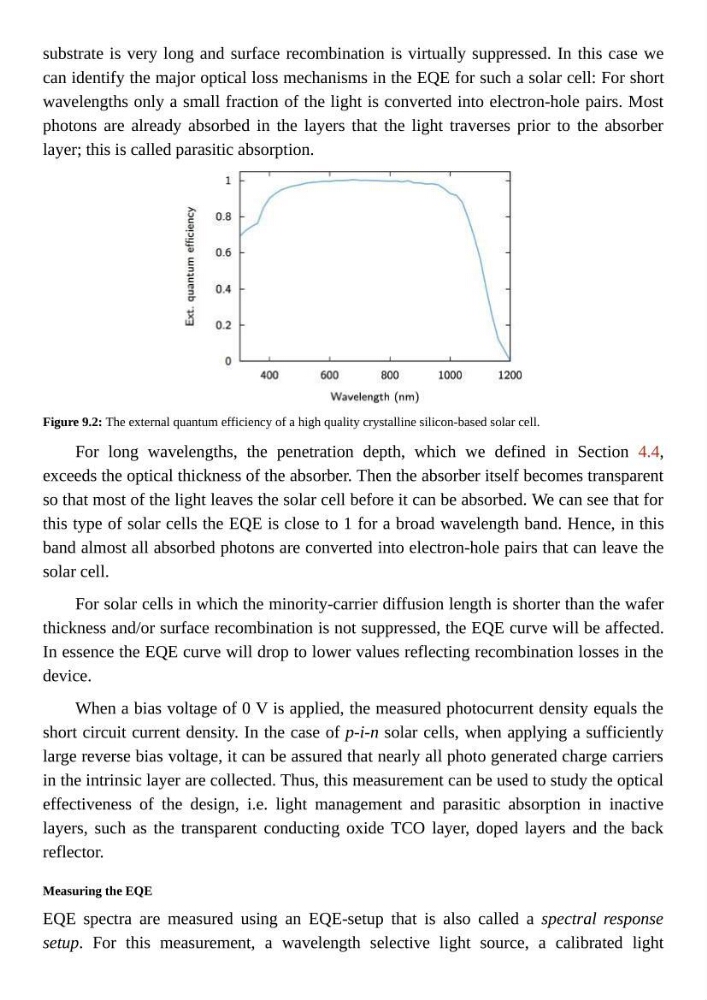
can identify the major optical loss mechanisms in the EQE for such a solar cell: For short
wavelengths only a small fraction of the light is converted into electron-hole pairs. Most
photons are already absorbed in the layers that the light traverses prior to the absorber
layer; this is called parasitic absorption.
Figure 9.2: The external quantum efficiency of a high quality crystalline silicon-based solar cell.
For long wavelengths, the penetration depth, which we defined in Section 4.4,
exceeds the optical thickness of the absorber. Then the absorber itself becomes transparent
so that most of the light leaves the solar cell before it can be absorbed. We can see that for
this type of solar cells the EQE is close to 1 for a broad wavelength band. Hence, in this
band almost all absorbed photons are converted into electron-hole pairs that can leave the
solar cell.
For solar cells in which the minority-carrier diffusion length is shorter than the wafer
thickness and/or surface recombination is not suppressed, the EQE curve will be affected.
In essence the EQE curve will drop to lower values reflecting recombination losses in the
device.
When a bias voltage of 0 V is applied, the measured photocurrent density equals the
short circuit current density. In the case of p-i-n solar cells, when applying a sufficiently
large reverse bias voltage, it can be assured that nearly all photo generated charge carriers
in the intrinsic layer are collected. Thus, this measurement can be used to study the optical
effectiveness of the design, i.e. light management and parasitic absorption in inactive
layers, such as the transparent conducting oxide TCO layer, doped layers and the back
reflector.
Measuring the EQE
EQE spectra are measured using an EQE-setup that is also called a spectral response
setup. For this measurement, a wavelength selective light source, a calibrated light
can identify the major optical loss mechanisms in the EQE for such a solar cell: For short
wavelengths only a small fraction of the light is converted into electron-hole pairs. Most
photons are already absorbed in the layers that the light traverses prior to the absorber
layer; this is called parasitic absorption.
Figure 9.2: The external quantum efficiency of a high quality crystalline silicon-based solar cell.
For long wavelengths, the penetration depth, which we defined in Section 4.4,
exceeds the optical thickness of the absorber. Then the absorber itself becomes transparent
so that most of the light leaves the solar cell before it can be absorbed. We can see that for
this type of solar cells the EQE is close to 1 for a broad wavelength band. Hence, in this
band almost all absorbed photons are converted into electron-hole pairs that can leave the
solar cell.
For solar cells in which the minority-carrier diffusion length is shorter than the wafer
thickness and/or surface recombination is not suppressed, the EQE curve will be affected.
In essence the EQE curve will drop to lower values reflecting recombination losses in the
device.
When a bias voltage of 0 V is applied, the measured photocurrent density equals the
short circuit current density. In the case of p-i-n solar cells, when applying a sufficiently
large reverse bias voltage, it can be assured that nearly all photo generated charge carriers
in the intrinsic layer are collected. Thus, this measurement can be used to study the optical
effectiveness of the design, i.e. light management and parasitic absorption in inactive
layers, such as the transparent conducting oxide TCO layer, doped layers and the back
reflector.
Measuring the EQE
EQE spectra are measured using an EQE-setup that is also called a spectral response
setup. For this measurement, a wavelength selective light source, a calibrated light