

9.2
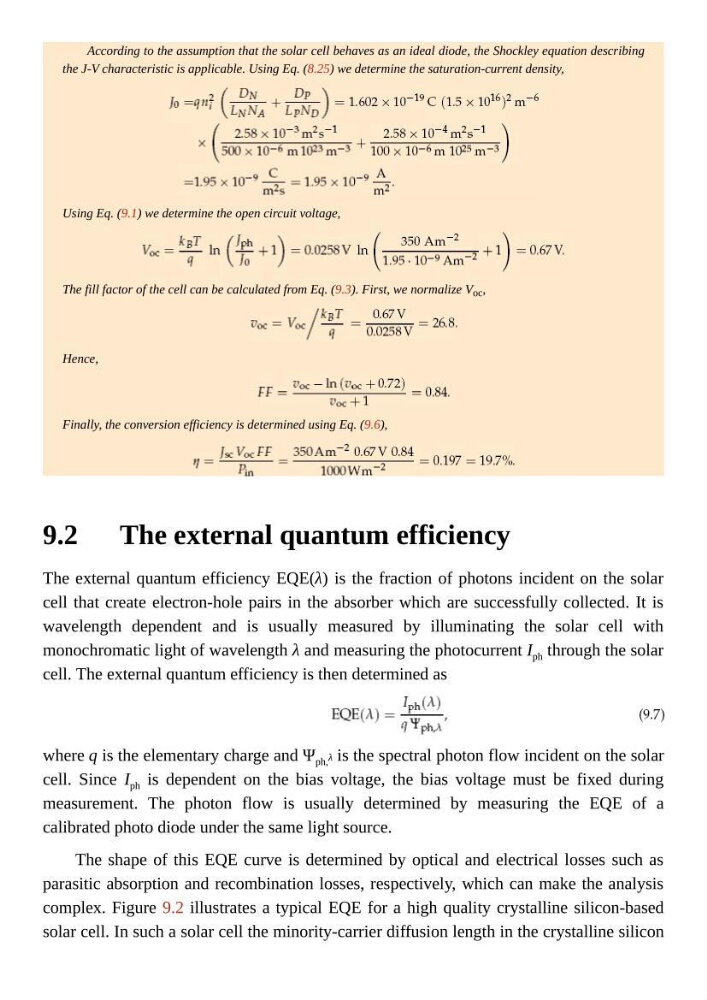
According to the assumption that the solar cell behaves as an ideal diode, the Shockley equation describing
the J-V characteristic is applicable. Using Eq. (8.25) we determine the saturation-current density,
Using Eq. (9.1) we determine the open circuit voltage,
The fill factor of the cell can be calculated from Eq. (9.3). First, we normalize V oc ,
Hence,
Finally, the conversion efficiency is determined using Eq. (9.6),
The external quantum efficiency
The external quantum efficiency EQE(λ) is the fraction of photons incident on the solar
cell that create electron-hole pairs in the absorber which are successfully collected. It is
wavelength dependent and is usually measured by illuminating the solar cell with
monochromatic light of wavelength λ and measuring the photocurrent I ph through the solar
cell. The external quantum efficiency is then determined as
where q is the elementary charge and Ψ ph, λ is the spectral photon flow incident on the solar
cell. Since I ph is dependent on the bias voltage, the bias voltage must be fixed during
measurement. The photon flow is usually determined by measuring the EQE of a
calibrated photo diode under the same light source.
The shape of this EQE curve is determined by optical and electrical losses such as
parasitic absorption and recombination losses, respectively, which can make the analysis
complex. Figure 9.2 illustrates a typical EQE for a high quality crystalline silicon-based
solar cell. In such a solar cell the minority-carrier diffusion length in the crystalline silicon
According to the assumption that the solar cell behaves as an ideal diode, the Shockley equation describing
the J-V characteristic is applicable. Using Eq. (8.25) we determine the saturation-current density,
Using Eq. (9.1) we determine the open circuit voltage,
The fill factor of the cell can be calculated from Eq. (9.3). First, we normalize V oc ,
Hence,
Finally, the conversion efficiency is determined using Eq. (9.6),
The external quantum efficiency
The external quantum efficiency EQE(λ) is the fraction of photons incident on the solar
cell that create electron-hole pairs in the absorber which are successfully collected. It is
wavelength dependent and is usually measured by illuminating the solar cell with
monochromatic light of wavelength λ and measuring the photocurrent I ph through the solar
cell. The external quantum efficiency is then determined as
where q is the elementary charge and Ψ ph, λ is the spectral photon flow incident on the solar
cell. Since I ph is dependent on the bias voltage, the bias voltage must be fixed during
measurement. The photon flow is usually determined by measuring the EQE of a
calibrated photo diode under the same light source.
The shape of this EQE curve is determined by optical and electrical losses such as
parasitic absorption and recombination losses, respectively, which can make the analysis
complex. Figure 9.2 illustrates a typical EQE for a high quality crystalline silicon-based
solar cell. In such a solar cell the minority-carrier diffusion length in the crystalline silicon