

8.3 Metal-semiconductor junctions
Almost all solar cells have metal-semiconductor junctions at the back and in most cases
also at the front. These junctions are very important for connecting the solar cells to the
external electric circuit, which consists of cables that – of course – also use metals as
conducting materials. In this section we will briefly summarize the physics of metalsemiconductor junctions. We roughly follow Sze [31] and will discuss the main concepts
for n-type semiconductors. From these results, the equations that are valid for p-type
semiconductors can easily be derived.
Depending on the material properties of the metal and the semiconductor, we
distinguish between two types of metal-semiconductor junctions: the rectifying type and
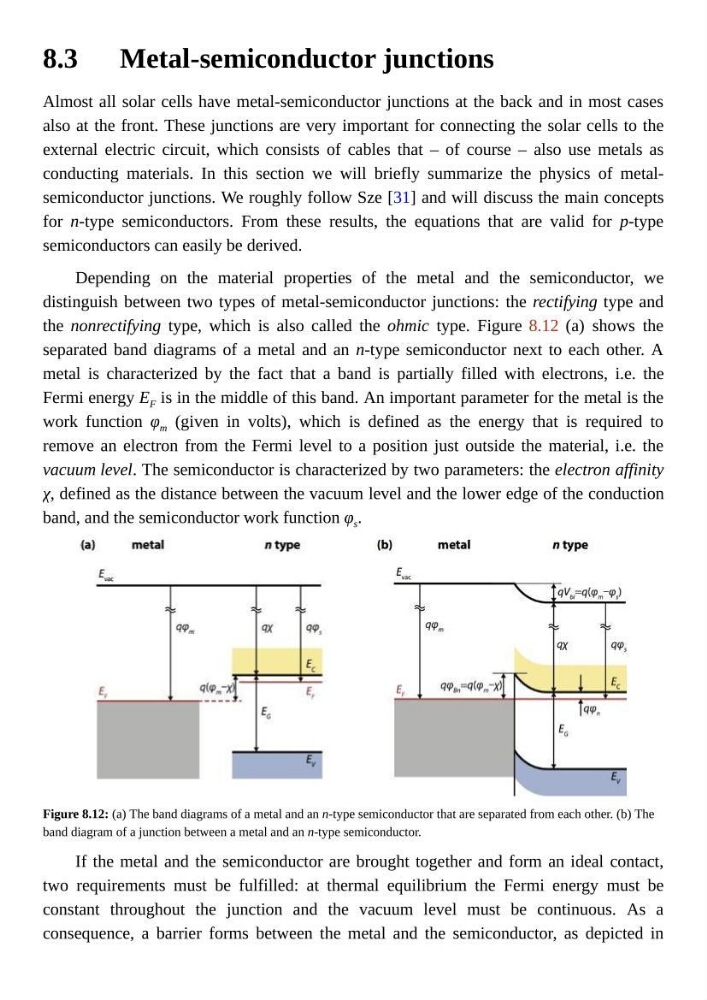
the nonrectifying type, which is also called the ohmic type. Figure 8.12 (a) shows the
separated band diagrams of a metal and an n-type semiconductor next to each other. A
metal is characterized by the fact that a band is partially filled with electrons, i.e. the
Fermi energy E F is in the middle of this band. An important parameter for the metal is the
work function φ m (given in volts), which is defined as the energy that is required to
remove an electron from the Fermi level to a position just outside the material, i.e. the
vacuum level. The semiconductor is characterized by two parameters: the electron affinity
χ, defined as the distance between the vacuum level and the lower edge of the conduction
band, and the semiconductor work function φ s .
Figure 8.12: (a) The band diagrams of a metal and an n-type semiconductor that are separated from each other. (b) The
band diagram of a junction between a metal and an n-type semiconductor.
If the metal and the semiconductor are brought together and form an ideal contact,
two requirements must be fulfilled: at thermal equilibrium the Fermi energy must be
constant throughout the junction and the vacuum level must be continuous. As a
consequence, a barrier forms between the metal and the semiconductor, as depicted in
Almost all solar cells have metal-semiconductor junctions at the back and in most cases
also at the front. These junctions are very important for connecting the solar cells to the
external electric circuit, which consists of cables that – of course – also use metals as
conducting materials. In this section we will briefly summarize the physics of metalsemiconductor junctions. We roughly follow Sze [31] and will discuss the main concepts
for n-type semiconductors. From these results, the equations that are valid for p-type
semiconductors can easily be derived.
Depending on the material properties of the metal and the semiconductor, we
distinguish between two types of metal-semiconductor junctions: the rectifying type and
the nonrectifying type, which is also called the ohmic type. Figure 8.12 (a) shows the
separated band diagrams of a metal and an n-type semiconductor next to each other. A
metal is characterized by the fact that a band is partially filled with electrons, i.e. the
Fermi energy E F is in the middle of this band. An important parameter for the metal is the
work function φ m (given in volts), which is defined as the energy that is required to
remove an electron from the Fermi level to a position just outside the material, i.e. the
vacuum level. The semiconductor is characterized by two parameters: the electron affinity
χ, defined as the distance between the vacuum level and the lower edge of the conduction
band, and the semiconductor work function φ s .
Figure 8.12: (a) The band diagrams of a metal and an n-type semiconductor that are separated from each other. (b) The
band diagram of a junction between a metal and an n-type semiconductor.
If the metal and the semiconductor are brought together and form an ideal contact,
two requirements must be fulfilled: at thermal equilibrium the Fermi energy must be
constant throughout the junction and the vacuum level must be continuous. As a
consequence, a barrier forms between the metal and the semiconductor, as depicted in