

90
Remanufacturing and Advanced Machining
It should be noted that the powder bed fusion technique has also been applied
to part repairing. In comparison with DED, the capability of PBF for remanufacturing is restricted because of smaller build envelopes and limited accessibility of
new material deposition (Zheng et al., 2021). For instance, the material can only be
deposited on a flat surface but not inside a concave structure.
According to Kumar and Sathiya (2021), the AM processes can be categorized
based on the state of the starting material, namely liquid, filament/paste, powder,
and solid sheet:
In the liquid state, such materials as photopolymers, especially acrylate-based
ones, hydrogel, or inert urethane wax can be processed with SLA-based methods,
nonlithography 3D printing, or multi-jet fluid dispensing.
Thermoplastics, ceramics, and polymer integrated with metal particles can be
processed in the form of a filament or paste using FDM machinery.
As powders, metals, ceramics, and polymers can be starting materials for laserbased AM processes, and especially magnetic alloys can be formed with laser engineered net shaping (LENS) methods.
Finally, sheets of metals, ceramics, or thermoplastics can be used in LOM processes to form 3D objects.
An important aspect of metal additive manufacturing (MAM) is hybridization
with material removal processes, the so-called ‘subtractive processes.’ Pragana et al.
(2021) grouped them into two different categories:
1. Utilization of material removal processes at post-processing level, usually
performed in order to obtain higher geometry precision, dimensional tolerances, and surface quality. This category can be considered the simplest,
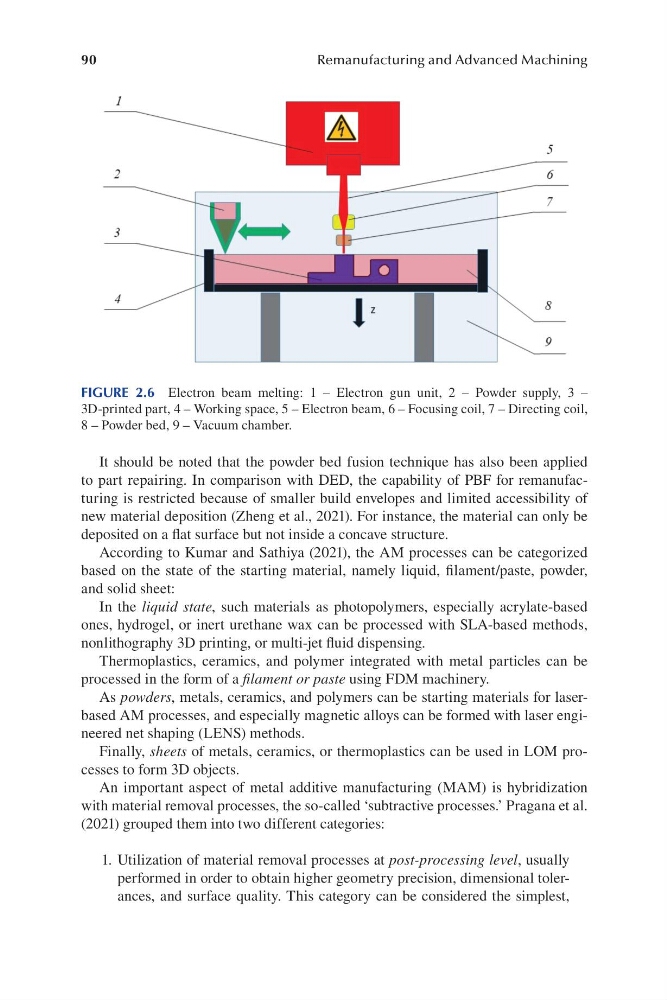
FIGURE 2.6 Electron beam melting: 1 – Electron gun unit, 2 – Powder supply, 3 –
3D-printed part, 4 – Working space, 5 – Electron beam, 6 – Focusing coil, 7 – Directing coil,
8 – Powder bed, 9 – Vacuum chamber.
Remanufacturing and Advanced Machining
It should be noted that the powder bed fusion technique has also been applied
to part repairing. In comparison with DED, the capability of PBF for remanufacturing is restricted because of smaller build envelopes and limited accessibility of
new material deposition (Zheng et al., 2021). For instance, the material can only be
deposited on a flat surface but not inside a concave structure.
According to Kumar and Sathiya (2021), the AM processes can be categorized
based on the state of the starting material, namely liquid, filament/paste, powder,
and solid sheet:
In the liquid state, such materials as photopolymers, especially acrylate-based
ones, hydrogel, or inert urethane wax can be processed with SLA-based methods,
nonlithography 3D printing, or multi-jet fluid dispensing.
Thermoplastics, ceramics, and polymer integrated with metal particles can be
processed in the form of a filament or paste using FDM machinery.
As powders, metals, ceramics, and polymers can be starting materials for laserbased AM processes, and especially magnetic alloys can be formed with laser engineered net shaping (LENS) methods.
Finally, sheets of metals, ceramics, or thermoplastics can be used in LOM processes to form 3D objects.
An important aspect of metal additive manufacturing (MAM) is hybridization
with material removal processes, the so-called ‘subtractive processes.’ Pragana et al.
(2021) grouped them into two different categories:
1. Utilization of material removal processes at post-processing level, usually
performed in order to obtain higher geometry precision, dimensional tolerances, and surface quality. This category can be considered the simplest,
FIGURE 2.6 Electron beam melting: 1 – Electron gun unit, 2 – Powder supply, 3 –
3D-printed part, 4 – Working space, 5 – Electron beam, 6 – Focusing coil, 7 – Directing coil,
8 – Powder bed, 9 – Vacuum chamber.