

89
Protection and Restoration
highly flexible technique which can generate high-quality complex geometry. In this
method, nylon, thermoplastic, or polystyrene may be used, as well as a wide range of
powder materials like polyamide (PA), glass-filled polyamide (PA-GF), and alumide.
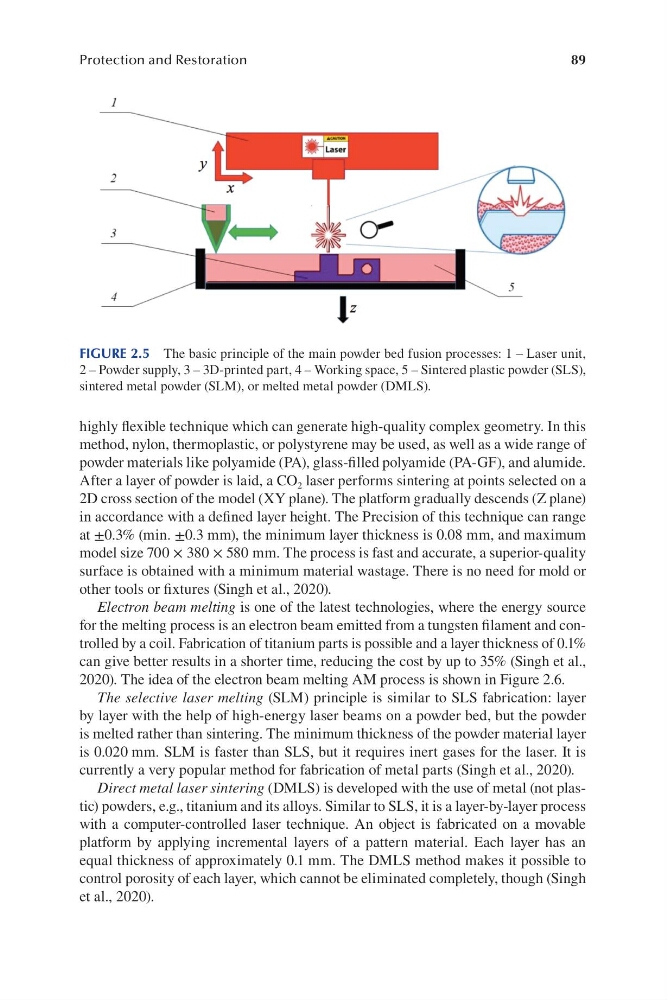
After a layer of powder is laid, a CO 2 laser performs sintering at points selected on a
2D cross section of the model (XY plane). The platform gradually descends (Z plane)
in accordance with a defined layer height. The Precision of this technique can range
at ±0.3% (min. ±0.3 mm), the minimum layer thickness is 0.08 mm, and maximum
model size 700 × 380 × 580 mm. The process is fast and accurate, a superior-quality
surface is obtained with a minimum material wastage. There is no need for mold or
other tools or fixtures (Singh et al., 2020).
Electron beam melting is one of the latest technologies, where the energy source
for the melting process is an electron beam emitted from a tungsten filament and controlled by a coil. Fabrication of titanium parts is possible and a layer thickness of 0.1%
can give better results in a shorter time, reducing the cost by up to 35% (Singh et al.,
2020). The idea of the electron beam melting AM process is shown in Figure 2.6.
The selective laser melting (SLM) principle is similar to SLS fabrication: layer
by layer with the help of high-energy laser beams on a powder bed, but the powder
is melted rather than sintering. The minimum thickness of the powder material layer
is 0.020 mm. SLM is faster than SLS, but it requires inert gases for the laser. It is
currently a very popular method for fabrication of metal parts (Singh et al., 2020).
Direct metal laser sintering (DMLS) is developed with the use of metal (not plastic) powders, e.g., titanium and its alloys. Similar to SLS, it is a layer-by-layer process
with a computer-controlled laser technique. An object is fabricated on a movable
platform by applying incremental layers of a pattern material. Each layer has an
equal thickness of approximately 0.1 mm. The DMLS method makes it possible to
control porosity of each layer, which cannot be eliminated completely, though (Singh
et al., 2020).
FIGURE 2.5 The basic principle of the main powder bed fusion processes: 1 – Laser unit,
2 – Powder supply, 3 – 3D-printed part, 4 – Working space, 5 – Sintered plastic powder (SLS),
sintered metal powder (SLM), or melted metal powder (DMLS).
Protection and Restoration
highly flexible technique which can generate high-quality complex geometry. In this
method, nylon, thermoplastic, or polystyrene may be used, as well as a wide range of
powder materials like polyamide (PA), glass-filled polyamide (PA-GF), and alumide.
After a layer of powder is laid, a CO 2 laser performs sintering at points selected on a
2D cross section of the model (XY plane). The platform gradually descends (Z plane)
in accordance with a defined layer height. The Precision of this technique can range
at ±0.3% (min. ±0.3 mm), the minimum layer thickness is 0.08 mm, and maximum
model size 700 × 380 × 580 mm. The process is fast and accurate, a superior-quality
surface is obtained with a minimum material wastage. There is no need for mold or
other tools or fixtures (Singh et al., 2020).
Electron beam melting is one of the latest technologies, where the energy source
for the melting process is an electron beam emitted from a tungsten filament and controlled by a coil. Fabrication of titanium parts is possible and a layer thickness of 0.1%
can give better results in a shorter time, reducing the cost by up to 35% (Singh et al.,
2020). The idea of the electron beam melting AM process is shown in Figure 2.6.
The selective laser melting (SLM) principle is similar to SLS fabrication: layer
by layer with the help of high-energy laser beams on a powder bed, but the powder
is melted rather than sintering. The minimum thickness of the powder material layer
is 0.020 mm. SLM is faster than SLS, but it requires inert gases for the laser. It is
currently a very popular method for fabrication of metal parts (Singh et al., 2020).
Direct metal laser sintering (DMLS) is developed with the use of metal (not plastic) powders, e.g., titanium and its alloys. Similar to SLS, it is a layer-by-layer process
with a computer-controlled laser technique. An object is fabricated on a movable
platform by applying incremental layers of a pattern material. Each layer has an
equal thickness of approximately 0.1 mm. The DMLS method makes it possible to
control porosity of each layer, which cannot be eliminated completely, though (Singh
et al., 2020).
FIGURE 2.5 The basic principle of the main powder bed fusion processes: 1 – Laser unit,
2 – Powder supply, 3 – 3D-printed part, 4 – Working space, 5 – Sintered plastic powder (SLS),
sintered metal powder (SLM), or melted metal powder (DMLS).