

88
Remanufacturing and Advanced Machining
have a significant advantage over many other AM processes because they do not
require support structures. During the process, overhangs and unconnected islands
are supported by a surrounding unfused powder bed, which allows more complex
geometries to be produced without the need for removal of support structures after
the build. The parts can be stacked freely in the powder bed without supporting
features, increasing the number of parts that can be produced in each build and
thus increasing productivity. Some design limitations are posed by the removal of
unfused powder from trapped volumes and fine channels. Another advantage of
PBF techniques is the wide range of materials that can potentially be processed,
which covers almost any material that can be melted and resolidified (Goodridge
and Ziegelmeier, 2017).
Among all the seven above-mentioned AM techniques, PBF is one of the most
widely applied (Singh et al., 2020). The powder bed fusion process is preferred
because of its low-cost quality and recyclability, which is one of its best qualities. In
particular, powder used in the process can be recycled to produce more parts.
In PBF, a heat source is required to fuse powder. Depending on thermal, electron,
or laser heat sources available, some different types of fusion can be used in the process, including laser fusion, thermal fusion, and electron beam melting. Laser fusion
can be further subdivided into selective laser sintering (SLS), selective laser melting
(SLM), and direct metal laser sintering (DMLS). The SLS process is capable of fusing only plastic parts, whereas SLM and DMLS are suitable for metals (Singh et al.,
2020). The principle of PBF is shown in Figure 2.5.
Selective laser sintering (SLS) is a process of combining a powder material to
form a solid piece by application of heat and pressure (Singh et al., 2020). SLS is a
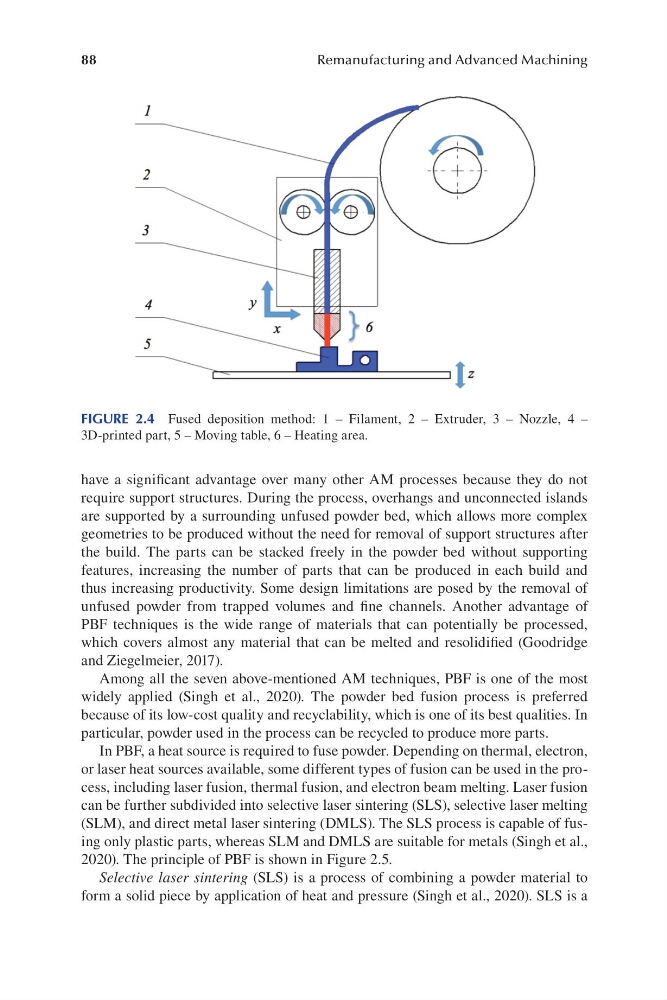
FIGURE 2.4 Fused deposition method: 1 – Filament, 2 – Extruder, 3 – Nozzle, 4 –
3D-printed part, 5 – Moving table, 6 – Heating area.
Remanufacturing and Advanced Machining
have a significant advantage over many other AM processes because they do not
require support structures. During the process, overhangs and unconnected islands
are supported by a surrounding unfused powder bed, which allows more complex
geometries to be produced without the need for removal of support structures after
the build. The parts can be stacked freely in the powder bed without supporting
features, increasing the number of parts that can be produced in each build and
thus increasing productivity. Some design limitations are posed by the removal of
unfused powder from trapped volumes and fine channels. Another advantage of
PBF techniques is the wide range of materials that can potentially be processed,
which covers almost any material that can be melted and resolidified (Goodridge
and Ziegelmeier, 2017).
Among all the seven above-mentioned AM techniques, PBF is one of the most
widely applied (Singh et al., 2020). The powder bed fusion process is preferred
because of its low-cost quality and recyclability, which is one of its best qualities. In
particular, powder used in the process can be recycled to produce more parts.
In PBF, a heat source is required to fuse powder. Depending on thermal, electron,
or laser heat sources available, some different types of fusion can be used in the process, including laser fusion, thermal fusion, and electron beam melting. Laser fusion
can be further subdivided into selective laser sintering (SLS), selective laser melting
(SLM), and direct metal laser sintering (DMLS). The SLS process is capable of fusing only plastic parts, whereas SLM and DMLS are suitable for metals (Singh et al.,
2020). The principle of PBF is shown in Figure 2.5.
Selective laser sintering (SLS) is a process of combining a powder material to
form a solid piece by application of heat and pressure (Singh et al., 2020). SLS is a
FIGURE 2.4 Fused deposition method: 1 – Filament, 2 – Extruder, 3 – Nozzle, 4 –
3D-printed part, 5 – Moving table, 6 – Heating area.