

91
Protection and Restoration
but nevertheless very important in lowering overall material and energy
consumption. This category of methods is recognized in the case of processing as expensive and difficult-to-work materials such as titanium or
nickel-based super alloys as a successful way to reduce the buy-to-fly, which
is the ratio of the initial workpiece mass to the mass of a finished part.
Hybridization of metal additive manufacturing with subtractive processes
at post-processing level is very effective at lowering overall manufacturing
cost and material waste.
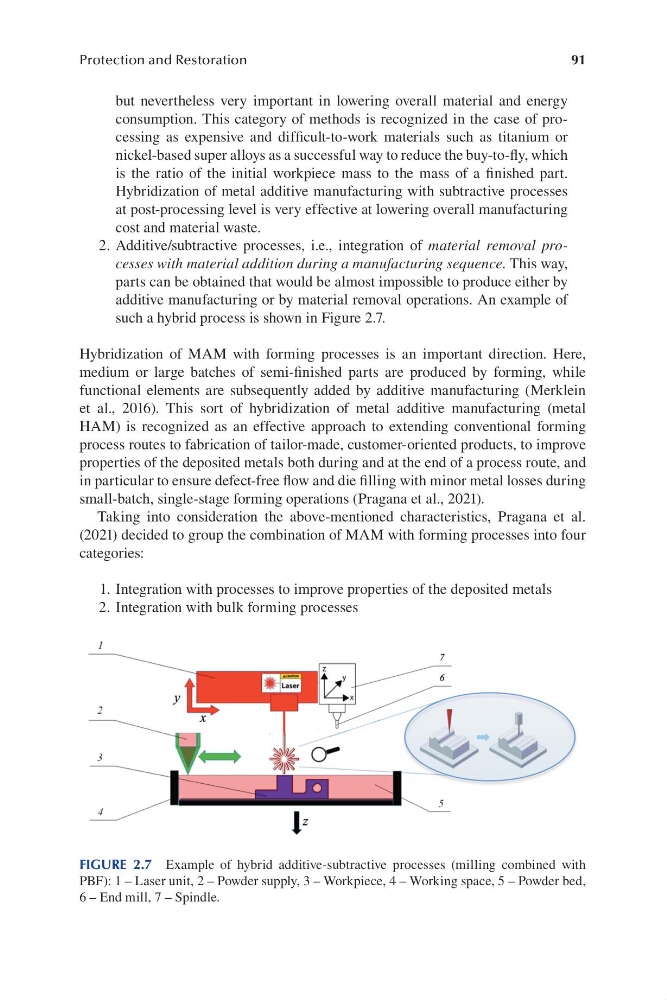
2. Additive/subtractive processes, i.e., integration of material removal processes with material addition during a manufacturing sequence. This way,
parts can be obtained that would be almost impossible to produce either by
additive manufacturing or by material removal operations. An example of
such a hybrid process is shown in Figure 2.7.
Hybridization of MAM with forming processes is an important direction. Here,
medium or large batches of semi-finished parts are produced by forming, while
functional elements are subsequently added by additive manufacturing (Merklein
et al., 2016). This sort of hybridization of metal additive manufacturing (metal
HAM) is recognized as an effective approach to extending conventional forming
process routes to fabrication of tailor-made, customer-oriented products, to improve
properties of the deposited metals both during and at the end of a process route, and
in particular to ensure defect-free flow and die filling with minor metal losses during
small-batch, single-stage forming operations (Pragana et al., 2021).
Taking into consideration the above-mentioned characteristics, Pragana et al.
(2021) decided to group the combination of MAM with forming processes into four
categories:
1. Integration with processes to improve properties of the deposited metals
2. Integration with bulk forming processes
FIGURE 2.7 Example of hybrid additive-subtractive processes (milling combined with
PBF): 1 – Laser unit, 2 – Powder supply, 3 – Workpiece, 4 – Working space, 5 – Powder bed,
6 – End mill, 7 – Spindle.
Protection and Restoration
but nevertheless very important in lowering overall material and energy
consumption. This category of methods is recognized in the case of processing as expensive and difficult-to-work materials such as titanium or
nickel-based super alloys as a successful way to reduce the buy-to-fly, which
is the ratio of the initial workpiece mass to the mass of a finished part.
Hybridization of metal additive manufacturing with subtractive processes
at post-processing level is very effective at lowering overall manufacturing
cost and material waste.
2. Additive/subtractive processes, i.e., integration of material removal processes with material addition during a manufacturing sequence. This way,
parts can be obtained that would be almost impossible to produce either by
additive manufacturing or by material removal operations. An example of
such a hybrid process is shown in Figure 2.7.
Hybridization of MAM with forming processes is an important direction. Here,
medium or large batches of semi-finished parts are produced by forming, while
functional elements are subsequently added by additive manufacturing (Merklein
et al., 2016). This sort of hybridization of metal additive manufacturing (metal
HAM) is recognized as an effective approach to extending conventional forming
process routes to fabrication of tailor-made, customer-oriented products, to improve
properties of the deposited metals both during and at the end of a process route, and
in particular to ensure defect-free flow and die filling with minor metal losses during
small-batch, single-stage forming operations (Pragana et al., 2021).
Taking into consideration the above-mentioned characteristics, Pragana et al.
(2021) decided to group the combination of MAM with forming processes into four
categories:
1. Integration with processes to improve properties of the deposited metals
2. Integration with bulk forming processes
FIGURE 2.7 Example of hybrid additive-subtractive processes (milling combined with
PBF): 1 – Laser unit, 2 – Powder supply, 3 – Workpiece, 4 – Working space, 5 – Powder bed,
6 – End mill, 7 – Spindle.