

Chapitre I. L’intégrale de Riemann-Stieltjes
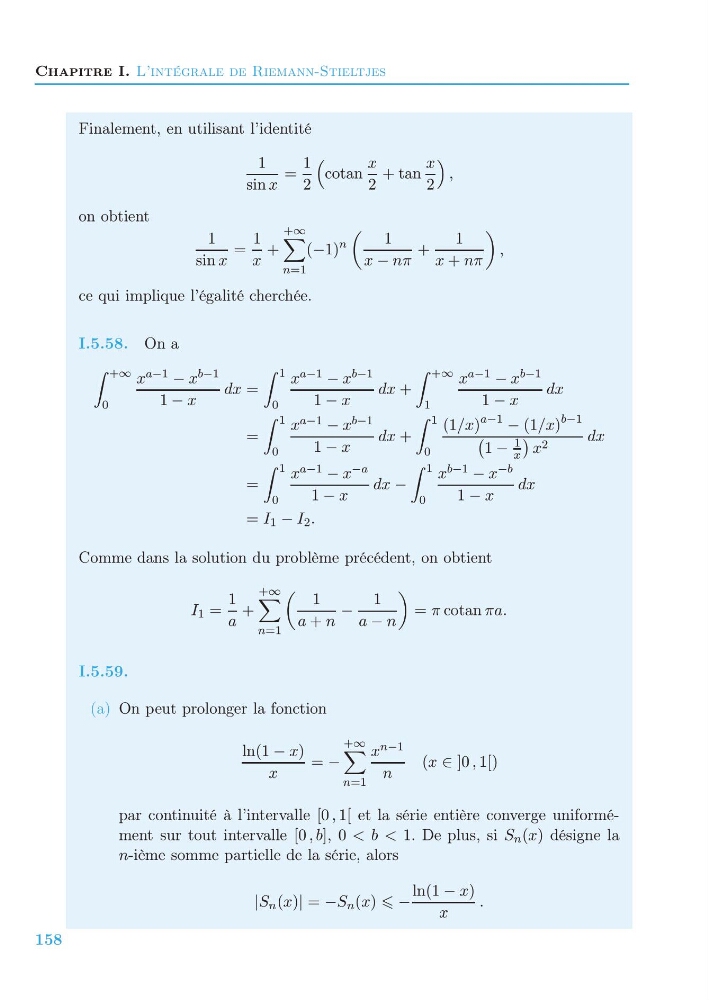
Finalement, en utilisant l’identité
1
sin x
=
1
2
cotan
x
2
+ tan
x
2
,
on obtient
1
sin x
=
1
x
+
+∞
n=1
(−1)
n
1
x − nπ
+
1
x + nπ
,
ce qui implique l’égalité cherchée.
I.5.58. On a
+∞
0
x a−1 − x b−1
1 − x
dx =
1
0
x a−1 − x b−1
1 − x
dx +
+∞
1
x a−1 − x b−1
1 − x
dx
=
1
0
x a−1 − x b−1
1 − x
dx +
1
0
(1/x)
a−1
− (1/x)
b−1
1 −
1
x
x 2
dx
=
1
0
x a−1 − x −a
1 − x
dx −
1
0
x b−1 − x −b
1 − x
dx
= I 1 − I 2 .
Comme dans la solution du problème précédent, on obtient
I 1 =
1
a
+
+∞
n=1
1
a + n
−
1
a − n
= π cotan πa.
I.5.59.
(a) On peut prolonger la fonction
ln(1 − x)
x
= −
+∞
n=1
x n−1
n
(x ∈ ]0 , 1[)
par continuité à l’intervalle [0 , 1[ et la série entière converge uniformément sur tout intervalle [0 , b], 0 < b < 1. De plus, si S n (x) désigne la
n-ième somme partielle de la série, alors
|S n (x)| = −S n (x) −
ln(1 − x)
x
.
158
Finalement, en utilisant l’identité
1
sin x
=
1
2
cotan
x
2
+ tan
x
2
,
on obtient
1
sin x
=
1
x
+
+∞
n=1
(−1)
n
1
x − nπ
+
1
x + nπ
,
ce qui implique l’égalité cherchée.
I.5.58. On a
+∞
0
x a−1 − x b−1
1 − x
dx =
1
0
x a−1 − x b−1
1 − x
dx +
+∞
1
x a−1 − x b−1
1 − x
dx
=
1
0
x a−1 − x b−1
1 − x
dx +
1
0
(1/x)
a−1
− (1/x)
b−1
1 −
1
x
x 2
dx
=
1
0
x a−1 − x −a
1 − x
dx −
1
0
x b−1 − x −b
1 − x
dx
= I 1 − I 2 .
Comme dans la solution du problème précédent, on obtient
I 1 =
1
a
+
+∞
n=1
1
a + n
−
1
a − n
= π cotan πa.
I.5.59.
(a) On peut prolonger la fonction
ln(1 − x)
x
= −
+∞
n=1
x n−1
n
(x ∈ ]0 , 1[)
par continuité à l’intervalle [0 , 1[ et la série entière converge uniformément sur tout intervalle [0 , b], 0 < b < 1. De plus, si S n (x) désigne la
n-ième somme partielle de la série, alors
|S n (x)| = −S n (x) −
ln(1 − x)
x
.
158