

56
eutectic solvents were assessed using the same protocol (Mbous et al. 2017).
However, the results of this in vivo study are difficult to interpret because they are
quoted in g/mL. The natural deep eutectic solvents were found to be less toxic than
other deep eutectic solvents, despite the high viscosity of some natural deep eutectic solvents.
The safety of deep eutectic solvents for use in the extraction of phenolic compounds was considered by Benlebna et al. focusing on their possible effects after
ingestion. They studied the toxicity of a green coffee bean extract in deep eutectic
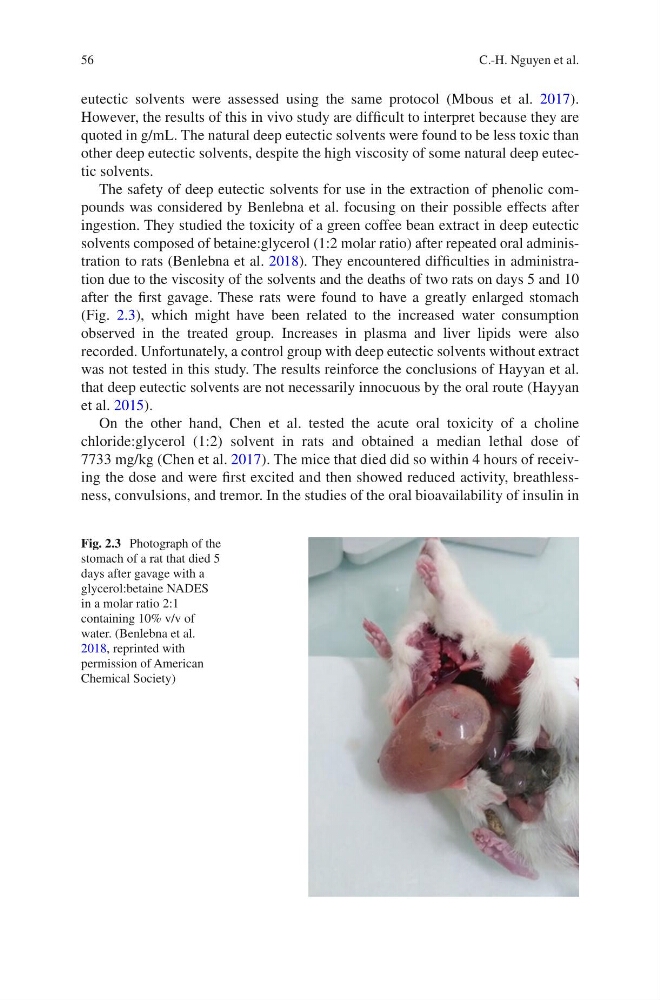
solvents composed of betaine:glycerol (1:2 molar ratio) after repeated oral administration to rats (Benlebna et al. 2018). They encountered difficulties in administration due to the viscosity of the solvents and the deaths of two rats on days 5 and 10
after the first gavage. These rats were found to have a greatly enlarged stomach
(Fig. 2.3), which might have been related to the increased water consumption
observed in the treated group. Increases in plasma and liver lipids were also
recorded. Unfortunately, a control group with deep eutectic solvents without extract
was not tested in this study. The results reinforce the conclusions of Hayyan et al.
that deep eutectic solvents are not necessarily innocuous by the oral route (Hayyan
et al. 2015).
On the other hand, Chen et al. tested the acute oral toxicity of a choline
chloride:glycerol (1:2) solvent in rats and obtained a median lethal dose of
7733 mg/kg (Chen et al. 2017). The mice that died did so within 4 hours of receiving the dose and were first excited and then showed reduced activity, breathlessness, convulsions, and tremor. In the studies of the oral bioavailability of insulin in
Fig. 2.3 Photograph of the
stomach of a rat that died 5
days after gavage with a
glycerol:betaine NADES
in a molar ratio 2:1
containing 10% v/v of
water. (Benlebna et al.
2018, reprinted with
permission of American
Chemical Society)
C.-H. Nguyen et al.
eutectic solvents were assessed using the same protocol (Mbous et al. 2017).
However, the results of this in vivo study are difficult to interpret because they are
quoted in g/mL. The natural deep eutectic solvents were found to be less toxic than
other deep eutectic solvents, despite the high viscosity of some natural deep eutectic solvents.
The safety of deep eutectic solvents for use in the extraction of phenolic compounds was considered by Benlebna et al. focusing on their possible effects after
ingestion. They studied the toxicity of a green coffee bean extract in deep eutectic
solvents composed of betaine:glycerol (1:2 molar ratio) after repeated oral administration to rats (Benlebna et al. 2018). They encountered difficulties in administration due to the viscosity of the solvents and the deaths of two rats on days 5 and 10
after the first gavage. These rats were found to have a greatly enlarged stomach
(Fig. 2.3), which might have been related to the increased water consumption
observed in the treated group. Increases in plasma and liver lipids were also
recorded. Unfortunately, a control group with deep eutectic solvents without extract
was not tested in this study. The results reinforce the conclusions of Hayyan et al.
that deep eutectic solvents are not necessarily innocuous by the oral route (Hayyan
et al. 2015).
On the other hand, Chen et al. tested the acute oral toxicity of a choline
chloride:glycerol (1:2) solvent in rats and obtained a median lethal dose of
7733 mg/kg (Chen et al. 2017). The mice that died did so within 4 hours of receiving the dose and were first excited and then showed reduced activity, breathlessness, convulsions, and tremor. In the studies of the oral bioavailability of insulin in
Fig. 2.3 Photograph of the
stomach of a rat that died 5
days after gavage with a
glycerol:betaine NADES
in a molar ratio 2:1
containing 10% v/v of
water. (Benlebna et al.
2018, reprinted with
permission of American
Chemical Society)
C.-H. Nguyen et al.