

57
the “CAGE” formulation of choline and geranic acid, no toxic effects and no histological changes in the intestines of the treated rats were observed (Banerjee et al.
2018a). With the ability of the “CAGE” formulation to reduce obesity, daily oral
administration to rats for 30 days was well tolerated (Nurunnabi et al. 2019). Blood
parameters and biomarkers of toxicity were unchanged compared with controls,
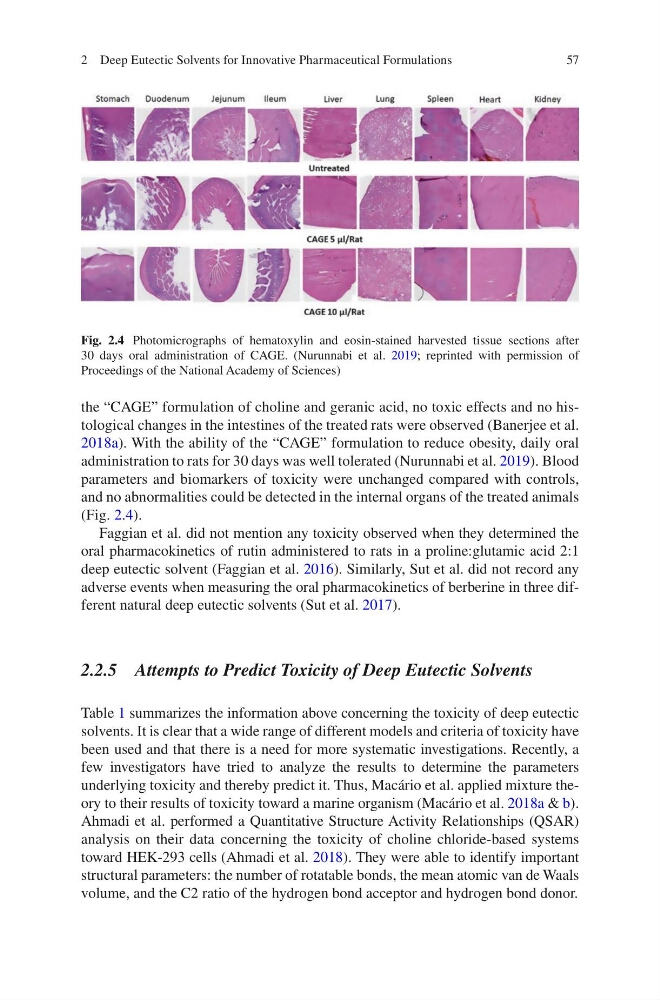
and no abnormalities could be detected in the internal organs of the treated animals
(Fig. 2.4).
Faggian et al. did not mention any toxicity observed when they determined the
oral pharmacokinetics of rutin administered to rats in a proline:glutamic acid 2:1
deep eutectic solvent (Faggian et al. 2016). Similarly, Sut et al. did not record any
adverse events when measuring the oral pharmacokinetics of berberine in three different natural deep eutectic solvents (Sut et al. 2017).
2.2.5 Attempts to Predict Toxicity of Deep Eutectic Solvents
Table 1 summarizes the information above concerning the toxicity of deep eutectic
solvents. It is clear that a wide range of different models and criteria of toxicity have
been used and that there is a need for more systematic investigations. Recently, a
few investigators have tried to analyze the results to determine the parameters
underlying toxicity and thereby predict it. Thus, Macário et al. applied mixture theory to their results of toxicity toward a marine organism (Macário et al. 2018a & b).
Ahmadi et al. performed a Quantitative Structure Activity Relationships (QSAR)
analysis on their data concerning the toxicity of choline chloride-based systems
toward HEK-293 cells (Ahmadi et al. 2018). They were able to identify important
structural parameters: the number of rotatable bonds, the mean atomic van de Waals
volume, and the C2 ratio of the hydrogen bond acceptor and hydrogen bond donor.
Fig. 2.4 Photomicrographs of hematoxylin and eosin-stained harvested tissue sections after
30 days oral administration of CAGE. (Nurunnabi et al. 2019; reprinted with permission of
Proceedings of the National Academy of Sciences)
2 Deep Eutectic Solvents for Innovative Pharmaceutical Formulations
the “CAGE” formulation of choline and geranic acid, no toxic effects and no histological changes in the intestines of the treated rats were observed (Banerjee et al.
2018a). With the ability of the “CAGE” formulation to reduce obesity, daily oral
administration to rats for 30 days was well tolerated (Nurunnabi et al. 2019). Blood
parameters and biomarkers of toxicity were unchanged compared with controls,
and no abnormalities could be detected in the internal organs of the treated animals
(Fig. 2.4).
Faggian et al. did not mention any toxicity observed when they determined the
oral pharmacokinetics of rutin administered to rats in a proline:glutamic acid 2:1
deep eutectic solvent (Faggian et al. 2016). Similarly, Sut et al. did not record any
adverse events when measuring the oral pharmacokinetics of berberine in three different natural deep eutectic solvents (Sut et al. 2017).
2.2.5 Attempts to Predict Toxicity of Deep Eutectic Solvents
Table 1 summarizes the information above concerning the toxicity of deep eutectic
solvents. It is clear that a wide range of different models and criteria of toxicity have
been used and that there is a need for more systematic investigations. Recently, a
few investigators have tried to analyze the results to determine the parameters
underlying toxicity and thereby predict it. Thus, Macário et al. applied mixture theory to their results of toxicity toward a marine organism (Macário et al. 2018a & b).
Ahmadi et al. performed a Quantitative Structure Activity Relationships (QSAR)
analysis on their data concerning the toxicity of choline chloride-based systems
toward HEK-293 cells (Ahmadi et al. 2018). They were able to identify important
structural parameters: the number of rotatable bonds, the mean atomic van de Waals
volume, and the C2 ratio of the hydrogen bond acceptor and hydrogen bond donor.
Fig. 2.4 Photomicrographs of hematoxylin and eosin-stained harvested tissue sections after
30 days oral administration of CAGE. (Nurunnabi et al. 2019; reprinted with permission of
Proceedings of the National Academy of Sciences)
2 Deep Eutectic Solvents for Innovative Pharmaceutical Formulations