

48
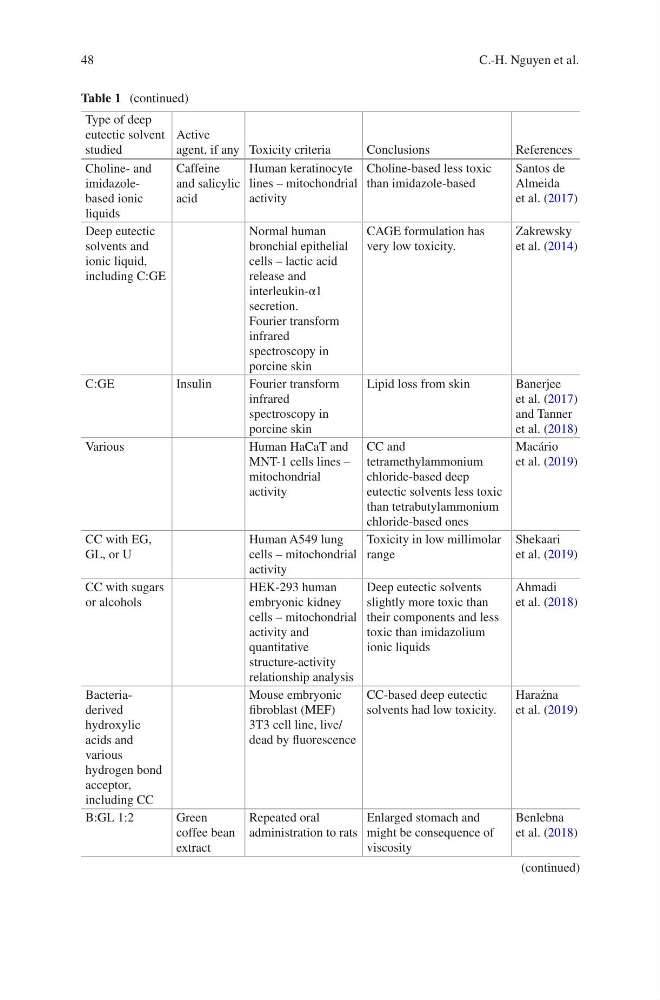
Table 1 (continued)
Type of deep
eutectic solvent
studied
Active
agent, if any Toxicity criteria
Conclusions
References
Choline- and
imidazolebased ionic
liquids
Caffeine
and salicylic
acid
Human keratinocyte
lines – mitochondrial
activity
Choline-based less toxic
than imidazole-based
Santos de
Almeida
et al. (2017)
Deep eutectic
solvents and
ionic liquid,
including C:GE
Normal human
bronchial epithelial
cells – lactic acid
release and
interleukin-α1
secretion.
Fourier transform
infrared
spectroscopy in
porcine skin
CAGE formulation has
very low toxicity.
Zakrewsky
et al. (2014)
C:GE
Insulin
Fourier transform
infrared
spectroscopy in
porcine skin
Lipid loss from skin
Banerjee
et al. (2017)
and Tanner
et al. (2018)
Various
Human HaCaT and
MNT-1 cells lines –
mitochondrial
activity
CC and
tetramethylammonium
chloride-based deep
eutectic solvents less toxic
than tetrabutylammonium
chloride-based ones
Macário
et al. (2019)
CC with EG,
GL, or U
Human A549 lung
cells – mitochondrial
activity
Toxicity in low millimolar
range
Shekaari
et al. (2019)
CC with sugars
or alcohols
HEK-293 human
embryonic kidney
cells – mitochondrial
activity and
quantitative
structure-activity
relationship analysis
Deep eutectic solvents
slightly more toxic than
their components and less
toxic than imidazolium
ionic liquids
Ahmadi
et al. (2018)
Bacteriaderived
hydroxylic
acids and
various
hydrogen bond
acceptor,
including CC
Mouse embryonic
fibroblast (MEF)
3T3 cell line, live/
dead by fluorescence
CC-based deep eutectic
solvents had low toxicity.
Haraźna
et al. (2019)
B:GL 1:2
Green
coffee bean
extract
Repeated oral
administration to rats
Enlarged stomach and
might be consequence of
viscosity
Benlebna
et al. (2018)
(continued)
C.-H. Nguyen et al.
Table 1 (continued)
Type of deep
eutectic solvent
studied
Active
agent, if any Toxicity criteria
Conclusions
References
Choline- and
imidazolebased ionic
liquids
Caffeine
and salicylic
acid
Human keratinocyte
lines – mitochondrial
activity
Choline-based less toxic
than imidazole-based
Santos de
Almeida
et al. (2017)
Deep eutectic
solvents and
ionic liquid,
including C:GE
Normal human
bronchial epithelial
cells – lactic acid
release and
interleukin-α1
secretion.
Fourier transform
infrared
spectroscopy in
porcine skin
CAGE formulation has
very low toxicity.
Zakrewsky
et al. (2014)
C:GE
Insulin
Fourier transform
infrared
spectroscopy in
porcine skin
Lipid loss from skin
Banerjee
et al. (2017)
and Tanner
et al. (2018)
Various
Human HaCaT and
MNT-1 cells lines –
mitochondrial
activity
CC and
tetramethylammonium
chloride-based deep
eutectic solvents less toxic
than tetrabutylammonium
chloride-based ones
Macário
et al. (2019)
CC with EG,
GL, or U
Human A549 lung
cells – mitochondrial
activity
Toxicity in low millimolar
range
Shekaari
et al. (2019)
CC with sugars
or alcohols
HEK-293 human
embryonic kidney
cells – mitochondrial
activity and
quantitative
structure-activity
relationship analysis
Deep eutectic solvents
slightly more toxic than
their components and less
toxic than imidazolium
ionic liquids
Ahmadi
et al. (2018)
Bacteriaderived
hydroxylic
acids and
various
hydrogen bond
acceptor,
including CC
Mouse embryonic
fibroblast (MEF)
3T3 cell line, live/
dead by fluorescence
CC-based deep eutectic
solvents had low toxicity.
Haraźna
et al. (2019)
B:GL 1:2
Green
coffee bean
extract
Repeated oral
administration to rats
Enlarged stomach and
might be consequence of
viscosity
Benlebna
et al. (2018)
(continued)
C.-H. Nguyen et al.