

49
the individual components. As far as biodegradability was concerned, only the choline chloride:urea and choline chloride:acetamide deep eutectic solvents could be
considered as fully biodegradable in their system (Wen et al. 2015).
In a study carried out by Radošević et al. (Radošević et al. 2018), the toxicity of
natural deep eutectic solvents toward several strains of bacteria (Escherichia coli,
Proteus mirabilis, Salmonella typhimurium, Pseudomonas aeruginosa,
Staphylococcus aureus) as well as the fungal species Candida albicans was tested.
They observed toxicity for compositions containing organic acids but that the solvents possessed antioxidative activity.
More recently, Macário et al. approached the question of the ecotoxicology of
deep eutectic solvents using mixture theory in an attempt to predict their toxicity as
a function of their components (Macário et al. 2018a & b). Toxicity was assessed
using the inhibition of bioluminescence produced by the marine bacterium Aliivibrio
fischeri. In one study, tetramethylammonium chloride, tetraethylammonium chloride, and tetrapropylammonium chloride where used as hydrogen bond acceptors
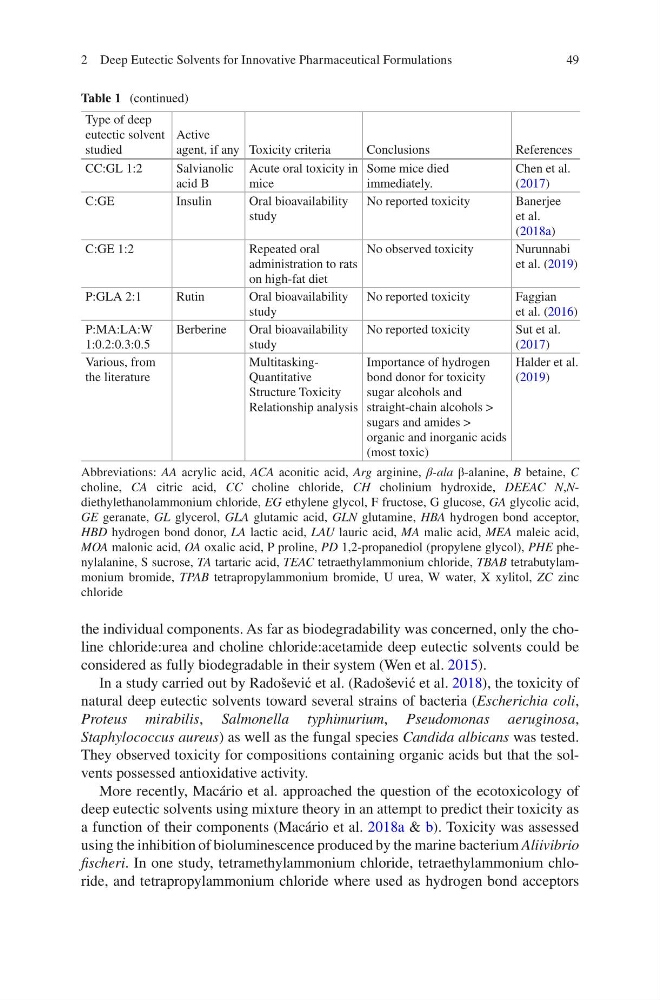
Table 1 (continued)
Type of deep
eutectic solvent
studied
Active
agent, if any Toxicity criteria
Conclusions
References
CC:GL 1:2
Salvianolic
acid B
Acute oral toxicity in
mice
Some mice died
immediately.
Chen et al.
(2017)
C:GE
Insulin
Oral bioavailability
study
No reported toxicity
Banerjee
et al.
(2018a)
C:GE 1:2
Repeated oral
administration to rats
on high-fat diet
No observed toxicity
Nurunnabi
et al. (2019)
P:GLA 2:1
Rutin
Oral bioavailability
study
No reported toxicity
Faggian
et al. (2016)
P:MA:LA:W
1:0.2:0.3:0.5
Berberine
Oral bioavailability
study
No reported toxicity
Sut et al.
(2017)
Various, from
the literature
MultitaskingQuantitative
Structure Toxicity
Relationship analysis
Importance of hydrogen
bond donor for toxicity
sugar alcohols and
straight-chain alcohols >
sugars and amides >
organic and inorganic acids
(most toxic)
Halder et al.
(2019)
Abbreviations: AA acrylic acid, ACA aconitic acid, Arg arginine, β-ala β-alanine, B betaine, C
choline, CA citric acid, CC choline chloride, CH cholinium hydroxide, DEEAC N,Ndiethylethanolammonium chloride, EG ethylene glycol, F fructose, G glucose, GA glycolic acid,
GE geranate, GL glycerol, GLA glutamic acid, GLN glutamine, HBA hydrogen bond acceptor,
HBD hydrogen bond donor, LA lactic acid, LAU lauric acid, MA malic acid, MEA maleic acid,
MOA malonic acid, OA oxalic acid, P proline, PD 1,2-propanediol (propylene glycol), PHE phenylalanine, S sucrose, TA tartaric acid, TEAC tetraethylammonium chloride, TBAB tetrabutylammonium bromide, TPAB tetrapropylammonium bromide, U urea, W water, X xylitol, ZC zinc
chloride
2 Deep Eutectic Solvents for Innovative Pharmaceutical Formulations
the individual components. As far as biodegradability was concerned, only the choline chloride:urea and choline chloride:acetamide deep eutectic solvents could be
considered as fully biodegradable in their system (Wen et al. 2015).
In a study carried out by Radošević et al. (Radošević et al. 2018), the toxicity of
natural deep eutectic solvents toward several strains of bacteria (Escherichia coli,
Proteus mirabilis, Salmonella typhimurium, Pseudomonas aeruginosa,
Staphylococcus aureus) as well as the fungal species Candida albicans was tested.
They observed toxicity for compositions containing organic acids but that the solvents possessed antioxidative activity.
More recently, Macário et al. approached the question of the ecotoxicology of
deep eutectic solvents using mixture theory in an attempt to predict their toxicity as
a function of their components (Macário et al. 2018a & b). Toxicity was assessed
using the inhibition of bioluminescence produced by the marine bacterium Aliivibrio
fischeri. In one study, tetramethylammonium chloride, tetraethylammonium chloride, and tetrapropylammonium chloride where used as hydrogen bond acceptors
Table 1 (continued)
Type of deep
eutectic solvent
studied
Active
agent, if any Toxicity criteria
Conclusions
References
CC:GL 1:2
Salvianolic
acid B
Acute oral toxicity in
mice
Some mice died
immediately.
Chen et al.
(2017)
C:GE
Insulin
Oral bioavailability
study
No reported toxicity
Banerjee
et al.
(2018a)
C:GE 1:2
Repeated oral
administration to rats
on high-fat diet
No observed toxicity
Nurunnabi
et al. (2019)
P:GLA 2:1
Rutin
Oral bioavailability
study
No reported toxicity
Faggian
et al. (2016)
P:MA:LA:W
1:0.2:0.3:0.5
Berberine
Oral bioavailability
study
No reported toxicity
Sut et al.
(2017)
Various, from
the literature
MultitaskingQuantitative
Structure Toxicity
Relationship analysis
Importance of hydrogen
bond donor for toxicity
sugar alcohols and
straight-chain alcohols >
sugars and amides >
organic and inorganic acids
(most toxic)
Halder et al.
(2019)
Abbreviations: AA acrylic acid, ACA aconitic acid, Arg arginine, β-ala β-alanine, B betaine, C
choline, CA citric acid, CC choline chloride, CH cholinium hydroxide, DEEAC N,Ndiethylethanolammonium chloride, EG ethylene glycol, F fructose, G glucose, GA glycolic acid,
GE geranate, GL glycerol, GLA glutamic acid, GLN glutamine, HBA hydrogen bond acceptor,
HBD hydrogen bond donor, LA lactic acid, LAU lauric acid, MA malic acid, MEA maleic acid,
MOA malonic acid, OA oxalic acid, P proline, PD 1,2-propanediol (propylene glycol), PHE phenylalanine, S sucrose, TA tartaric acid, TEAC tetraethylammonium chloride, TBAB tetrabutylammonium bromide, TPAB tetrapropylammonium bromide, U urea, W water, X xylitol, ZC zinc
chloride
2 Deep Eutectic Solvents for Innovative Pharmaceutical Formulations