

47
Table 1 (continued)
Type of deep
eutectic solvent
studied
Active
agent, if any Toxicity criteria
Conclusions
References
Various
ammoniumbased
Human cell
lines – mitochondrial
activity, microscopic
examination,
apoptosis, lactate
dehydrogenase
release, reactive
oxygen species
production, and
radical scavenging.
Acute toxicity in
mice
CC:U 1:3 lethal to mice
Hayyan
et al. (2015)
CC with G, F,
S, GL, MOA,
and W
Human cell
lines – mitochondrial
activity, modelling of
interactions with
phospholipids
Organic acids main source
of toxicity
Hayyan
et al. (2016)
Various
ammoniumbased
Human cell
lines – mitochondrial
activity, membrane
permeability,
reactive oxygen
species production,
and radical
scavenging. Acute
toxicity in mice
CC-based less toxic than
DEEAC-based
Mbous et al.
(2017)
CC with G, F,
X, GL, and MA
Grape skin
extract
Human cell lines –
mitochondrial
activity
Radošević
et al. (2016)
CC with G, GL,
and OA
Fish (CCO) and
human (MCF-7) cell
lines – mitochondrial
activity and wheat
seed germination
Toxicity of OA-containing
deep eutectic solvent
Radošević
et al. (2015)
Deep eutectic
solvents
containing
organic acids
Human cells lines
(HeLa, MCF-7 and
HEK293T) –
mitochondrial
activity
Deep eutectic solvents are
safe and show
antioxidative activity.
Mitar et al.
(2019)
CA with
L-arginine or
ethambutol
Therapeutic
deep
eutectic
solvents
Toxicity to human
intestinal Caco2
cells – mitochondrial
activity
Deep eutectic solvent
toxicity intermediate
between components – CA
is toxic due to pH
lowering.
Santos et al.
(2019)
(continued)
2 Deep Eutectic Solvents for Innovative Pharmaceutical Formulations
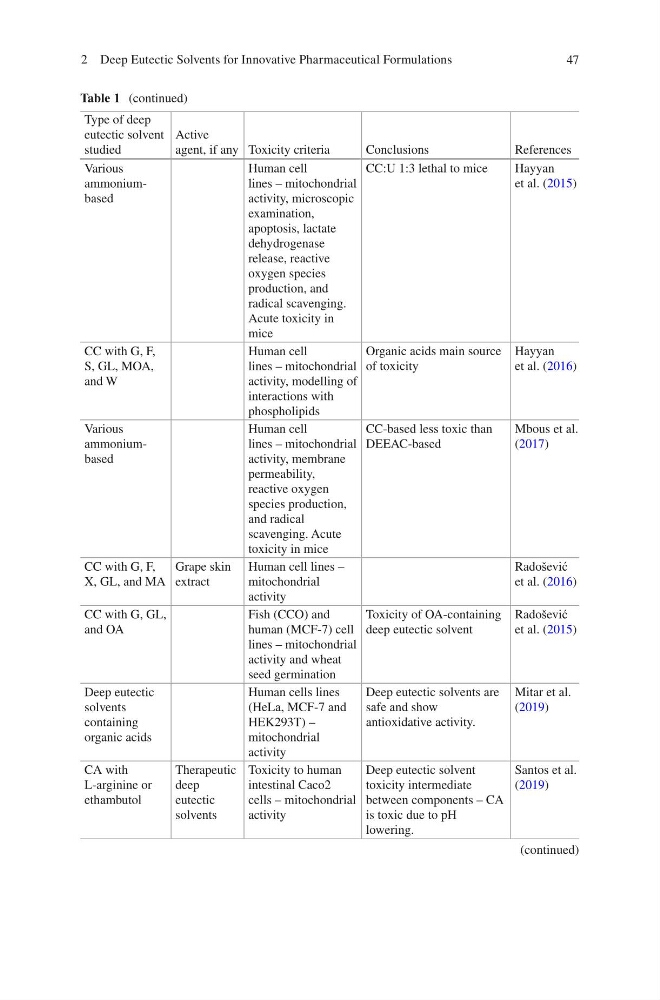
Table 1 (continued)
Type of deep
eutectic solvent
studied
Active
agent, if any Toxicity criteria
Conclusions
References
Various
ammoniumbased
Human cell
lines – mitochondrial
activity, microscopic
examination,
apoptosis, lactate
dehydrogenase
release, reactive
oxygen species
production, and
radical scavenging.
Acute toxicity in
mice
CC:U 1:3 lethal to mice
Hayyan
et al. (2015)
CC with G, F,
S, GL, MOA,
and W
Human cell
lines – mitochondrial
activity, modelling of
interactions with
phospholipids
Organic acids main source
of toxicity
Hayyan
et al. (2016)
Various
ammoniumbased
Human cell
lines – mitochondrial
activity, membrane
permeability,
reactive oxygen
species production,
and radical
scavenging. Acute
toxicity in mice
CC-based less toxic than
DEEAC-based
Mbous et al.
(2017)
CC with G, F,
X, GL, and MA
Grape skin
extract
Human cell lines –
mitochondrial
activity
Radošević
et al. (2016)
CC with G, GL,
and OA
Fish (CCO) and
human (MCF-7) cell
lines – mitochondrial
activity and wheat
seed germination
Toxicity of OA-containing
deep eutectic solvent
Radošević
et al. (2015)
Deep eutectic
solvents
containing
organic acids
Human cells lines
(HeLa, MCF-7 and
HEK293T) –
mitochondrial
activity
Deep eutectic solvents are
safe and show
antioxidative activity.
Mitar et al.
(2019)
CA with
L-arginine or
ethambutol
Therapeutic
deep
eutectic
solvents
Toxicity to human
intestinal Caco2
cells – mitochondrial
activity
Deep eutectic solvent
toxicity intermediate
between components – CA
is toxic due to pH
lowering.
Santos et al.
(2019)
(continued)
2 Deep Eutectic Solvents for Innovative Pharmaceutical Formulations