

46
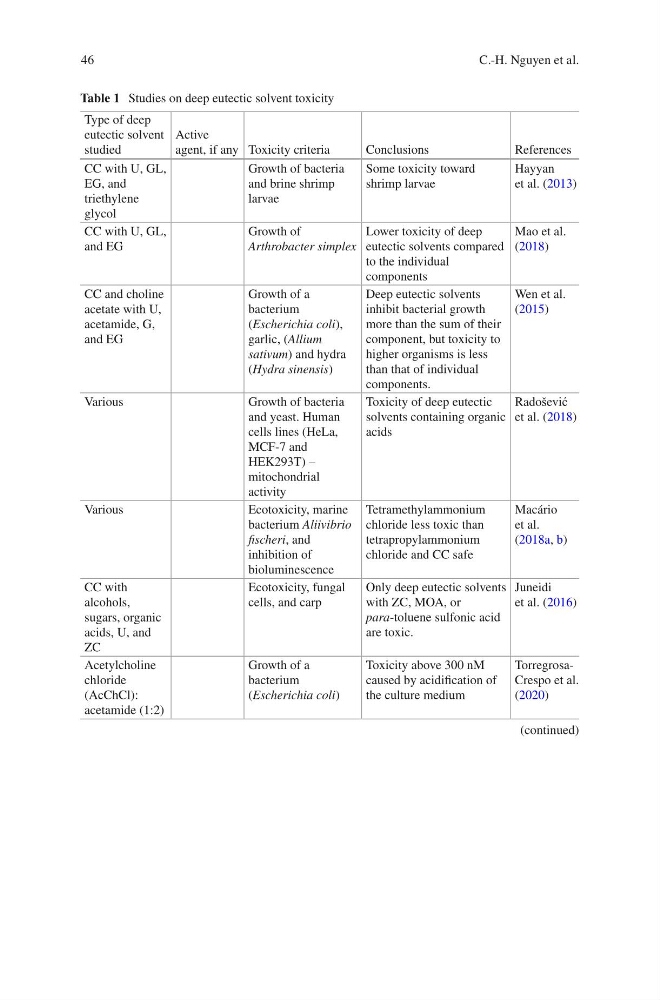
Table 1 Studies on deep eutectic solvent toxicity
Type of deep
eutectic solvent
studied
Active
agent, if any Toxicity criteria
Conclusions
References
CC with U, GL,
EG, and
triethylene
glycol
Growth of bacteria
and brine shrimp
larvae
Some toxicity toward
shrimp larvae
Hayyan
et al. (2013)
CC with U, GL,
and EG
Growth of
Arthrobacter simplex
Lower toxicity of deep
eutectic solvents compared
to the individual
components
Mao et al.
(2018)
CC and choline
acetate with U,
acetamide, G,
and EG
Growth of a
bacterium
(Escherichia coli),
garlic, (Allium
sativum) and hydra
(Hydra sinensis)
Deep eutectic solvents
inhibit bacterial growth
more than the sum of their
component, but toxicity to
higher organisms is less
than that of individual
components.
Wen et al.
(2015)
Various
Growth of bacteria
and yeast. Human
cells lines (HeLa,
MCF-7 and
HEK293T) –
mitochondrial
activity
Toxicity of deep eutectic
solvents containing organic
acids
Radošević
et al. (2018)
Various
Ecotoxicity, marine
bacterium Aliivibrio
fischeri, and
inhibition of
bioluminescence
Tetramethylammonium
chloride less toxic than
tetrapropylammonium
chloride and CC safe
Macário
et al.
(2018a, b)
CC with
alcohols,
sugars, organic
acids, U, and
ZC
Ecotoxicity, fungal
cells, and carp
Only deep eutectic solvents
with ZC, MOA, or
para-toluene sulfonic acid
are toxic.
Juneidi
et al. (2016)
Acetylcholine
chloride
(AcChCl):
acetamide (1:2)
Growth of a
bacterium
(Escherichia coli)
Toxicity above 300 nM
caused by acidification of
the culture medium
TorregrosaCrespo et al.
(2020)
(continued)
C.-H. Nguyen et al.
Table 1 Studies on deep eutectic solvent toxicity
Type of deep
eutectic solvent
studied
Active
agent, if any Toxicity criteria
Conclusions
References
CC with U, GL,
EG, and
triethylene
glycol
Growth of bacteria
and brine shrimp
larvae
Some toxicity toward
shrimp larvae
Hayyan
et al. (2013)
CC with U, GL,
and EG
Growth of
Arthrobacter simplex
Lower toxicity of deep
eutectic solvents compared
to the individual
components
Mao et al.
(2018)
CC and choline
acetate with U,
acetamide, G,
and EG
Growth of a
bacterium
(Escherichia coli),
garlic, (Allium
sativum) and hydra
(Hydra sinensis)
Deep eutectic solvents
inhibit bacterial growth
more than the sum of their
component, but toxicity to
higher organisms is less
than that of individual
components.
Wen et al.
(2015)
Various
Growth of bacteria
and yeast. Human
cells lines (HeLa,
MCF-7 and
HEK293T) –
mitochondrial
activity
Toxicity of deep eutectic
solvents containing organic
acids
Radošević
et al. (2018)
Various
Ecotoxicity, marine
bacterium Aliivibrio
fischeri, and
inhibition of
bioluminescence
Tetramethylammonium
chloride less toxic than
tetrapropylammonium
chloride and CC safe
Macário
et al.
(2018a, b)
CC with
alcohols,
sugars, organic
acids, U, and
ZC
Ecotoxicity, fungal
cells, and carp
Only deep eutectic solvents
with ZC, MOA, or
para-toluene sulfonic acid
are toxic.
Juneidi
et al. (2016)
Acetylcholine
chloride
(AcChCl):
acetamide (1:2)
Growth of a
bacterium
(Escherichia coli)
Toxicity above 300 nM
caused by acidification of
the culture medium
TorregrosaCrespo et al.
(2020)
(continued)
C.-H. Nguyen et al.