

29
Studied system(s)
Water content
Technique(s)
Comments
References
ChCl:malic acid 1:1
4–60 wt%
Brillouin and NMR
spectroscopies
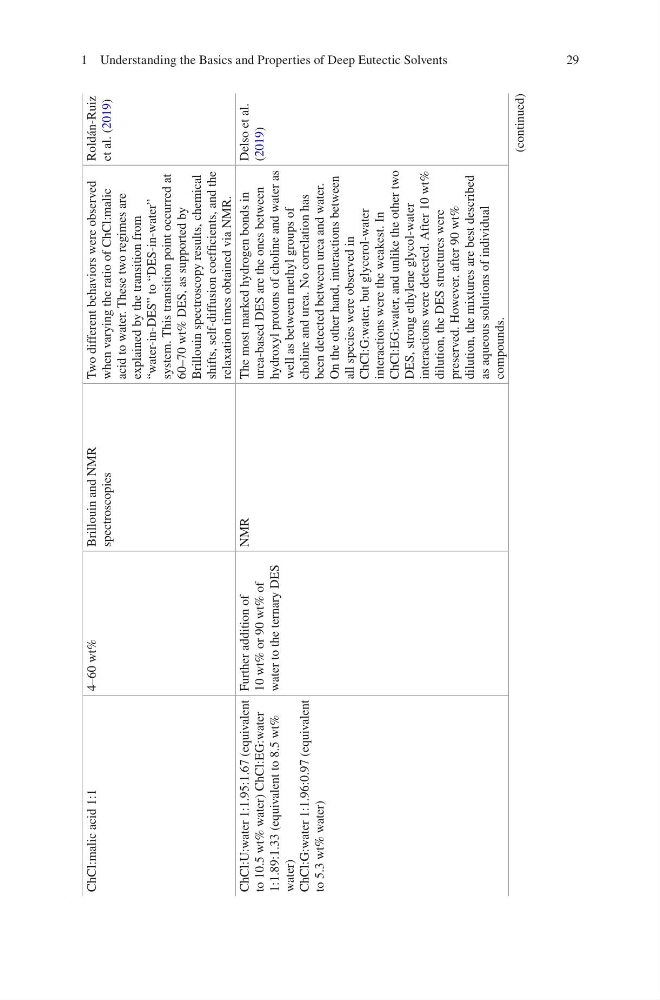
Two different behaviors were observed
when varying the ratio of ChCl:malic
acid to water. These two regimes are
explained by the transition from
“water-in-DES” to “DES-in-water”
system. This transition point occurred at
60–70 wt% DES, as supported by
Brillouin spectroscopy results, chemical
shifts, self-diffusion coefficients, and the
relaxation times obtained via NMR.
Roldán-Ruiz
et al. (2019)
ChCl:U:water 1:1.95:1.67 (equivalent
to 10.5 wt% water) ChCl:EG:water
1:1.89:1.33 (equivalent to 8.5 wt%
water)
ChCl:G:water 1:1.96:0.97 (equivalent
to 5.3 wt% water)
Further addition of
10 wt% or 90 wt% of
water to the ternary DES
NMR
The most marked hydrogen bonds in
urea-based DES are the ones between
hydroxyl protons of choline and water as
well as between methyl groups of
choline and urea. No correlation has
been detected between urea and water.
On the other hand, interactions between
all species were observed in
ChCl:G:water, but glycerol-water
interactions were the weakest. In
ChCl:EG:water, and unlike the other two
DES, strong ethylene glycol-water
interactions were detected. After 10 wt%
dilution, the DES structures were
preserved. However, after 90 wt%
dilution, the mixtures are best described
as aqueous solutions of individual
compounds.
Delso et al.
(2019)
(continued)
1 Understanding the Basics and Properties of Deep Eutectic Solvents
Studied system(s)
Water content
Technique(s)
Comments
References
ChCl:malic acid 1:1
4–60 wt%
Brillouin and NMR
spectroscopies
Two different behaviors were observed
when varying the ratio of ChCl:malic
acid to water. These two regimes are
explained by the transition from
“water-in-DES” to “DES-in-water”
system. This transition point occurred at
60–70 wt% DES, as supported by
Brillouin spectroscopy results, chemical
shifts, self-diffusion coefficients, and the
relaxation times obtained via NMR.
Roldán-Ruiz
et al. (2019)
ChCl:U:water 1:1.95:1.67 (equivalent
to 10.5 wt% water) ChCl:EG:water
1:1.89:1.33 (equivalent to 8.5 wt%
water)
ChCl:G:water 1:1.96:0.97 (equivalent
to 5.3 wt% water)
Further addition of
10 wt% or 90 wt% of
water to the ternary DES
NMR
The most marked hydrogen bonds in
urea-based DES are the ones between
hydroxyl protons of choline and water as
well as between methyl groups of
choline and urea. No correlation has
been detected between urea and water.
On the other hand, interactions between
all species were observed in
ChCl:G:water, but glycerol-water
interactions were the weakest. In
ChCl:EG:water, and unlike the other two
DES, strong ethylene glycol-water
interactions were detected. After 10 wt%
dilution, the DES structures were
preserved. However, after 90 wt%
dilution, the mixtures are best described
as aqueous solutions of individual
compounds.
Delso et al.
(2019)
(continued)
1 Understanding the Basics and Properties of Deep Eutectic Solvents