

28
Table 1.2 (continued)
Studied system(s)
Water content
Technique(s)
Comments
References
ChCl:U ChCl:methylurea ChCl:EG
ChCl:G 1:2 ChCl:glucose
ChCl:xylitol 2:1 ChCl:oxalic acid
ChCl:glutaric acid 1:1
Measured water
absorption from air as a
function of time (up to
4–8 h) at a temperature of
22 ± 2 °C and a humidity
of 32%
Attenuated total reflectance
infrared spectroscopy
(ATR-IR) and perturbationcorrelation moving-window
two-dimensional correlation
IR spectra techniques
(PCMW2D-COS)
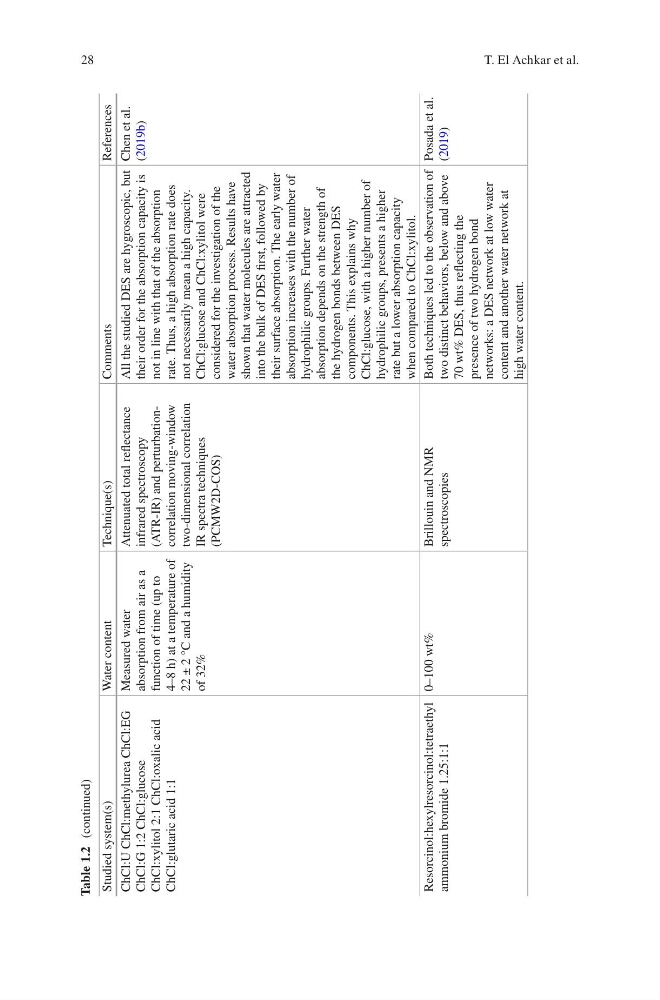
All the studied DES are hygroscopic, but
their order for the absorption capacity is
not in line with that of the absorption
rate. Thus, a high absorption rate does
not necessarily mean a high capacity.
ChCl:glucose and ChCl:xylitol were
considered for the investigation of the
water absorption process. Results have
shown that water molecules are attracted
into the bulk of DES first, followed by
their surface absorption. The early water
absorption increases with the number of
hydrophilic groups. Further water
absorption depends on the strength of
the hydrogen bonds between DES
components. This explains why
ChCl:glucose, with a higher number of
hydrophilic groups, presents a higher
rate but a lower absorption capacity
when compared to ChCl:xylitol.
Chen et al.
(2019b)
Resorcinol:hexylresorcinol:tetraethyl
ammonium bromide 1.25:1:1
0–100 wt%
Brillouin and NMR
spectroscopies
Both techniques led to the observation of
two distinct behaviors, below and above
70 wt% DES, thus reflecting the
presence of two hydrogen bond
networks: a DES network at low water
content and another water network at
high water content.
Posada et al.
(2019)
T. El Achkar et al.
Table 1.2 (continued)
Studied system(s)
Water content
Technique(s)
Comments
References
ChCl:U ChCl:methylurea ChCl:EG
ChCl:G 1:2 ChCl:glucose
ChCl:xylitol 2:1 ChCl:oxalic acid
ChCl:glutaric acid 1:1
Measured water
absorption from air as a
function of time (up to
4–8 h) at a temperature of
22 ± 2 °C and a humidity
of 32%
Attenuated total reflectance
infrared spectroscopy
(ATR-IR) and perturbationcorrelation moving-window
two-dimensional correlation
IR spectra techniques
(PCMW2D-COS)
All the studied DES are hygroscopic, but
their order for the absorption capacity is
not in line with that of the absorption
rate. Thus, a high absorption rate does
not necessarily mean a high capacity.
ChCl:glucose and ChCl:xylitol were
considered for the investigation of the
water absorption process. Results have
shown that water molecules are attracted
into the bulk of DES first, followed by
their surface absorption. The early water
absorption increases with the number of
hydrophilic groups. Further water
absorption depends on the strength of
the hydrogen bonds between DES
components. This explains why
ChCl:glucose, with a higher number of
hydrophilic groups, presents a higher
rate but a lower absorption capacity
when compared to ChCl:xylitol.
Chen et al.
(2019b)
Resorcinol:hexylresorcinol:tetraethyl
ammonium bromide 1.25:1:1
0–100 wt%
Brillouin and NMR
spectroscopies
Both techniques led to the observation of
two distinct behaviors, below and above
70 wt% DES, thus reflecting the
presence of two hydrogen bond
networks: a DES network at low water
content and another water network at
high water content.
Posada et al.
(2019)
T. El Achkar et al.