

30
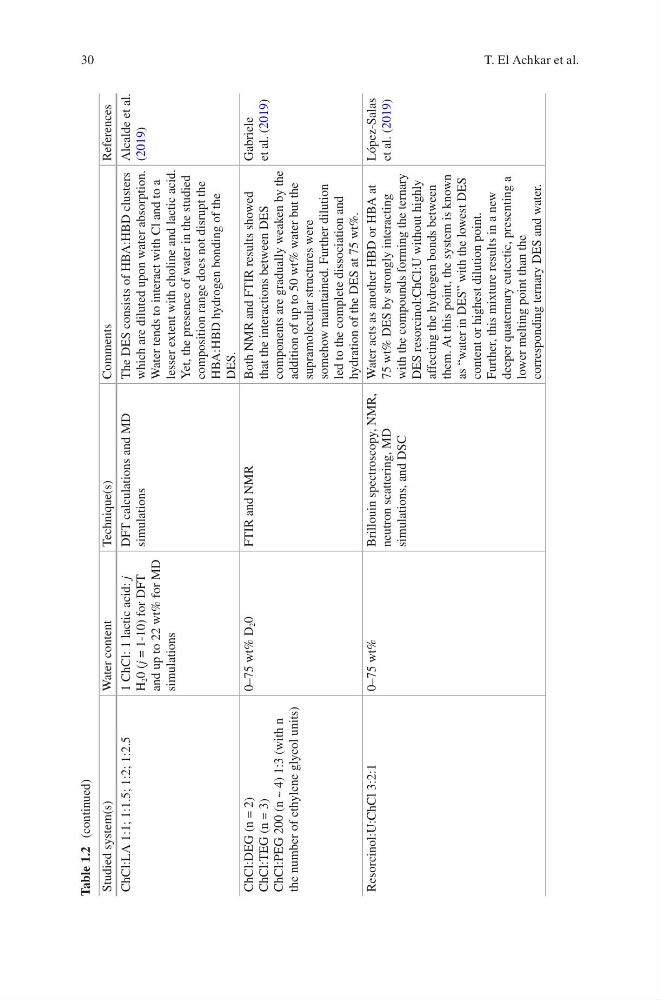
Table 1.2 (continued)
Studied system(s)
Water content
Technique(s)
Comments
References
ChCl:LA 1:1; 1:1.5; 1:2; 1:2.5
1 ChCl: 1 lactic acid: j
H
2 0 (j = 1-10) for DFT
and up to 22 wt% for MD
simulations
DFT calculations and MD
simulations
The DES consists of HBA:HBD clusters
which are diluted upon water absorption.
Water tends to interact with Cl and to a
lesser extent with choline and lactic acid.
Yet, the presence of water in the studied
composition range does not disrupt the
HBA:HBD hydrogen bonding of the
DES.
Alcalde et al.
(2019)
ChCl:DEG (n = 2)
ChCl:TEG (n = 3)
ChCl:PEG 200 (n ~ 4) 1:3 (with n
the number of ethylene glycol units)
0–75 wt% D
2 0
FTIR and NMR
Both NMR and FTIR results showed
that the interactions between DES
components are gradually weaken by the
addition of up to 50 wt% water but the
supramolecular structures were
somehow maintained. Further dilution
led to the complete dissociation and
hydration of the DES at 75 wt%.
Gabriele
et al. (2019)
Resorcinol:U:ChCl 3:2:1
0–75 wt%
Brillouin spectroscopy, NMR,
neutron scattering, MD
simulations, and DSC
Water acts as another HBD or HBA at
75 wt% DES by strongly interacting
with the compounds forming the ternary
DES resorcinol:ChCl:U without highly
affecting the hydrogen bonds between
them. At this point, the system is known
as “water in DES” with the lowest DES
content or highest dilution point.
Further, this mixture results in a new
deeper quaternary eutectic, presenting a
lower melting point than the
corresponding ternary DES and water.
López-Salas
et al. (2019)
T. El Achkar et al.
Table 1.2 (continued)
Studied system(s)
Water content
Technique(s)
Comments
References
ChCl:LA 1:1; 1:1.5; 1:2; 1:2.5
1 ChCl: 1 lactic acid: j
H
2 0 (j = 1-10) for DFT
and up to 22 wt% for MD
simulations
DFT calculations and MD
simulations
The DES consists of HBA:HBD clusters
which are diluted upon water absorption.
Water tends to interact with Cl and to a
lesser extent with choline and lactic acid.
Yet, the presence of water in the studied
composition range does not disrupt the
HBA:HBD hydrogen bonding of the
DES.
Alcalde et al.
(2019)
ChCl:DEG (n = 2)
ChCl:TEG (n = 3)
ChCl:PEG 200 (n ~ 4) 1:3 (with n
the number of ethylene glycol units)
0–75 wt% D
2 0
FTIR and NMR
Both NMR and FTIR results showed
that the interactions between DES
components are gradually weaken by the
addition of up to 50 wt% water but the
supramolecular structures were
somehow maintained. Further dilution
led to the complete dissociation and
hydration of the DES at 75 wt%.
Gabriele
et al. (2019)
Resorcinol:U:ChCl 3:2:1
0–75 wt%
Brillouin spectroscopy, NMR,
neutron scattering, MD
simulations, and DSC
Water acts as another HBD or HBA at
75 wt% DES by strongly interacting
with the compounds forming the ternary
DES resorcinol:ChCl:U without highly
affecting the hydrogen bonds between
them. At this point, the system is known
as “water in DES” with the lowest DES
content or highest dilution point.
Further, this mixture results in a new
deeper quaternary eutectic, presenting a
lower melting point than the
corresponding ternary DES and water.
López-Salas
et al. (2019)
T. El Achkar et al.