

23
Studied system(s)
Water content
Technique(s)
Comments
References
ChCl:U 1:2
0.25 wt% (initial water
content)
Measurement of water
absorption as a function of the
exposure time to the open air
by Karl Fischer titration
method at a temperature of
298 ± 2 K and a humidity of
60%
The water uptake by the DES is very
high during the first hours with a rate of
around 6.8 wt% per day. The rate
decreased to 3.4 wt% after 10 hours and
then was zeroed after 65 days’ exposure
to air with 40 wt% water content. On the
other hand, water content can be easily
tailored through heating. It went down
from 40 wt% to 1.5 wt% after heating
for 6 to 18 h.
Du et al.
(2016)
ChCl:U ChCl:EG ChCl:G 1:2
0–1 mole fraction
MD simulations
Water molecules are integrated within
the DES network below 30% mole
fraction of water while retaining the
intermolecular interactions occurring in
the three DES. However, important
changes were observed in fluidity of the
different species and the number of
hydrogen bonds above 50% mole
fraction.
Zhekenov
et al. (2017)
ChCl:U 1:2
0–100 wt%
Brillouin and NMR
spectroscopies
Both techniques perfectly agreed on the
dilution range at which structural
rearrangements occur in DES-water
mixtures. Two distinct regions
intersecting at 85 wt% DES were
observed for sound propagation via
Brillouin spectroscopy, while hydroxyl
protons of choline were completely
exchanged with water at the same
hydration level, as proved by NMR.
Posada et al.
(2017)
(continued)
1 Understanding the Basics and Properties of Deep Eutectic Solvents
Studied system(s)
Water content
Technique(s)
Comments
References
ChCl:U 1:2
0.25 wt% (initial water
content)
Measurement of water
absorption as a function of the
exposure time to the open air
by Karl Fischer titration
method at a temperature of
298 ± 2 K and a humidity of
60%
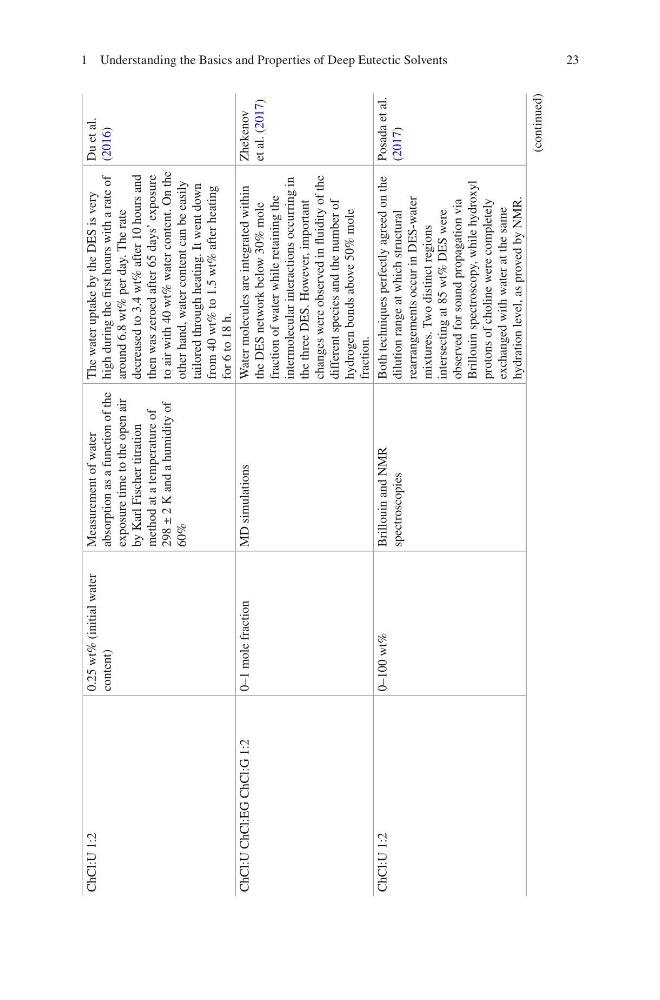
The water uptake by the DES is very
high during the first hours with a rate of
around 6.8 wt% per day. The rate
decreased to 3.4 wt% after 10 hours and
then was zeroed after 65 days’ exposure
to air with 40 wt% water content. On the
other hand, water content can be easily
tailored through heating. It went down
from 40 wt% to 1.5 wt% after heating
for 6 to 18 h.
Du et al.
(2016)
ChCl:U ChCl:EG ChCl:G 1:2
0–1 mole fraction
MD simulations
Water molecules are integrated within
the DES network below 30% mole
fraction of water while retaining the
intermolecular interactions occurring in
the three DES. However, important
changes were observed in fluidity of the
different species and the number of
hydrogen bonds above 50% mole
fraction.
Zhekenov
et al. (2017)
ChCl:U 1:2
0–100 wt%
Brillouin and NMR
spectroscopies
Both techniques perfectly agreed on the
dilution range at which structural
rearrangements occur in DES-water
mixtures. Two distinct regions
intersecting at 85 wt% DES were
observed for sound propagation via
Brillouin spectroscopy, while hydroxyl
protons of choline were completely
exchanged with water at the same
hydration level, as proved by NMR.
Posada et al.
(2017)
(continued)
1 Understanding the Basics and Properties of Deep Eutectic Solvents